
By The Pulseline News Desk
A high-level delegation of European Union (EU) ambassadors is scheduled to visit the Chemmani mass grave in Jaffna next week, underscoring growing international attention on one of Sri Lanka’s most significant ongoing forensic investigations into alleged wartime disappearances.
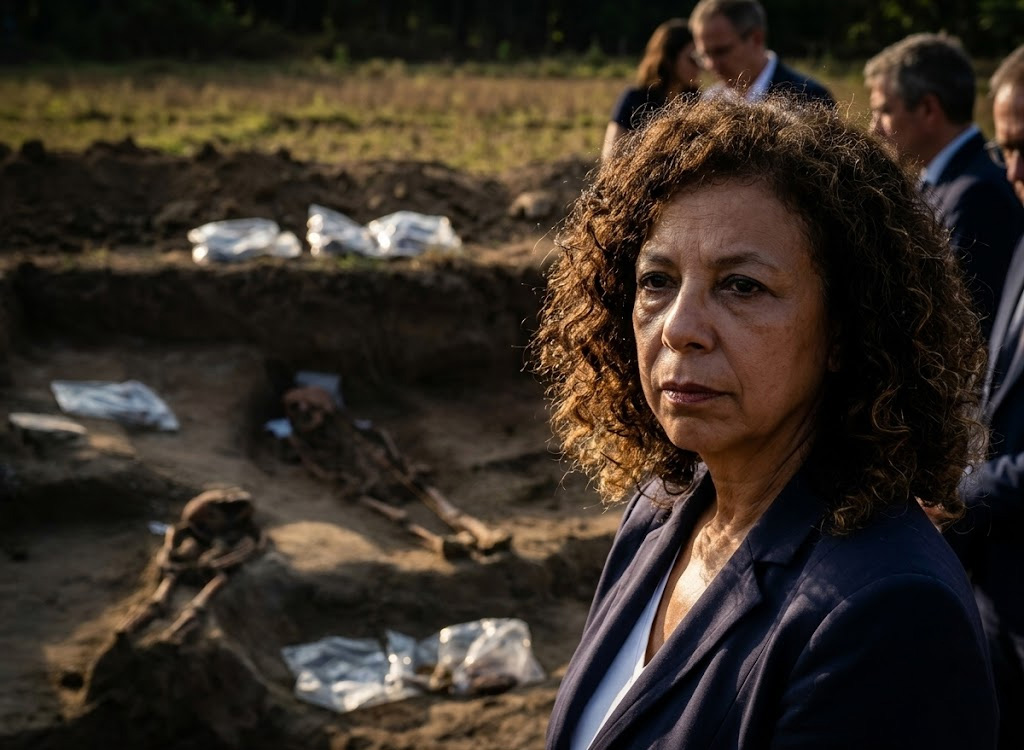
The visit comes as court-supervised excavations at the site have uncovered 423 human skeletons, making Chemmani one of the country’s largest known mass grave investigations.
The delegation, led by EU Ambassador Carmen Moreno, will include the ambassadors of Italy, Germany, France and the Netherlands. According to proceedings before the Jaffna Magistrate’s Court last week, permission was sought for the diplomatic delegation to visit the excavation site during its visit to the Northern Province this coming week.
Their visit comes amid renewed scrutiny of Sri Lanka’s efforts to investigate enforced disappearances and account for thousands of people who went missing during the country’s decades-long conflict.
Excavations continue under court supervision
The latest phase of excavations began in February after workers digging a foundation for a fence near a cemetery in Chemmani unearthed human remains.
Since then, forensic investigations have continued in stages under the supervision of the Jaffna Magistrate’s Court, involving archaeologists, Judicial Medical Officers, officials and members of the Jaffna Bar.
By July 17, investigators had recovered 423 human skeletons, including 11 additional sets of human remains identified during the latest round of excavations.
Investigators have also recovered numerous personal belongings from the burial site, including jewellery and other ornaments, all of which have been placed under judicial custody as potential evidence.
The painstaking excavation process is expected to continue as experts document, preserve and analyse the remains in accordance with forensic standards.
A site with painful history
Chemmani occupies a unique place in Sri Lanka’s post-war history.
The area first drew national and international attention in 1998 following the abduction, rape and murder of 18-year-old schoolgirl Krishanthi Kumaraswamy, her mother, brother and a neighbour at an Army checkpoint in Kaithady, Jaffna.
During subsequent legal proceedings, one of the soldiers convicted in the case alleged that hundreds of civilians who had disappeared in the Jaffna peninsula had been buried in the Chemmani area.
Those allegations prompted excavations in the late 1990s, leading to the recovery of several human remains. However, many families of the disappeared and human rights organisations maintained that investigations were never pursued comprehensively.
More than two decades later, the latest discoveries have revived hopes that unanswered questions surrounding wartime disappearances may finally receive greater forensic and judicial attention.
Search for the missing
The Chemmani investigation carries significance far beyond Jaffna.
Sri Lanka has one of the world’s largest unresolved caseloads of enforced disappearances, spanning the southern insurrection of the late 1980s as well as the nearly three-decade civil conflict that ended in 2009.
According to the Office on Missing Persons (OMP), more than 22,000 complaints of missing persons have been formally received since the institution was established, with over 6,000 originating from the Northern and Eastern Provinces — the regions most affected by the armed conflict.
For many families, the recovery and identification of human remains represent not only an opportunity to establish the fate of missing relatives but also an essential step towards truth, accountability and closure after decades of uncertainty.
International interest
The planned visit by EU ambassadors reflects continuing international interest in Sri Lanka’s efforts to investigate alleged human rights violations and strengthen mechanisms for truth-seeking and accountability.
The EU has consistently emphasised the importance of credible investigations into enforced disappearances, effective functioning of transitional justice institutions and meaningful progress on reconciliation as part of its broader engagement with Sri Lanka.
While the ambassadors are expected to observe the ongoing excavation process, the visit is also likely to be viewed as a gesture of support for the judicially supervised forensic investigation and for efforts to establish the identities of those buried at the site.
Long road ahead
Although hundreds of skeletal remains have now been recovered, identifying the victims and determining the circumstances of their deaths is expected to be a lengthy and technically complex process involving forensic analysis, archaeological documentation and, where possible, DNA testing.
For the families of Sri Lanka’s disappeared, however, each discovery at Chemmani represents another step in a search that has continued for decades.
As excavations proceed under judicial supervision, the findings at Chemmani are expected to remain central to both domestic discussions on accountability and the international community’s assessment of Sri Lanka’s commitment to addressing one of the country’s most enduring human rights challenges.










Leave a comment