
By Madhusha Thavapalakumar
Sri Lanka’s ability to withstand the latest global oil shock may be stronger than before, but economists caution that the real test is how the pressure is transmitted through prices, incomes, and external flows in the coming months.
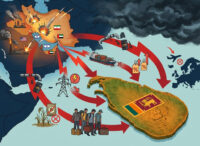
The escalation of the conflict in the Middle East since late February has already tightened global oil markets, with disruptions to shipping through the Strait of Hormuz cutting supply flows and pushing crude prices sharply higher. Brent crude has crossed the $ 100 mark, with volatility showing uncertainty over how long disruptions will persist and how widely they could spread across the region.
Being an import-dependent economy such as Sri Lanka, the implications are immediate, but the extent of the damage depends on both the duration of the shock and the underlying strength of the domestic economy.
The macroeconomic impact
Frontier Research Head of Macroeconomic Advisory Chayu Damsinghe, speaking to The Morning Money stated that the country is entering this episode from a fundamentally different macroeconomic position compared to past crises, which changes the way external shocks are absorbed.
“My top line message is that all of this context of where we’re dealing with the Middle Eastern crisis is in a very fundamentally different context than ever before,” he said, pointing to three consecutive years of twin surpluses.
Sri Lanka’s recent performance on both the fiscal and external fronts has reduced its reliance on external financing, allowing it to build buffers that were absent during earlier periods of volatility. This means that higher oil prices are less likely to trigger an immediate balance of payments crisis, although they still affect the pace of improvement.
“So, 70 years of twin deficits, and in the crisis at that point, it’d be in the context of us running deficit-sparing, but now, for the last three years in a row, we’ve not only been running twin surpluses, but we’ve been running expanding twin surpluses,” he said.
Even so, the strength at the macro level does not fully capture the condition of the domestic economy, where recovery has been slower and more uneven.
Verité Research Lead Economist Raj Prabu Rajakulendran, speaking to The Morning Money pointed out that headline indicators can obscure the underlying fragility in household incomes and living standards, which remain vulnerable to price shocks.
That distinction becomes important when global energy prices rise, because fuel costs feed directly into transport, electricity, and production expenses, with implications for inflation and cost of living.
“There’s usually a lag effect, so before we could see all of that recovery we had, my view is that it has full implications when the price of oil goes up,” Rajakulendran said, referring to the delayed but widespread impact of energy-driven inflation.
Sri Lanka entered the year with relatively subdued inflation, creating some space to absorb a temporary increase in prices without immediately destabilising the broader economy. However, that buffer depends heavily on how long the current disruption persists.
“The fact that inflation is underperforming, the inflation target of 5% probably means that even an increase in inflation from this point onwards only probably takes you around to the target, although that is clearly coming from a negative external shock,” Damsinghe said.
If oil prices stabilise within a short period, the inflationary impact may remain contained and time-bound. A prolonged disruption, particularly one that significantly reduces supply through the Gulf, would create a more persistent pressure on prices and external balances.
Tourism and remittances
Beyond inflation, the spillover effects are likely to be uneven across sectors, with tourism and remittances facing different forms of exposure. Tourism, while not directly dependent on the Middle East as a source market, relies heavily on the region for connectivity, with a significant share of travelers transiting through Gulf hubs.
“Almost 30% of our tourists use the Middle East, so there is a global disruption in tourism that can come through those channels,” Rajakulendran said.
Higher aviation fuel costs, potential flight disruptions, and changes in global travel patterns could weigh on arrivals, although the overall impact may be moderated by shifts in demand rather than outright cancellations.
“I think fundamentally our remittance mix has really changed compared to the past, where now less than 50% of our remittances are coming from the Middle East,” Damsinghe said, noting a gradual diversification in both sources and types of workers.
At the same time, recent trends have been strong, with remittances recording significant growth in the early months of the year, providing some cushion against potential disruptions.
“It is already growing, and as a result there is probably space to take a little bit of a shock even if it comes through, while still maintaining a relatively positive outcome,” he said.
Rajakulendran, however, stated that remittance behaviour during crises can be difficult to predict, as individual decisions vary depending on risk perceptions and economic conditions in host countries.
“Historically there is also the sentiment that when there is a crisis people are sometimes scared to keep money with them, so it can go both ways, which is why remittances are something we have to wait and see,” he said.
Adjustments to pricing, ensuring adequate supply, and maintaining stable expectations will be critical in preventing short-term disruptions from amplifying into economic instability.
“Being able to manage forward prices and the forward queues is probably the critical thing for the government at this point, because the impact will mainly come through those channels,” Rajakulendran said.
The outlook remains closely tied to the duration and intensity of the conflict, which continues to evolve with no clear resolution in sight. If disruptions ease within a relatively short period, Sri Lanka’s improved macroeconomic position may allow it to absorb the shock without significant long-term damage. If the conflict persists or escalates further, the cumulative impact on prices, external balances, and household incomes could place renewed strain on an already uneven recovery.
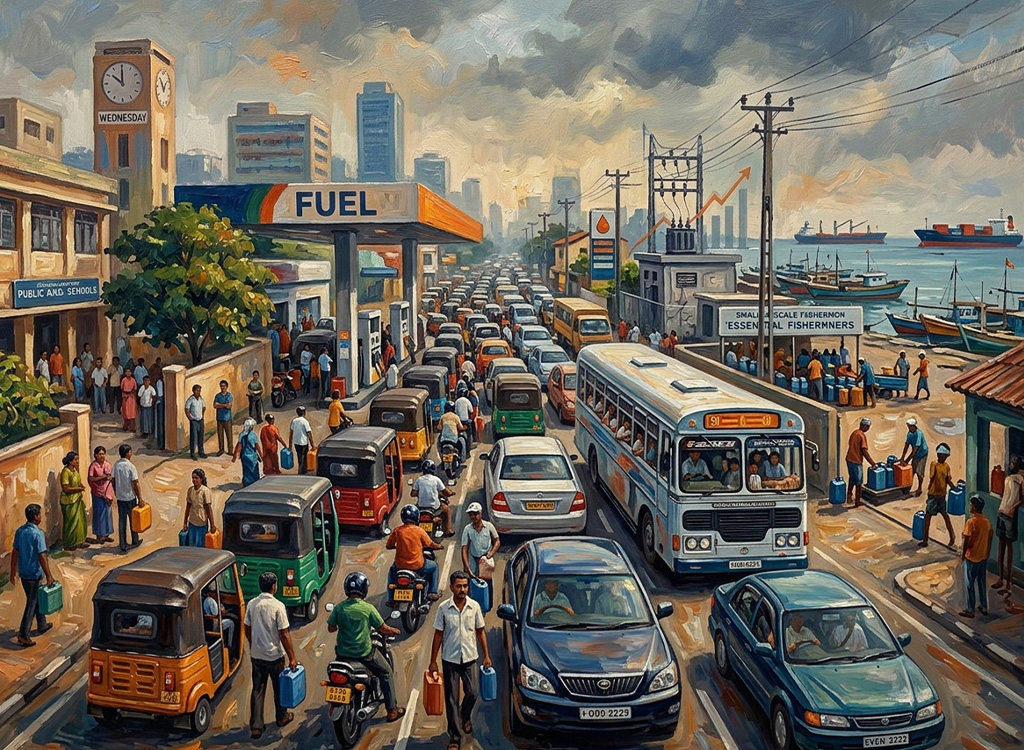
| Spillover effects as crisis response moves beyond fuel Fuel access gets tighter The government has moved from fuel rationing to tighter physical control over who can refuel and when. From 15 March, fuel sales are being restricted. Now there is a system under an odd-even number plate system, with vehicles ending in 0, 2, 4, 6, and 8 are allowed to purchase fuel on even-numbered dates, and those ending in 1, 3, 5, 7, and 9 on odd-numbered dates. The measure comes on top of the QR code system, which was reintroduced as supply routes remain under pressure due to the Middle East conflict and domestic demand rises abnormally. A shorter working week for the public sector The spillover is now visible in how the state itself is functioning. Wednesdays have been declared holidays for the public sector until further notice, with the government arguing that a midweek shutdown would reduce commuting demand without causing a full administrative breakdown. The option of a three-day weekend was considered and rejected on the basis that it would disrupt state operations more severely. The Wednesday closure now extends well beyond government offices. Schools, universities, government-approved private schools, and preschools have been asked to remain closed on those days. Tuition classes and lectures have also been halted on Wednesdays. Essential sectors are being ringfenced Even as the government cuts activity elsewhere, it is trying to shield sectors that cannot stop. Fisheries is one such sector. Multi-day fishing vessels will now receive fuel through designated harbours, with allocations verified through vessel movement data from the Vessel Monitoring System. One-day and small-scale vessels will continue to receive fuel through about 100 registered filling stations, based on recommendations from Fisheries Officers. The ministry says nearly 30,000 such vessels operate daily, with each vessel allocated 25 liters a day and distribution taking place once every five days. Remote fishing communities, including Delft Island and Baththalangunduwa, are to receive special support. Fuel for generators used in fish processing factories and aquaculture farms will also continue through existing arrangements with the CPC. Gas supply is under separate management Two liquefied petroleum gas carriers docked on 18 March, and unloading began at the Uswetakeiyawa terminal. A fuel tanker also arrived the same day. President Anura Kumara Dissanayake said Sri Lanka had already imported 38,000 MT of LP gas this month and that another 33,000 MT was expected within days. According to the President, the country’s original March requirement was 33,000 MT, but additional orders had to be placed after a private supplier reduced deliveries. Another shipment was due between 19-20 March, while the next scheduled supply is expected in late April. Electricity demand is the next concern Authorities are also watching the power system more closely. The President has said there is no immediate need for power cuts, but officials have stopped short of ruling them out if the conflict worsens. One emerging concern is evening electricity demand, especially between 6-10 p.m. According to the government, growing electric vehicle usage has added about 300 MW to peak demand compared with previous years, largely because many vehicle owners charge during those evening hours. EV owners have therefore been asked to shift charging to daytime, when excess electricity is available. The government is also planning to introduce smart meters and time-based pricing, allowing lower daytime rates and higher tariffs during peak hours. A crisis response is being formalised Cabinet has now approved four separate committees to manage the fallout: one on energy procurement, one on public service continuity, one on essential goods distribution, and one on welfare support for affected groups. |
Source: The Morning Money








Leave a comment