
By Rohan Samarajiva
Risk was always a fact of life. Modern society made us think risks had been eliminated. But risks have only changed form. We have to understand risks and mitigate them to the extent possible.
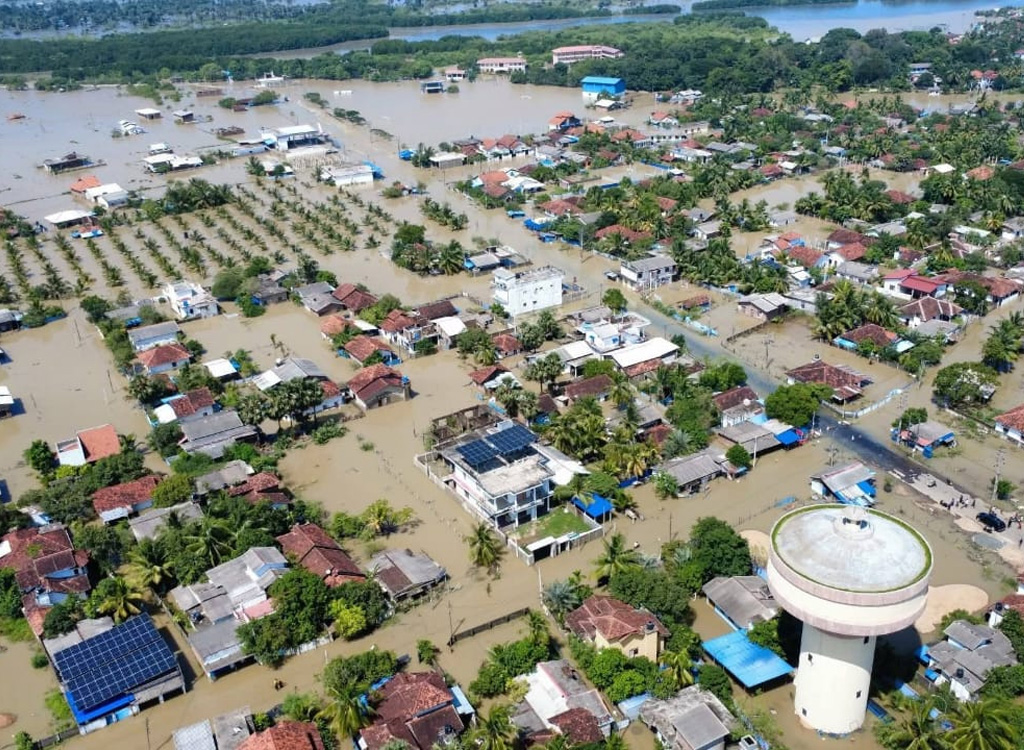
Ditwah was climate change. Predictions were that weather would get extreme: droughts would be longer and floods would be bigger. We had the drought in 2016-2017. Then Ditwah.
Its origin was the unusually warm ocean that caused the cyclone to take up a heavy amount of moisture. For reasons not fully understood, it was also a slow-moving storm. The result was abnormal rainfall of over 300 mm within 24 hours in most of the Central Province, where annual rainfall is around 5,000 mm. The highest recorded was 540.6 mm in Gammaduwa, Matale. One tenth of annual rainfall in a day simply cannot be absorbed. Flooding is inevitable. As are landslides. Much of the talk of deforestation and construction being the causes of landslides is misinformed. Some of the largest landslides started in hill slopes untouched by humans.
Climate change is increasing the frequency and scale of hazards such as rain dumping storms like Ditwah. There is little that can be done to reduce global warming at this time (not that we should not change behaviors that add to it). What we can do is climate adaptation, including reducing the risks of harm when the hazards become disasters.
Telecom
What happened to the telecom networks is educative. Compared to the 1990s when bombs and strikes were commonplace, the electricity supply appeared more reliable, at least until Ditwah hit. Back then the telcos invested in backup batteries and generators. After the war’s end, they gradually relaxed. But then came the floods and landslides. Different risks and bigger consequences. Now the networks are not just for talking. When they fail, even ATMs are affected. Credit cards and QR-based payments will not work. So, the risks are more, not less.
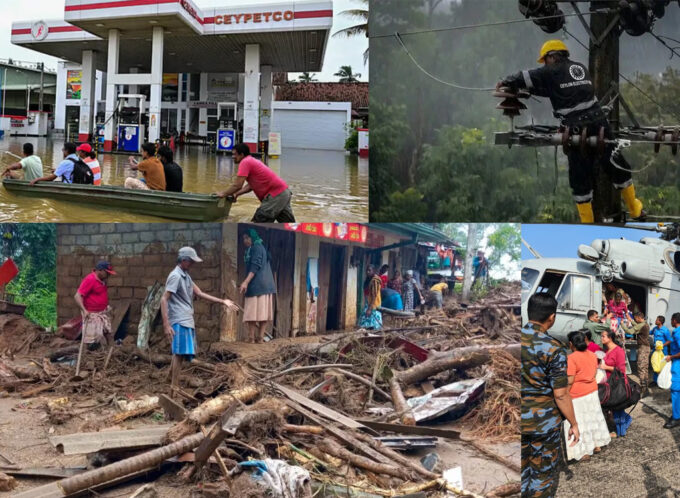
Too many people were unable to use telecom services during and after Ditwah. According to a recent news report, “at the peak of the crisis, more than 2,000 telecom sites were impacted, leaving several districts without mobile and data services for two to five days. Network outages were primarily caused by prolonged grid power failures, fibre cut due to floods and landslides, site flooding in low-lying areas, and restricted access that delayed restoration efforts.”
Machine learning can help provide accurate predictions of when water will rise to what levels in particular locations. Cell broadcasting can disseminate location-specific warnings effectively in multiple languages. Use of the Common Alerting Protocol (CAP) can reduce ambiguity in the messages and enable automatic translations. We at LIRNEasia had studied each of these elements and communicated them to the relevant decision makers. Sadly, they were not used. We also communicated how digital could help in the relief and recovery phases, with emphasis on the Sahana software suite, developed for disaster management by Sri Lankan volunteers after the tsunami.
Were there any flaws in our recommendations? The big one is the failure of the telecom networks described above. Location-specific early warnings may have been delivered before the floods arrived, but relief could not have been coordinated once the networks failed.
Resilience/building back better
Sri Lankans are said to be resilient. Resilience is getting back to where things were before the disaster. But then the same failures would recur with next disaster. Building back better remedies the causes of failure, reducing the likelihood of failure next time. Sri Lankans are not well known for building back better.
Network failures were caused by loss of power for the base transceiver stations (BTS) and fiber cuts. BTS are critical infrastructures. The telecom operators must assure adequate back up power in the event the electricity supply fails: x hours of battery backup; and in selected vulnerable sites, y hours of generator-based power. Or solar plus battery. As the major mobile operator will soon find out, networks that fail when most needed will cause customers to defect or at least get themselves backup connections. Providing adequate backup power makes good business sense, but the regulator can reinforce the requirement.
Building back better requires analysis of what went wrong in the Ditwah disaster and remedying those faults. Just getting back to where we were will mean digging more people out from the ground and donating cooked food and dry rations for the displaced, again and again. Unless we make our telecom infrastructure more robust, even those tasks will be difficult.
Electricity
The US Cybersecurity and Infrastructure Security Agency identified 18 critical infrastructures: Chemical, Commercial Facilities, Communications, Critical Manufacturing, Dams, Defense Industrial Base, Emergency Services, Energy, Financial Services, Food and Agriculture, Government Facilities, Healthcare and Public Health, Information Technology, Nuclear Reactors, Materials, and Waste, Transportation Systems, and Water and Wastewater Systems.
Many of these are not relevant in our vastly different conditions. But what I took from a related discussion is the statement that all seventeen critical infrastructures would fail, or be significantly affected, if the energy infrastructure were to fail.
Electricity failures during Ditwah directly contributed to telecom and banking failures. According to data compiled from public sources:
Around 4 million of the 7 million electricity customers were affected by Ditwah. 40 percent of CEB’s infrastructure was damaged.
As of December 5th, 85 percent of the affected consumers were reconnected.
The distribution network suffered the most damage with 17,143 transformers out of 39,537 becoming inactive.
The Rantambe-Mahiyangana transmission line suffered severe damage.
2,994 high voltage breakdowns and 32,341 low voltage breakdowns were reported.
It is not easy to make the electricity network reslient, especially from flood damage. Water and electricity do not mix.
Yet the CEB successor companies can surely do better than the CEB did in 2025. The first thing is an independent assessment of system performance that can identify what can be done to minimize the damage next time. Given climate change, there will be a next time.
Principles for reslient infrastructure
If the CEB successor companies are wholly or partially privately owned, the best practice would be to require that they be insured against these kinds of losses. Having the government routinely absorb the additional costs (directly with Treasury funds or by allowing them to be passed on through tariffs) will reward suboptimal design and operation of networks and thereby creates a moral hazard. The companies/managers will continue to spend resources on themselves and not for risk reduction.
If insurance is made mandatory, unsafe behavior will drive up insurance premia which may be disallowed by the regulator. Costs and damages not covered by insurance will have to be borne by the shareholders, not by the customers.
This may be effective after the changes envisioned under the Final Transfer Plan (FTP) specified in the 2025 Electricity Act Amendment. The successor entities created by the FTP will have varying degrees of private ownership. Even now there are many private generating plants.
A national policy would have to set out general principles on how the different elements of the system are to deal with disaster risk. This should address the problems posed by fully state-owned assets where the managers are immune to the pressures that work for private investors.
The tariff policy should specify whether disaster-recovery costs can be covered by tariffs, as some are suggesting in the aftermath of Ditwah. Simply dumping these costs on customers without setting in place any incentives for making the system more resilient, sets the stage for future bailouts.
Disclaimer: The views and opinions expressed in this article are those of the writer and do not necessarily reflect the official position of this publication.








Leave a comment