
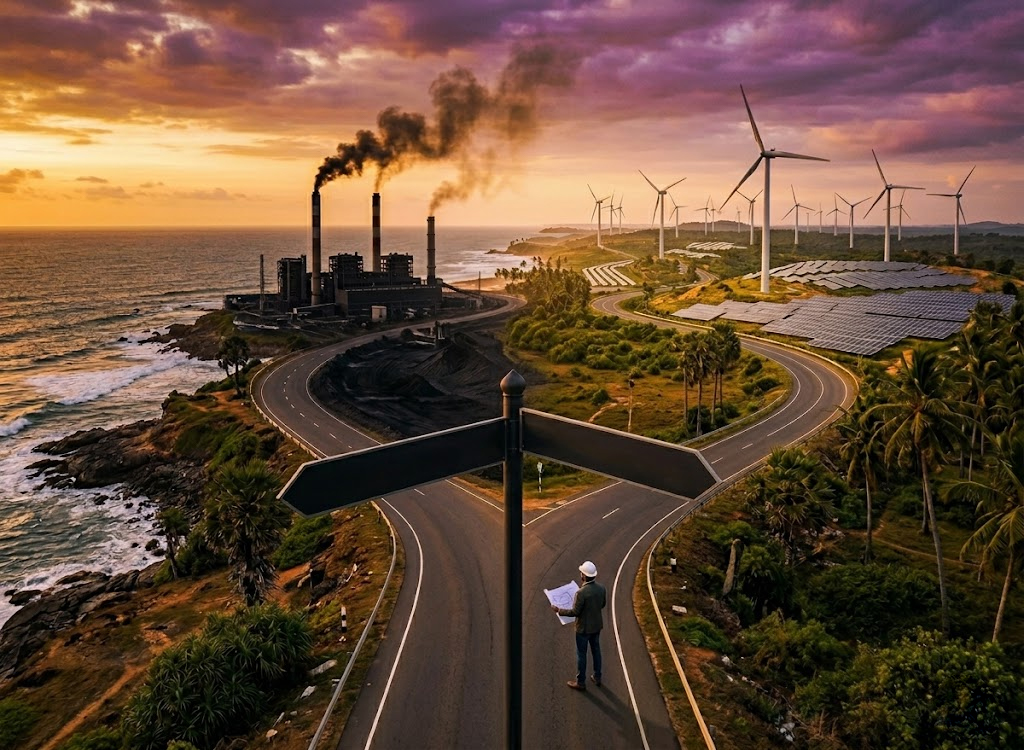
The window for deliberation is closing. The time for coordinated action is here
By Prof. Udayanga Hemapala
Sri Lanka is at a fork in the road on energy – and it has been standing there too long. The decisions made, or left unmade, over the next twelve to eighteen months will determine whether the country moves toward a secure, affordable, and self-reliant energy future, or remains trapped in a familiar cycle of power shortages, tariff shocks, and dangerous dependence on imported fossil fuels.
This is not a distant, theoretical risk. The data from the national grid right now makes the urgency plain – and the numbers behind that data tell a story that should accelerate every conversation about reform.
Energy transition is not just about renewables
There is a common misconception in public debate that energy transition means building solar farms and wind turbines. It means something far larger. Energy transition is the transformation of Sri Lanka’s entire energy system – electricity and petroleum together – spanning technology deployment, market design, regulatory reform, and how consumers and industries use energy. The destination is a system that is cleaner, yes, but more critically one that is resilient, affordable, and no longer held hostage to global commodity prices or foreign exchange availability.
The 2022 economic crisis offered a brutal reminder of what happens when that hostage situation reaches breaking point. Fuel ran out, power plants went silent, and the economy paid a devastating price. Energy transition is, at its core, Sri Lanka’s most credible insurance policy against a repeat of that collapse.
Why demand Is outrunning supply – and the numbers behind it
Night peak electricity demand has already crossed 3,100 MW – exceeding what the country’s own Long-Term Generation Expansion Plan (LTGEP) had projected for 2026. Reserve margins have dropped to critically low levels. A single unexpected outage of a major power plant during peak hours could now trigger serious supply disruptions. This is not a future scenario to plan against. It is today’s operational reality.
What is driving this demand surge? Several forces are converging at once, and the planning frameworks have not kept pace with any of them.
Sri Lanka’s economic recovery from the 2022 crisis has been faster and stronger than projected. GDP growth for 2025 was forecast at 4 percent – the actual figure came in above 5 percent. That one percentage point difference carries real consequences for energy demand across industry, commerce, and households. A recovering economy consumes more power, and the planning models did not adequately factor in the speed of that rebound.
At the household level, rising incomes and rapid urbanisation are changing consumption patterns. The spread of air conditioning, the shift to apartment-based lifestyles in urban centres, and higher ownership of electrical appliances are each individually modest changes — but in aggregate they are reshaping the national load curve in ways the existing LTGEP assumptions do not yet fully reflect.
Then there is the electric vehicle question. More than 6,000 EVs were imported into Sri Lanka in 2025 alone. Yet the country still has no published EV policy and no EV charging infrastructure policy. This is a significant gap. EVs are not just a transport decision – they are an energy decision. Unmanaged EV charging during evening hours will add directly to the night peak problem that is already at critical levels. A national EV and charging policy is not a future requirement; it is overdue today.
Underlying all of this is a forecasting problem. Existing demand models may not fully capture the pace of post-crisis recovery. Rapid technology adoption – EVs, rooftop solar, air conditioning — is not being properly reflected in LTGEP assumptions. And the planning process has made limited use of real-time data analytics and AI-based load forecasting tools that are now standard practice in comparable electricity systems elsewhere. The result is a plan built on assumptions that the real world has already moved past.
Compounding this further is the near-total absence of demand-side management. There is no effective programme for deploying smart meters or introducing Time-of-Use tariffs for consumers above 180 units per month — a straightforward mechanism that would incentivise shifting discretionary consumption away from peak hours. There are no meaningful consumer incentives for peak reduction. Managing the demand side of the equation is not only cheaper than building new generation capacity – it is faster. This tool is available and it is not being used.
The pipeline of new capacity – stalled at every stage
Sri Lanka has not commissioned any significant new power plant in several years. Meanwhile, more than 1,000 MW of renewable energy projects that have already been approved, awarded, or had PPAs signed are sitting idle – in some cases for years. The specifics are worth naming, because the pattern is too consequential to leave abstract:
- The 100 MW Siyabalanduwa solar project, tendered in 2022, has financing secured but construction has not commenced.
- The 165 MW solar programme tendered in February 2024, less than 10 MW projects, has not connected a single project to the grid. Several awarded projects are still awaiting PPA signing.
- The 150 MW and 50 MW Hambantota Solar Parks signed a PPA in March 2024, renegotiated it in 2025, and construction has still not started.
- Following a Cabinet decision on 31 August 2021, the Sustainable Energy Authority received over 500 proposals from investors for projects of 50 MW and above. Not one PPA has been signed.
- The 120 MW Sampur Solar Project signed an MOU in early 2025. A contractor has not been awarded.
- Three separate 50 MW wind projects have been awarded. Not one has broken ground.
Every day these projects remain unbuilt, Sri Lanka burns expensive diesel to keep the lights on — at a direct and measurable cost in generation expenses, foreign exchange outflows, and tariff burden on consumers and industry.
Why does this keep happening? Several structural failures are at work simultaneously, and naming them clearly is the first step toward fixing them.
Procurement processes that were designed for a different era
Conventional tendering in the energy sector routinely takes several years from initiation to contract award. Multiple approval layers — spanning the Ministry, CEB, PUCSL, SEA, and Treasury — create compounding delays at each stage. Appeals and procurement disputes add further time. A procurement architecture built for slower, larger projects is ill-suited to the pace at which renewable energy deployment needs to happen.
Policy that is published but not followed
Sri Lanka’s National Energy Policy and Strategies was published in Gazette Extraordinary No. 2135/61 on 9 August 2019. It provides a clear framework for the country’s energy transition. The problem is not the absence of policy — it is the inconsistency with which published, gazette-notified policy is actually adhered to in practice. When institutions deviate from gazetted policy without formal revision, investor confidence erodes and legal disputes follow.
Institutional fragmentation with no effective coordinator
Responsibilities for the energy sector are spread across the Ministry, PUCSL, CEB, SEA, and Treasury — with overlapping mandates, weak coordination mechanisms, and approval bottlenecks at every interface. No single institution has the authority or capacity to drive end-to-end delivery of a major energy project. The result is that projects pass through multiple gates, each of which can stall them independently.
Grid and transmission constraints
New generation capacity is of limited value if the transmission infrastructure to carry that power does not keep pace. Transmission line development is itself subject to the same slow procurement processes, compounded by land acquisition delays and extended environmental clearance timelines. Sri Lanka’s grid cannot absorb the renewable capacity it needs to build without parallel investment in transmission — and that investment is also behind schedule.
Bankability and investor confidence
For private investment to flow into the energy sector at the scale Sri Lanka requires, the commercial framework must be credible. At present, PPA terms are widely regarded as insufficiently bankable — meaning lenders are reluctant to finance projects on the basis of those agreements. Combined with tariff uncertainty and the track record of PPA renegotiation, this is systematically deterring the private capital that public financing alone cannot replace.
An unresolved LNG and thermal strategy
Sri Lanka’s LNG strategy has been in discussion for years without a policy decision. The future of thermal plants — Sobadhanavi, West Coast, Sahasdhanavi — and the coal fleet remains unclear. Fuel supply agreements in the sector are constrained by CPC’s exclusive role, limiting commercial flexibility. Without a clear decision on where LNG fits in the transition, the country cannot rationally plan the retirement of coal and oil-based generation, or the infrastructure investment that LNG would require.
What has been built — and the gap that now needs closing
It is important to acknowledge what has been genuinely achieved. The Soorya Bala Sangramaya programme was a real success. Sri Lanka now has over 2,500 MW of installed solar capacity, with a substantial share contributed by households and businesses through rooftop systems. Feed-in Tariff-based ground-mounted solar has added further significant capacity. This is a strong foundation.
But there is a structural problem embedded in this success. All of that solar generation happens during daylight hours. Sri Lanka’s peak electricity demand falls at night. The country has built a large solar fleet that cannot serve its most critical demand window.
This is where Battery Energy Storage Systems (BESS) become essential rather than merely useful. BESS captures surplus solar energy during the day and releases it during the evening peak — converting variable, weather-dependent generation into firm, dispatchable power. At scale, this allows Sri Lanka to reduce dependence on expensive diesel peaker plants, lower generation costs, protect foreign exchange, and improve reliability simultaneously.
Critically, this does not require waiting for public financing. A well-structured Feed-in Tariff mechanism for solar-plus-storage systems can draw in private investment from households, businesses, and project developers — extending a model that Sri Lanka has already proven can work.
Six actions that cannot be deferred
The path forward is neither mysterious nor technically complex. What it requires is the institutional will and political commitment to act on what is already known. Six priorities stand out as immediately actionable.
1. Unblock the stalled project pipeline — with named accountability
Every project with a signed PPA, awarded contract, or secured financing must be placed on a tracked dashboard with named accountability at senior official level. Where bureaucratic, legal, or inter-agency obstacles are stalling progress, those obstacles must be identified and resolved — not deferred. Sri Lanka does not need more project announcements. It needs to commission what has already been approved.
2. Overhaul demand forecasting and introduce an EV policy immediately
The LTGEP projections have been overtaken by actual demand. The planning authority must revise forecasts using real 2024-2026 operational data and commission an independent review of the forecasting methodology — incorporating real-time data analytics and AI-based tools as standard practice. Simultaneously, a national EV policy and EV charging infrastructure policy must be published without further delay. With over 6,000 EVs already on the road and more arriving each month, managing their impact on the grid is not a future problem — it is a present one.
3. Activate demand-side management tools
Smart meters and Time-of-Use tariffs for consumers above 180 units per month should be introduced on a planned rollout timeline. Consumer incentive schemes for peak reduction should be designed and launched. These are proven, cost-effective tools for reducing peak demand without building new generation capacity — and Sri Lanka is not using them.
4. Launch a national BESS deployment programme
A Feed-in Tariff for solar-plus-BESS systems should be designed and published without delay, prioritising less than 10 MW projects to enable rapid, distributed deployment. “Around-the-Clock” solar-plus-storage projects — retrofitting existing solar assets with battery storage — should be actively promoted. If moved on urgently, this single intervention can measurably reduce night peak diesel dependency within few months.
5. Make a decision on LNG and thermal — and publish it
Sri Lanka’s LNG strategy must be resolved and formally published. The future role of Sobadhanavi, West Coast, Sahasdhanavi, and the coal fleet at Norochcholai requires a clear, gazetted policy position. LNG can serve as a credible bridge fuel during the transition, but only if infrastructure, regulatory, and fuel supply decisions — including the constraints around CPC’s exclusive role — are addressed now. Continued ambiguity is itself a policy choice, and an expensive one.
6. Establish the National Energy Policy Planning Office and enforce institutional coordination
A National Energy Policy Planning Office (NEPPO) – staffed by engineers, economists, and energy specialists and insulated from electoral cycles – should be established to lead long-term energy modelling, technology assessment, and cross-sector policy coordination. At the same time, the overlapping mandates of the Ministry, PUCSL, CEB, SEA, and Treasury must be clearly delineated, with a single point of accountability for project delivery. The CEB, PUCSL, and SLSEA must be genuinely empowered to make technical and commercial decisions without day-to-day political interference. Investor confidence requires regulatory predictability – and that requires institutional independence in practice, not just on paper.
This Is an economic agenda first
A misconception that surfaces in policy discussions is that energy transition is primarily an environmental commitment — driven by climate obligations or donor conditionality. That framing misses the more important point for Sri Lanka.
Sri Lanka imports every barrel of oil and every tonne of coal it consumes. Every rupee spent on those imports leaves the country. Transitioning to indigenous renewable energy is an act of economic self-interest before it is anything else. The SLSEA’s own modelling suggests a renewable-dominant generation system could save Sri Lanka between US$18 billion and US$19 billion in projected coal import costs by 2050. That is capital that stays in the economy and can be reinvested in infrastructure, healthcare, and education.
Countries that move early on energy transition attract investment, build competitive industries, and strengthen national energy security. Countries that delay pay more, depend more, and fall further behind. Sri Lanka has every reason — economic, strategic, and technical — to be in the first group.
The moment calls for action, not more analysis
Sri Lanka has the renewable energy resources to make this transition work — solar irradiation and wind potential among the best in South Asia. It has a technically capable engineering community, a gazetted national energy policy, and growing private investor interest. What has been in shorter supply is coordinated execution and the institutional follow-through to move projects from approval to commissioning.
The analyses have been thorough. The reports have been well-written. The presentations have been thoughtful. What the energy sector needs now is implementation — accountable, time-bound, and driven by a clear understanding that every month of delay has a measurable cost in diesel burned, foreign exchange spent, and investment deterred.
The next decade will determine whether Sri Lanka emerges as an energy-secure, economically resilient nation, or whether it looks back and asks why it had everything it needed and still did not act in time. That is a question the country should not have to answer.
(The writer is a Professor in the Department of Electrical Engineering, University of Moratuwa, and former Secretary to the Ministry of Energy, Sri Lanka)
Disclaimer: The views and opinions expressed in this article are those of the writer and do not necessarily reflect the official position of this publication.









Leave a comment