
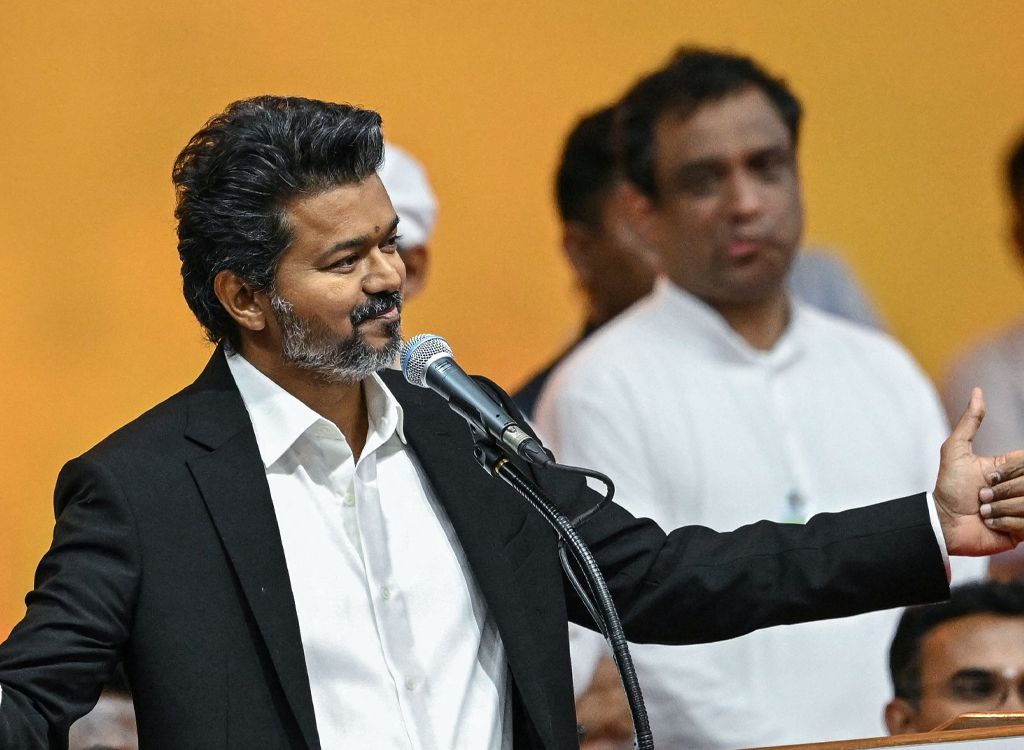
Even half a century after MGR came to power, a persona constructed through cinema is still required to bring about a change in governance!
By Veeragathi Thanabalasingham
The greatest achievement of actor Chandrasekhar Joseph Vijay is that, within a short span of two years, he has elevated the Tamilaga Vettri Kazhagam (TVK) as one of the major political forces capable of capturing power, disrupting the half-century dominance of the two main Dravidian movements, the Dravida Munnetra Kalagam (DMK) and the All India Anna Dravida Munnetra Kalagam (AIADMK).
Although many actors have launched political parties in the past, none were able to challenge the dominance of the Dravidian parties. Over time, they were forced to align with those very Dravidian parties just to secure seats in Parliament or the State Assembly.
Until now, parties like the Congress, the two Communist parties, and Thirumavalavan’s Viduthalai Chiruththagal Kadchi (VCK) had only the option of forming electoral alliances with one of the Dravidian parties. Now, with TVK emerging not just as a third major force but as the ruling party, the equation of coalition politics in the state is set to change. This is clearly evidenced by the fact that long-term allies of the DMK, including the Congress, are now extending support to Vijay to form the government.
Except for failing to secure an absolute majority of seats (118) in the assembly, Vijay has achieved certain milestones in electoral politics that even M.G. Ramachandran (MGR) – the first cinema actor to become Chief Minister of Tamil Nadu – did not. It was once a common saying that actors entering politics “could never become another MGR” Today, it can be said that Vijay has emerged as a benchmark that surpasses even MGR.
After being expelled from the DMK, MGR founded the AIADMK and, five years later in the 1977 Assembly elections, contested in alliance with two other parties to secure 33.5 percent of the vote. However, Vijay, within two years of starting his own party, contested alone without any alliance and secured 35 percent of the vote.
When Vijay stated that the 2026 Assembly election would be a turning point in the state’s political history – akin to the 1967 election where the DMK under C.N. Annadurai ended Congress rule, and the 1977 election where M.G.R.’s party ousted M. Karunanidhi’s DMK – many did not take him seriously.
In the 1967 election, the DMK under Annadurai contested in an alliance with five parties, securing 144 seats with 40.6 percent of the vote. In the 1977 election, AIADMK won 137 seats. When viewed against these benchmarks, Vijay’s rise from the cinematic world to the Chief Minister’s chair is unprecedented.
In terms of the speed with which he captured power, comparing Vijay with the former Andhra Pradesh Chief Minister and actor N.T. Rama Rao (NTR) is far more appropriate than comparing him with MGR. In 1982, Rama Rao ascended to power within just eight months of founding the Telugu Desam Party.
In the 1967 elections, students rallied behind the DMK amidst an emotionally charged political atmosphere fueled by anti-Hindi protests in Tamil Nadu. However, without any such backdrop of protest-driven sentiment, the younger generation and women who rallied behind Vijay have helped him defeat the Dravidian parties that have ruled alternately for 60 years.
Just as the ‘Rising Sun’ symbol aided Annadurai and the DMK back then, the ‘Whistle’ symbol has come to Vijay’s aid now. People voted in large numbers for the ‘Whistle’ without even knowing the candidates of the TVK. Vijay was unable to travel to many parts of the state for election campaigning; instead, he asked the people to vote for the ‘Whistle’ by imagining that he himself was the candidate in all 234 constituencies.
Impact on vote banks
Vijay has shattered the vote banks of every political party, particularly those of the DMK and AIADMK. His party secured a massive victory in the Chennai region. Even MGR, in his first election, could not break the DMK’s dominance in Chennai. It was only after 20 years that the AIADMK, under Jayalalithaa’s leadership, was able to make inroads to the DMK’s fortress.
The AIADMK captured 7 out of 14 assembly seats in Chennai at the 2006 elections and 14 out of 16 seats at 2011 election.
This time Vijay’s party has captured 14 seats in Chennai.
Even the DMK President and outgoing Chief Minister, M.K. Stalin, faced defeat in his own Chennai constituency against the TVK candidate.
“Vijay Makkal Iyakkam”
Critics, who pointed out that MGR’s political and cinematic lives ran parallel and that he used both fields from the beginning to build a “People’s Hero” persona, attempted to portray Vijay as someone who started a party out of a sudden political whim.
When Vijay launched his party two years ago with the intent of facing the 2026 Assembly elections, the prevailing opinion was that defeating the two major Dravidian parties – which possess decades-old grassroots infrastructure – was an impossible task. However, he had been working for several years to build a base of public support through his fan clubs.
One cannot say that Vijay’s entry into politics happened suddenly. As early as 2009, he transformed his network of fan clubs into the ‘Vijay Makkal Iyakkam’ (Vijay People’s Movement) and began social service initiatives, including establishing study centers, libraries, and computer centers. The movement also carried out flood relief work and organized medical and blood donation camps.
At the same time, after establishing himself as a leading actor, he carefully maintained in every interview that he would “enter politics at the right time.” Beyond grassroots social work, his 2009 meeting with Congress leader Rahul Gandhi and his support for Anna Hazare’s anti-corruption movement signaled his political ambitions.
Consequently, it was said that the then-ruling DMK grew dissatisfied, leading to several hurdles for Vijay’s films. The Vijay Makkal Iyakkam first made its electoral stance clear in the 2011 Assembly elections by deciding to support Jeyalalitha’s AIADMK.
However, in 2013, the tagline “Time to Lead” in his film ‘Thalaivaa’ created friction between Vijay and the Jayalalithaa government. In the years that followed, he focused his attention on key social issues. To test his influence among the public, the Vijay Makkal Iyakkam contested 169 seats in the 2021 local body elections winning more than 100 of those seats sent a shockwave through the state’s political arena.
Campaign strategy
The campaign strategy adopted by Vijay has proven that in specific circumstances, electoral victory can be achieved without deep-rooted grassroots party structures, traditional media dominance, continuous activities, massive conferences, or monumental election expenditures. His approach highlights the growing importance of alternative methods that establish direct communication with the youth and digitally active voters.
It is said that Vijay’s appeal to children – whom he had attracted through cinema – to persuade their parents to vote for his party, yielded significant results. Through social media, Vijay called upon the children of Tamil Nadu, saying, “Just as you insist on your parents buying your favourite toys, plead with them to vote for the ‘Whistle’ symbol of Vijay Mama’s party.”
While Dravidian movement parties utilised modern technology for their campaigns to some extent, they largely remained dependent on an old-school political style based on oratorical skills – a practice established over half a century ago. In today’s environment, dominated by social media, this approach centered on emotional rhetoric is unlikely to be highly effective.
The sunset of Dravidian parties’ dominance?
Vijay’s victory can be said to have put an end to the bipolar politics of Tamil Nadu. The shift toward a three-way contest creates a field where smaller parties can exert influence disproportionate to their actual vote banks, potentially reshaping the entire political equation. The current situation, where even parties with only two seats are setting conditions and delaying support for Vijay to form a government, clearly illustrates this.
Despite the fact that the main Dravidian parties have faced defeat and are seen as corrupt or losing significant public support, it cannot be said that these election results will cause a major setback to the deeply rooted Dravidian ideologies in the near future.
Even Vijay prioritised the fundamental principles of the Dravidian movement, such as social justice and state autonomy, in his election campaigns. He lacks a distinct policy of his own. Whether the defeat of the Dravidian parties is a temporary setback or the beginning of a journey toward permanent decline depends largely on how Vijay, while forming a government with the support of multiple parties, handles the complexities of governance.
Finally, Vijay’s victory was compared by most political observers and the media to a “seismic shift” – a massive movement in the earth’s layers during an earthquake. They attempt to suggest that a fundamental change has occurred, implying that nothing will ever be the same.
However, when a screen-cultivated image is still required to bring about a change in government even half a century after MGR’s party first won the assembly elections and came to power, how can we call this a “political earthquake” ideologically?
Vijay’s rise today is nothing more than the latest chapter in a long-standing trend where carefully crafted cinematic identities are converted into powerful political capital.
(The writer is a senior journalist based in Colombo)
Disclaimer: The views and opinions expressed in this article are those of the writer and do not necessarily reflect the official position of this publication.








Leave a comment