
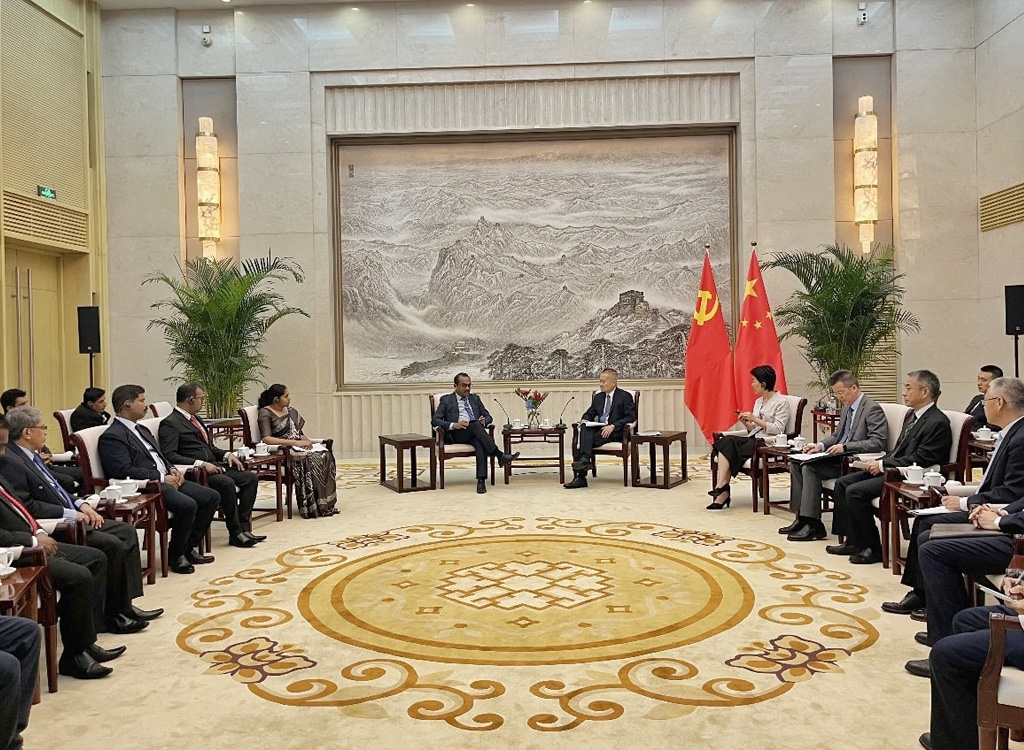
China’s growing influence in Sri Lanka’s politics raises questions over whether Bimal Ratnayake is being positioned as the JVP’s next leader.
by Upul Joseph Fernando
There was some unrest regarding certain container transshipments prior to the removal of Bimal Ratnayake from the Ministry of Ports and Civil Aviation. These container transshipments belonged to a Chinese company.
The United States had warned the Sri Lankan government that Chinese container shipments contained weapons being sent to Houthi rebels in Syria, a claim China categorically denied.
However, the Port Authority disregarded this warning, allowing the transshipments to pass freely, as they originated from China.
The U.S. had requested that Sri Lanka destroy any weapons discovered in those consignments, but China strongly opposed such inspections.
Caught between the U.S. and China over this sensitive issue, the government became cautious. Bimal, too, was reluctant to anger China.
Consequently, the transshipments were allowed to proceed without obstruction. A few days later, Bimal lost his position as Minister of Ports and Civil Aviation.
After being removed from his ministerial post, Bimal immediately travelled to China at the invitation of the Chinese Communist Party.
He stayed there for over a week and met with senior party officials.
Bimal is the head of the JVP’s international division and has long maintained the JVP’s relations with China.
The Sri Lankan Ministry of Ports is a strategically important ministry for China.
Therefore, Bimal’s appointment as Minister of Ports could have been seen as a positive development from China’s perspective.
It is reported that China may now be closely observing the reasons for Bimal’s removal from that post.
Although China has also built a close relationship with Tilvin Silva of the JVP, Bimal has earned greater trust from the Chinese.
It is not known whether China believes that, following Anura, Bimal would be his successor, nor is it clear whether the Chinese Communist Party is grooming him for leadership.
Otherwise, it would be unusual for Bimal to have travelled to China for several days while holding a ministerial post and serving as the leader of the house in Parliament.
The Chinese Embassy, compared with some other embassies, maintains closer ties to the internal affairs of the JVP.
Recently, a former JVP leader, Wimal Weerawansa, told the media that he was informed of his removal from the JVP through a Chinese Embassy official, via a reliable source.
The reasons for Bimal’s sudden visit to China are not publicly known; however, it is evident that China maintains significant understanding of, and interest in, the internal decisions and operations of the JVP’s political wing.












Leave a comment