
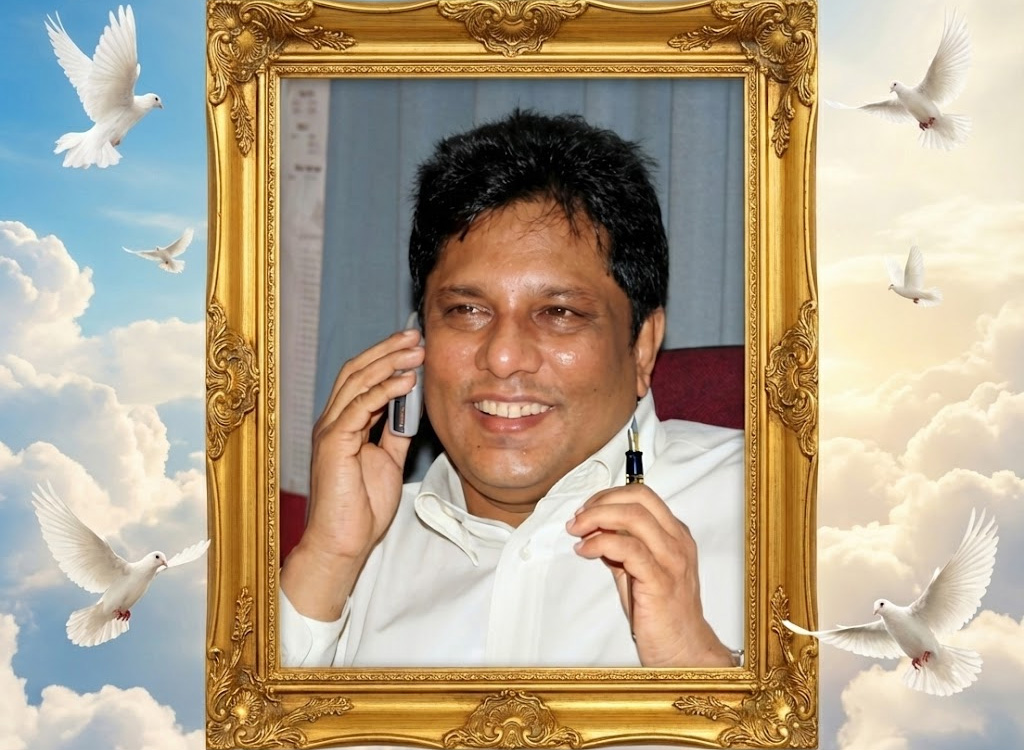
By Navin Obeyesekere
The Tamil and Sinhalese communities in Sri Lanka remain fragmented, created by conflicting narratives about heroes and villains. Propaganda often sanitizes the past, portraying fighters as selfless champions of a cause while glossing over the violence they wielded. Genuine progress demands that we confront these truths and cultivate a deeper understanding of our history. Only by looking to those extraordinary individuals who fought with the courage of their convictions — those who wielded words and ideas instead of weapons — can we truly begin the rebirth of countries still scarred by war.
Lasantha Wickrematunge was one such individual. A renowned stalwart of justice and a celebrated defender of human rights, he emerged from Sri Lanka’s elite yet steadily aligned himself with the disadvantaged and voiceless. He challenged his own friends in positions of power, envisioning a Sri Lanka grounded in fairness. His place amongst the political ruling class gave him a understanding of its inner workings, and it was this insight that enabled him to confront a brutal regime with uncommon clarity. His public criticism of the government of Mahinda Rajapaksa — once a close friend with whom he shared a very public quarter-century complex personal history — marked a decisive rupture. Crossing that final line ultimately cost him his life, but it also placed him, for all time, among the most courageous defenders of good governance and the great heroes of this world.
Lasantha was never someone motivated by power or wealth. He understood, with painful certainty, the risks he faced. Fully aware of the ruthlessness of the state apparatus, he continued his journey knowing that he won’t survive. In an act of valor, he authored his own posthumous obituary, titled ‘And Then They Came for Me,’ echoing Martin Niemöller’s reflection on Nazi persecution. In that final testament, he identified those within the ranks of the government whom he believed responsible for his assassination and offered a chilling forecast of Sri Lanka’s descent into repression. It was both an indictment and a warning to Sri Lanka, and it ensured that the legacy he left behind would be unmistakable. Lasantha was the very core of critical inquiry and human rights activism, holding the state to account when few others dared to do so.
The utmost fortunate who knew him often spoke of an extraordinary presence marked by integrity and quiet authority. Many who had the privelege of encountering him have reflected on the honour of having been in the presence of a warrior they can one day proudly claim meeting to their grandchildren. A journalist writing in The Sunday Leader eulogised him as a man almost close to perfect, while a former colleague recalled that he always commanded such natural respect that people instinctively stood up unconsciously when he entered a room.
A devout Christian, Lasantha frequently spoke of the role his faith played in influencing his values and decisions, particularly its emphasis on peacemaking. In the mid ninetees, when he and his wife were assaulted by hired assassins and the perpetrators were apprehended, he instructed his lawyers to withdraw the charges and offered forgiveness to those who had attacked him. His legal counsel warned that doing so might set a dangerous precedent in the country, yet Lasantha wanted to set an example, demonstrating forgiveness in conditions of sustained personal threat. That brutal attack did nothing to diminish his spirituality. Instead, it reinforced his belief in justice pursued without vengeance and in the value of courage.
An examination of Lasantha’s life inevitably invites reflection on the origins of such a rare and exceptional human being who was of such conviction. His family history reveals striking continuities of principle and purpose down lineage.
His grand-uncle, George E. de Silva, was a leader in Sri Lanka’s struggle for equity and independence. Alongside his wife, he championed women’s empowerment, suffrage, and fight against colonial rule. A politician rooted in the lives of the people, George E. de Silva earned a reputation as a representative for the oppressed and the voiceless. His opposition to colonialism and corruption left a long-lasting footprint.
Like Lasantha, George E. de Silva was a journalist, lawyer, and politician who relied on the power of words as much as action. He was a promoter of universal franchise, worked to uplift the poor, and played a very important role in the independence movement. A eulogy for George said his dedication to anti-colonialism and non-violent action was forged in part by his work and association with Mahatma Gandhi, who even stayed at his home in Kandy. Both Lasantha and his grand uncle shared a mutual belief in peaceful opposition, standing in sharp contrast to those who sought power through violence and intimidation.
While a later political dynasty relied on coercion and brutality to consolidate authority and bring the war to an end, George E. de Silva and Lasantha Wickrematunge demonstrated that real strength lies in peaceful protest and the pursuit of truth. The divergent paths taken by these families offer a lesson to us in the choices that accompany power. One legacy is burdened by allegations of authoritarianism and human rights abuses; the other is defined by selfless service and a pledge to justice.
These contrasting legacies underline humanity’s capacity for both light and darkness. George E. de Silva’s principles lived on through Lasantha, affirming that values passed down through generations can shape the course of polity. Their lives reveal how a family’s dedication to justice can inspire others to pursue peace rather than resort to the very violence used to silence Lasantha.
George E. de Silva passed away in 1950, long before he could witness the extraordinary legacy his grand nephew would later leave. It is one of history’s quiet losses that a man whose ideals so closely mirrored Lasantha’s never lived to see those same principles re-emerge so powerfully in the next generation. Had he done so, he would undoubtedly have recognised in Lasantha a reflection of his own lifelong struggle for justice proving that the apple doesn’t fall far from the tree.
Lasantha’s final public appearance came in open defiance of tyranny. On 6 January 2009, he appeared on MTV Sirasa, visibly weary from the burdens of Sri Lanka that laid heavily on him yet he was still resolute. He unequivocally condemned the attack on the station, describing it as an act of terrorism. That image — Lasantha in that black and yellow shirt — remains in the public’s memory, symbolising both his sacrifice and his spirit. That piece of clothing should be kept in preservation as part of Sri Lanka’s historical record.
His oft-quoted motto, unbowed and unafraid, was inspired by his favourite poem, Invictus by William Ernest Henley. Written in 1875, the poem’s themes of perseverance and inner strength resonated with him. As Henley writes,
“In the fell clutch of circumstance
I have not winced nor cried aloud.
Under the bludgeonings of chance
My head is bloody, but unbowed.
“Beyond this place of wrath and tears
Looms but the Horror of the shade,
And yet the menace of the years
Finds, and shall find, me unafraid.”
The poem came to define the manner in which Lasantha confronted danger, intimidation, and ultimately death, as a sacrifice for truth.
With unshakeable resolve, Lasantha hurled himself against the citadels of tyranny, his words a clarion call to the oppressed. He was the lone voice that refused to be silent. Across the vast sweep of time, billions of lives fade into obscurity. Yet among those forgotten multitudes, a few very special voices echo through the ages. Lasantha Wickrematunge will forever be remembered as a titan of democracy, honoured in the firmament of human rights — a lionhearted cultural icon and example of what allegiance to liberty and human dignity can achieve.
Disclaimer: The views and opinions expressed in this column are those of the author, and do not necessarily reflect those of this publication.







Leave a comment