
By Dinouk Colombage
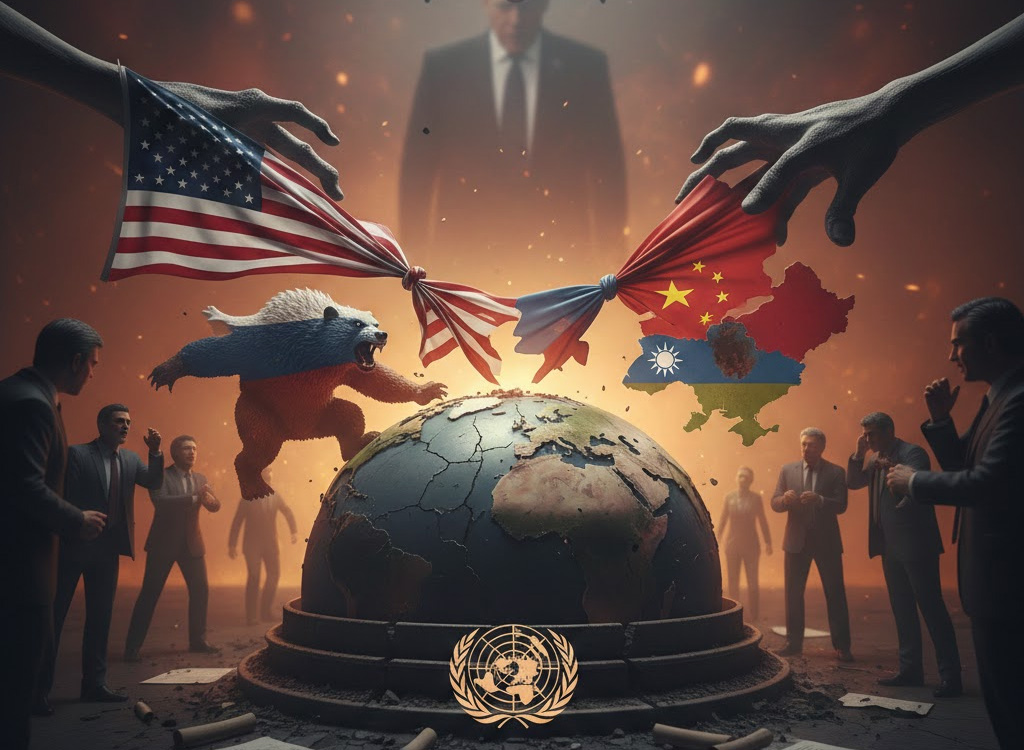
If the U.S. can justify the military intervention and deposition of Venezuela’s President, citing national security concerns, then Russia’s 2022 invasion of Ukraine under a similar concern now stands validated.
When U.S. President Donald Trump deployed a naval blockade on Venezuela in December 2024, few would have imagined that in less than a month a U.S. sanctioned Special Forces operation would be launched to abduct Venezuela’s President Nicholas Maduro and his wife. However, on January 3rd, the United States engaged in an operation which saw the abduction of a sovereign nation’s President and his wife, along with the killing of 80 foreign nationals. The U.S. has justified their actions in Venezuela, claiming that Maduro was guilty of “narco-terrorism”, while his regime was supporting drug trafficking into the U.S.
While both domestically and internationally the Presidency and Government of Nicholas Maduro has been under a question mark. Many countries refused to recognise his electoral victory in 2024, citing allegations of electoral tampering, voter intimidation and abuse of state resources during the election. However, the decision by the U.S. to unilaterally intervene and depose a sitting President of a sovereign nation has raised concerns and questions around the globe. The U.S. and Venezuela have been in the middle of a diplomatic war since Trump took office in 2024, however, the military intervention by the U.S. appears to be in violation of the Kellogg-Briand Pact. Signed in 1928 this pact, which included among sixty-two other states the United States of America, outlawed war as an instrument of national policy. The decision by the U.S. to invade the sovereign territory of Venezuela and abduct the country’s sitting President and his wife can, to many, be construed as an act of war.
While the world will be watching closely the response by Venezuela’s newly installed President, former Vice-President Delcy Rodríguez, attention will also turn to several other hot spots around the world.
On the 24th of February 2022, Russia launched an invasion of Ukraine, occupying over 20% of the country including the territories of Donetsk and Luhansk. In the lead-up to the invasion by Russian forces, Russia’s President Vladimir Putin had expressed concerns over Ukraine’s attempts to join NATO (North Atlantic Treaty Organisation). Following the 1990 reunification of Germany, Russia obtained verbal assurances from the Western Power Bloc, including U.S. Secretary of State James Baker, that NATO would not expand eastward. While there has been no formal agreement between Russia and NATO over whether the alliance would expand eastward, Putin has demanded that the continued growth of the alliance, up to Russia’s Western borders would constitute a threat to their national security.
As Ukrainian President, Volodymyr Zelenskyy, attempted to secure Ukraine’s membership to NATO, the Russian President and his military feared that such a development would result in nuclear weapons being placed on Russia’s Western borders. Referencing the 1962 Cuban Missile Crisis, which saw the U.S. enter into a military standoff with the Soviet Union’s over the latter’s plans to deploy nuclear weapons in Cuba, Putin has justified military intervention to safeguard their borders.
With the absence of calming voice among the Western European leadership and the U.S., Putin pursued the theory that a nation at war would not be capable of securing NATO membership. Under the threat that the rest of the alliance would be forced to defend the newly inducted member; Putin launched a full-scale invasion of Ukraine. Along with securing a buffer in Eastern Ukraine from further NATO expansion, the ongoing conflict has delayed any further development in Ukraine’s membership to NATO.
Four years on from the invasion, the war is at a stalemate with neither Russia making further gains, nor Ukraine regaining any territory. This is to Russia’s benefit. Putin has, for the time being, ensured that NATO’s induction of Ukraine has been halted, while also securing a land passage to Crimea and its warm water port. For Ukraine, despite the continued support of Western Europe, the U.S. under President Trump, has begun a gradual yet poignant withdrawal of its support. Globally, Russia has faced systematic isolation by Europe and the Global North over its actions in Ukraine. While its relationship with China and India remains strong, the apparent violation of the international rules-based order by Russia has meant that these relationships are limited to an extent.
However, the recent actions by the U.S. have now provided Russia with an opportunity to justify its actions among the global community. Furthermore, the absence of a condemnation by the U.S’ allies over its actions in Venezuela have provided an opportunity for Putin and his government to regain lost ground with those that have previously vilified Russia. Countries such as the United Kingdom, France and Germany have all chosen to pursue diplomatic language, which raised concerns with the actions of Donald Trump while not going as far as condemning the violation of the sovereignty of Venezuela. Each of the three Western European nations, who have been at the forefront of the campaign to isolate Russia, now faces an uncomfortable prospect of maintaining an allyship with the U.S. post-Venezuela while upholding the remnants of a Rules Based Order regarding the Russo-Ukraine war.
While Europe will certainly be left red-faced over the actions of Donald Trump, Asia will also be viewing the developments closely with one eye on China. Over the past several years, as the U.S – China rivalry continued to evolve, the threat of a forced reunification of Taiwan by mainland China has been propped up. While China has continually maintained its right for reunification with the island, previous efforts to pursue such an initiative have been absent. Live military exercises around Taiwan were first held in 2022, during the visit of then Speaker of the U.S. House of Representatives Nancy Pelosi to Taiwan. In the subsequent three years as many as six separate military exercise have been held, with the latest and largest being held on the 30th of December 2025.
It has been the continuous stance of China, since the creation of the People’s Republic of China in 1949, that Taiwan is a breakaway Province which will eventually be brought under Chinese rule. The global community has tiptoed around this issue, with the majority adopting a “One China Policy” which does not officially recognise Taiwan. While the U.S. also does not officially recognise Taiwan, the country has maintained relations through the Taiwan Relations Act of 1979. The main reasoning behind this legislation has been to ensure regional stability and prevent “coercion” by any foreign powers. While the U.S. is not obliged to militarily defend Taiwan, recent years have seen an increased exertion by U.S. officials pushing back against China and their policy towards the island.
As China has continually maintained that Taiwan is in-fact a part of mainland China, and not recognised as an independent state, any efforts to “reunify” the island would be justified as an internal matter. While this remains a grey area in the eyes of Europe and the U.S., under the Rules Based Order, the actions of Donald Trump in Venezuela have thrown a new light on the issue. Diplomatically and ethically, the ability of the U.S’ allies to avoid condemning the assault on Venezuela has meant that any future actions by China, justified as an internal matter, will leave these countries incapable of maintaining a moral high ground on the international stage.
For the Asian states such as the Philippines, Vietnam and Japan, who are locked in diplomatic standoffs with China over the ownership of islands in the South China Sea, the future is looking less certain. Previously the support of the U.S. in these disagreements has meant that these Asian nations have been able to push back against China with the belief that the America would support them in the event of any escalation. However, Trump’s indication that the sovereignty of a country no longer has a bearing on international relations will leave a clouded future for these countries.
While the debates will continue over the legality of the U.S’ actions in Venezuela, with the United Nations Security Council due to meet on the 5th of January[1], the actions by the U.S. and President Donald Trump had clearly signalled that the Rules Based Order was in its concluding act. Regardless of technical arguments that will be put forth in the coming days and weeks, the actions of the U.S. have demonstrated that the rules by which the international community is expected to abide by do not apply to the self-proclaimed “Leader of the Free World”. Furthermore, the sovereignty of a nation, a topic which has seen numerous conflicts fought over the course of modern history, has now been diminished by the actions of the U.S.
As the polarisation of the global community continues, the absence of nations or global bodies upholding the rules-based order, even in the face of violations by a global superpower, suggests that conflict may once again become a tool of international diplomacy. Ukraine, Gaza and now Venezuela are all examples of a nation’s sovereignty being trampled on for self-serving purposes. Under the flippant guise of national security, the global community is facing the very real prospect that the 21st Century Cold War will be far hotter than previously imagined.
[1] At the time of writing, the UN Security Council had not yet convened.
(The writer is the former Director of International Affairs to President Ranil Wickremesinghe and the Chief Research Officer for the Geopolitical Cartographer)
Disclaimer: The views and opinions expressed in this column are those of the author, and do not necessarily reflect those of this publication.







Leave a comment