
By Nilantha Ilangamuwa
How expensive is a strike if its secrets can be bet on? What is the highest-stakes geopolitical question today? Will Israeli Prime Minister Benjamin Netanyahu lose his seat and resign by 31 December? On Polymarket, the stakes, starting at fractions of a penny, if correctly placed, can be converted into millions.
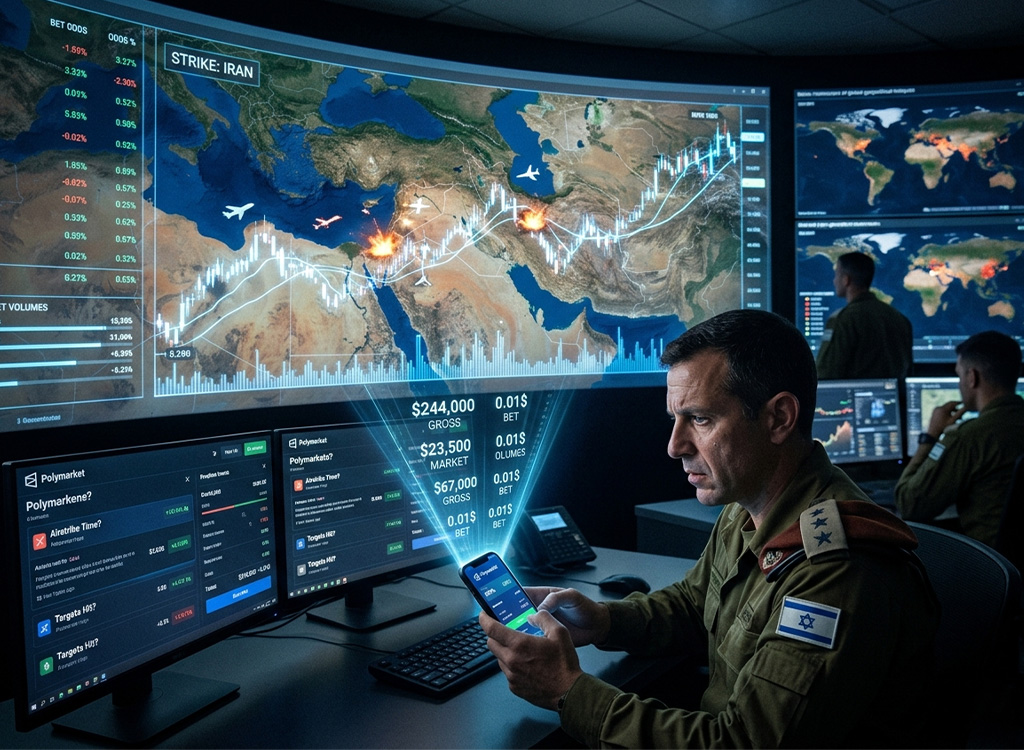
By June 2025, the previously disciplined, proficient, and honourable Israeli Air Force was subject to historical judicial scrutiny. A reserve major allegedly leaked secret details of airstrikes on Iran to a colleague who placed bets on the crypto prediction platform. The bets were minuscule, from pennies down to fractions of a penny, but precise intelligence allowed the market to multiply those fractions exponentially, ultimately grossing a reported $ 244,000.
The indictment stated the officer updated his bets during operations, even while he had signed nondisclosure forms, to list exact targets and times. But it isn’t just a momentary lapse of judgement; it is a new, inherent calculus for war, where war itself is subject to the rules of the market and money can act as its own command chain.
The digital economy of war
The concept can be historically traced, but not on this scale, nor with this kind of immediacy. In Ancient Rome, people bet on gladiators’ lives. Nobles bet on the outcome of battles from Waterloo to Gettysburg in early modern Europe. Both events were symbolic, short-lived, and localised.
By the time soldiers were even gambling on battles during the 20th century, there was no leverage, speed, or anonymity – but there is today in prediction markets. In effect, Polymarket offers a structural shift wherein intelligence, human behaviour, and timing of an operation are traded in a real-time global market, not just for foresight, but for profit.
It was not so much that the strike was predicted in June 2025 as it was gambled upon as it unfolded. At fractions of a penny on Polymarket, there are millions of dollars at stake for a correctly placed bet. War itself has now become a digital economy.
Polymarket Founder and CEO Shayne Coplan claims to defend the platform but admits the risks involved. He argues it aggregates intelligence, as opposed to being simply speculative. In war zones, it is allegedly being used as a resource by individuals there seeking to find the best times and locations to shelter. It cannot be denied, though, that the potential for abuse is inherent, turning a high-stakes situation into immediate profit for those with certain intelligence.
Real-time intelligence becomes fluid capital. The Iran strike is an example of this, with bets updated during an operation in a pattern of converting classified intelligence into money, similar to reports of the market turning $ 34,000 into $ 400,000 from a bet on the downfall of Nicolás Maduro in Venezuela, or $ 553,000 for the Ayatollah shortly before his death.
The sheer size of the prediction market’s daily volume is staggering: nearly $ 425 million was wagered on geopolitical contracts in one week alone – almost three times the amount the week prior. It’s not just a matter of small bets on geopolitical events creating small-scale impacts, but micro-bets are now being seen with macro-level consequences, merging speculation with strategy as the money itself can be thought of as part of the calculus of command.
Small bets, starting at pennies but leveraging substantial financial returns, create disproportionately outsized outcomes that Polymarket’s very architecture allows for.
The rise of Polymarket
The platform, founded by 21-year-old dropout Coplan while still a student, who previously had a career in the crypto markets, has since swelled, drawing in tens of millions of users across everything from elections to corporate deals, celebrity actions, and conflicts.
The company has since received $ 2 billion investment from the owners of the New York Stock Exchange, valued at $ 9 billion in October 2025. The platform itself, because of its speed, anonymity, and size, could not have been imagined at any prior point in history. Every bet on the platform, regardless of how small it starts, will begin to influence, at a minimum, market perception.
The platform can’t be confined to its role as a mere bystander, as its architecture could potentially sway real-time decision-making. Its system of anonymised, speed-based bets with real-time information can lead the market to move faster and further than any command hierarchy could achieve individually.
Operational intelligence is no longer simply intelligence; it’s currency. In an operation, it would be foolish not to leverage even small but reliable information when millions of dollars are on the line, even if the operational risks seem higher – especially since intelligence has become a variable of wealth. This is the first overt display of warfare being dictated by prediction markets, a phenomenon which is clearly transferable to any conflict globally.
The old-age concept of betting on gladiators or events of ancient wars pales compared to the speed, leverage, and real-world impact of such a platform today. A bet that starts with pennies today could influence the trajectory of the world in ways that a bet on the outcome of a 20th century battle could not have, even if that bet starts off with a wager smaller than it takes to buy a bottle of water.
With Polymarket’s offshore operations and the anonymity provided by cryptocurrency, traditional regulatory bodies are struggling to provide an adequate framework to account for such activities. They are not simply forecasting anymore, as the platforms have shown that the markets themselves can sway real-world events, and profit motive takes precedence over any ethical or operational considerations.
The idea of placing a micro-bet in London to influence an airstrike in Tehran might be absurd now, but the velocity and leverage of the system make the immediacy and reality of this interaction something that current military theory hasn’t anticipated.
A new information ecosystem
It challenges our old methods of command, intelligence, and risk as well. Prior to this, mistakes were born of bias or lack of information. Now they can be driven by greed, making every unit aware that the pursuit of profit has now been intrinsically blended with the realities of battle. Humans have always had the capacity to be influenced by money; now, the immediacy and leverage of a prediction market provide the perfect conduit for this manipulation.
Insider information, before the public, policymakers, or the enemy can act on it, can and will be profited from. The ethics, operations, and accountability aspects of warfare are now entirely quantifiable, especially on the platform’s end, as the ability to generate wealth at a faster and larger pace than before creates greater incentive. Even though bets only start at a penny, with enough precise data, this information can easily turn into million-dollar payouts.
Yemen and Venezuela are further examples of how this prediction market operates on a large scale, influencing elections and internal perception of various activities. Decisions are being impacted on the ground and throughout global markets due to these transactions, which are faster, more anonymous, and more pervasive than ever before. This new information ecosystem turns the world into one giant bet, and even the smallest amounts on the lowest stakes can now snowball into tremendous impacts on decision-making.
There is no doubt that this system turns information into currency. Previously, information remained confidential for high-level stakeholders. Today, its profit has been monetised and can be earned very rapidly, at an immediate and widespread cost, with minimal bet inputs that can create the same impact as massive institutional players. Ethical and practical challenges are evident in our military doctrine, law, and regulation of the market. It is beyond all three now.
In this way, Polymarket functions as both an informational tool and a real-world laboratory. By essentially allowing any user to bet on the real world, information becomes valuable both by the insights derived from it and for the sheer potential for profit.
While traditional theory relied on human variables of knowledge, intuition, and speculation, now it must also incorporate markets which are, at their very best, attempting to profit from or contribute to the information that is relevant to any military operation. Insiders and laypeople can turn a few pennies into a windfall of wealth with only privileged information, impacting everyone else in the equation by shifting market sentiment and ultimately potentially operational behaviour.
This is undoubtedly not an optimistic, but a highly concerning prediction, and we are only seeing the very nascent stages of its potential repercussions.
(The writer is an author based in Colombo)
Disclaimer: The views and opinions expressed in this article are those of the writer and do not necessarily reflect the official position of this publication.











Leave a comment