
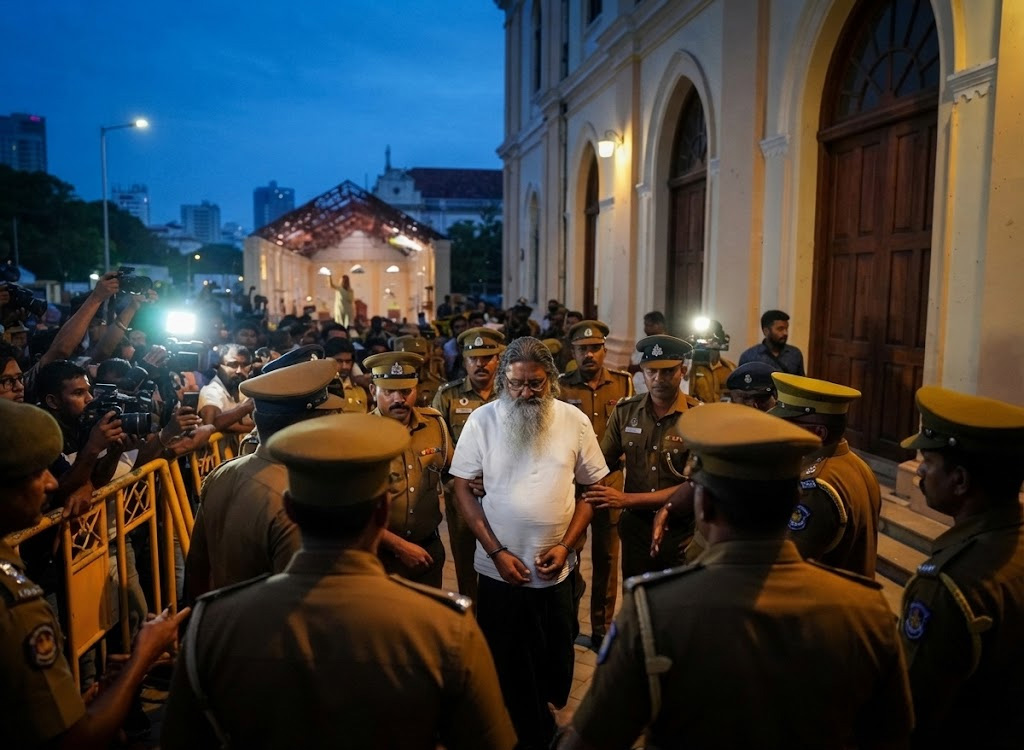
Fifteen convicted defendants to challenge verdict over alleged trial irregularities, torture claims and questions surrounding judicial appointment
By The Pulseline News Desk
Fifteen individuals convicted in connection with the Easter Sunday terror attacks have reportedly filed appeals before the Supreme Court challenging a Colombo Permanent High Court at Bar judgment that had imposed prison sentences ranging from 200 to 260 years, alleging that the trial was neither fair nor transparent.
The appellants have reportedly contend that the three-judge bench had failed to give due consideration to their statements in defence and relied on evidence that, they argue, had not been properly established in accordance with the law.
According to reports, the appeals were filed with the assistance of a team of senior lawyers, marking the latest development in a highly controversial case involving 23,270 charges and lengthy prison sentences against those convicted.
The judgment was delivered unanimously on September 22, 2026, by a three-judge bench comprising Navaratne Marasinghe, Ramanathan Kannan and Sujeewa Nishshanka.
The case has attracted renewed scrutiny over the conduct and duration of the trial, allegations that defendants were subjected to torture while in Criminal Investigation Department (CID) custody, and the appointment of the presiding judge to the Court of Appeal shortly after the verdict.
23,270 charges in a landmark trial
The Attorney General had filed 23,270 charges against 25 defendants before the Colombo Permanent High Court at Bar on October 4, 2021.
The proceedings were marked by repeated objections and submissions from lawyers representing the accused. Three senior lawyers, recognised for their work in the human rights field, had subsequently withdrawn from the case in protest over the court’s conduct, according to the account accompanying the appeals.
The appellants have reportedly argued that the proceedings had not adequately addressed their defence and that the evidence relied upon to convict them had not met the required legal standards.
The speed with which the judgment was delivered has also become a point of contention. The trial had reportedly concluded with a relatively short interval between the presentation of evidence, the submission of oral and written arguments, and the delivery of the verdict.
Torture allegations raise questions
A central issue raised by the appellants concerns allegations of physical and psychological torture during their detention by the CID.
Several defendants have reportedly told the court that investigators had subjected them to coercion and had obtained statements under duress.
Some have also alleged that they had been humiliated through acts that violated their religious beliefs, including being forced to consume pork.
The appellants have maintained that their defence statements were not given adequate consideration when the court reached its verdict.
Whether these allegations were properly assessed in the original proceedings, and whether they have any bearing on the convictions, are among the issues requiring scrutiny through the appropriate legal process.
The appeals have placed renewed focus on the treatment of terrorism suspects in custody and the importance of ensuring that evidence obtained during investigations complies with legal safeguards.
Fifteen convicted, nine acquitted
Of the 25 individuals originally indicted, one defendant, identified as the 17th accused, Yasim Bawa Abdul Rauf, had died after falling ill while in prison during the trial.
The three-judge bench had subsequently acquitted and released nine of the remaining 24 defendants, while convicting the other 15.
The court had imposed lengthy terms of rigorous imprisonment and ordered the confiscation of all movable and immovable property belonging to those convicted.
Four defendants had received sentences of 240 years each, while five were sentenced to 220 years each.
Five others had received 200-year prison terms, while Abdul Manaf Mohamed Firdaus was sentenced to 260 years.
The sentences were imposed in a case instituted under the Prevention of Terrorism Act (PTA).
The appellants are now seeking to overturn the convictions and sentences through the Supreme Court proceedings.











Leave a comment