
By The Pulseline News Desk
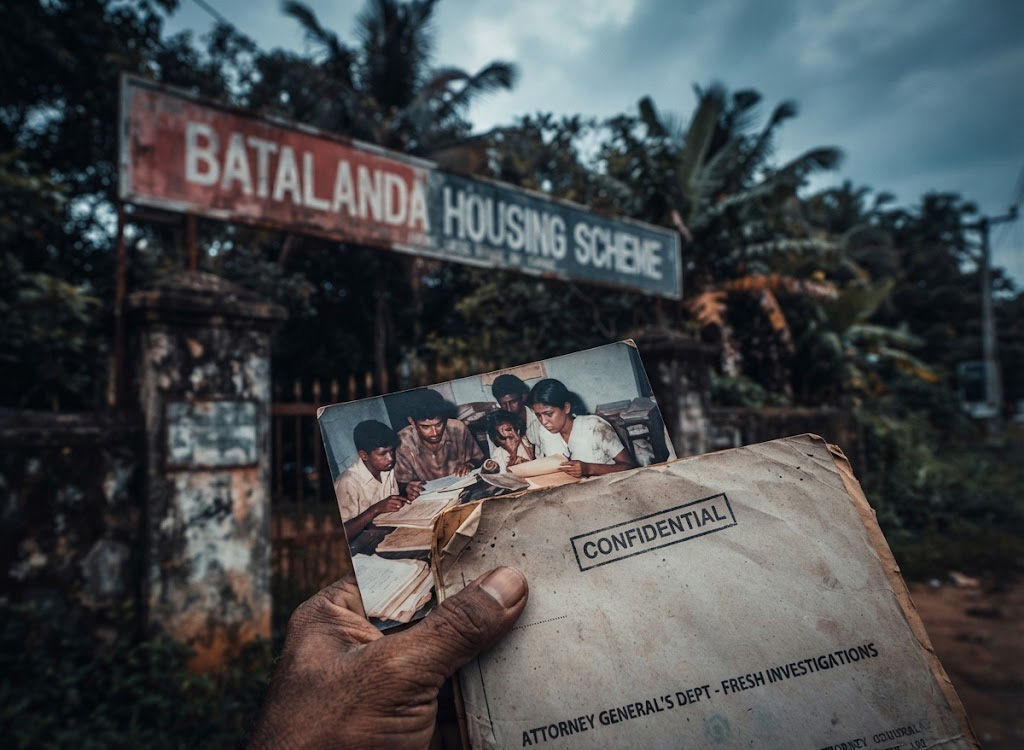
The Attorney General (AG) has reportedly recommended fresh investigations into killings allegedly linked to the Batalanda torture sites, reopening a decades-old chapter of Sri Lanka’s history involving allegations of unlawful detention, torture, disappearances and extrajudicial killings.
The Attorney General’s Department has reportedly stated that observations containing the Attorney General’s conclusion have been forwarded to the Secretary to the President.
However, the Attorney General has determined that indictments cannot be filed against suspects solely based on evidence contained in the Batalanda Commission of Inquiry Report. Instead, the Attorney General has called for fresh investigations into the allegations, potentially paving the way for authorities to revisit evidence relating to crimes that occurred during one of the country’s most violent periods.
What is the Batalanda Commission Report?
The Batalanda Commission was established following the election of Chandrika Bandaranaike Kumaratunga as President in 1994, after 17 years of United National Party (UNP) rule.
One of the key promises of her campaign was to seek justice for killings and disappearances reported during the 1988-1990 period, when Sri Lanka was gripped by severe political violence.
On September 21, 1995, President Kumaratunga appointed a Presidential Commission of Inquiry to investigate allegations that young people had been unlawfully detained, tortured, killed or disappeared at locations within the Batalanda Housing Scheme in Biyagama.
The housing scheme, owned by the State Fertilizer Manufacturing Corporation, became associated with allegations of secret detention and torture facilities.
The Commission was also tasked with identifying those responsible for the alleged abuses.
After receiving 12 extensions, the Commission submitted its report to President Kumaratunga on March 26, 1998.
Allegations involving state security personnel
The Commission proceedings had produced several significant allegations, including evidence concerning premises reportedly used by security personnel associated with then UNP politician and later President Ranil Wickremesinghe.
According to the report, House A2/2 in the housing complex had been used by Wickremesinghe from 1983 until April 1989 as a holiday bungalow belonging to the Ministry of Youth Affairs and Employment.
From April 1989 to 1994, the same premises was reportedly used as his official residence while he served as Minister of Industries.
House A2/1 was reportedly allocated to his security personnel, while House A2/3 was assigned to a ministry under his purview.
The Commission had also recorded allegations concerning other premises in the complex.
House A1/7 was reportedly used by security personnel attached to Wickremesinghe, while House B2 was allegedly used by him as an office.
A person who claimed to have been tortured and subsequently had escaped reportedly identified House B2 during the Commission proceedings.
House B1 was also reportedly used by security personnel attached to Wickremesinghe. The report had further stated that Police Inspector Sudath Chandrasekara, who had served as a personal security officer to Wickremesinghe, had used House B7.
House B8, located nearby, was reportedly used by security personnel attached to then Superintendent of Police Douglas Peiris.
Witness testimony
Among the testimony before the Commission was that of one Earl Sugi Perera, who had alleged that he had been detained and tortured at the location.
Perera had told the Commission that he had been held and beaten for 23 days and claimed he could identify members of a security escort whom he had alleged had participated in the abuse.
His testimony had been one of the significant accounts associated with the allegations surrounding the Batalanda premises.
The allegations recorded by the Commission have remained a politically and legally sensitive part of Sri Lanka’s recent history.
Why has the report returned to the spotlight?
The Batalanda Commission Report has returned to public debate in recent months amid renewed calls to investigate unresolved crimes dating back to the late 1980s and early 1990s.
Leader of the House, Minister Bimal Ratnayake, tabled the report in Parliament on March 14, 2025, bringing a document that had remained largely outside mainstream public debate back into national focus.
However, the Attorney General’s latest position highlights a significant legal obstacle: the Commission report itself cannot be treated as sufficient evidence to prosecute alleged perpetrators.
The recommendation for fresh investigations therefore places the responsibility on law enforcement authorities to determine whether additional admissible evidence can still be located after more than three decades.
That could include identifying surviving witnesses, examining documentary records and establishing whether other evidence exists that can independently substantiate the allegations recorded by the Commission.
A question of delayed justice
The Attorney General’s position does not close the door on the Batalanda allegations. Instead, it places the emphasis on conducting investigations capable of producing evidence that could meet the requirements of a criminal prosecution.
For families of those who were allegedly detained, tortured, disappeared or killed during the violence of the late 1980s, however, the passage of nearly four decades raises an unavoidable question.
Can justice still be delivered for victims whose allegations have remained unresolved for decades?
The Batalanda Commission was established to uncover the truth and identify those responsible. Its report has documented serious allegations and testimony from people who have said they had endured torture and unlawful detention.
But a commission report is not, by itself, a criminal trial.
The Attorney General’s recommendation for fresh investigations now creates a new test for the authorities: whether the state can finally establish, through legally admissible evidence, what happened at Batalanda and who was responsible.
For victims and their families, the question is no longer simply whether the allegations should be investigated. It is whether, after so many years, the search for accountability can finally move from the pages of a commission report to a court of law.











Leave a comment