
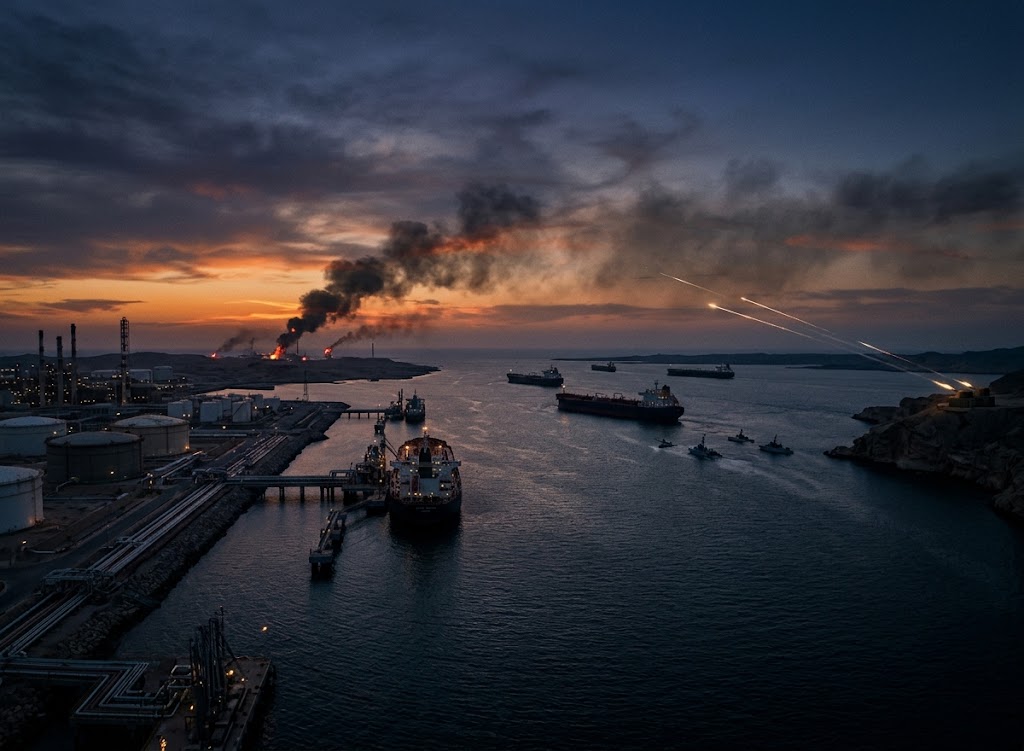
Oil prices hit their highest since May amid Houthi strikes on Saudi Arabia, Strait of Hormuz risks and fresh supply disruptions
By The Pulseline News Desk
Global oil prices reportedly surged to their highest levels since May on Thursday as renewed Houthi attacks on Saudi Arabia and escalating tensions across the Middle East heightened concerns over disruptions to crude supplies from one of the world’s most important oil-producing regions.
Brent crude futures rose by $3.35, or 3.08%, to $112.17 a barrel by 0818 GMT, after reaching $112.55 earlier in the session, the highest level since May 18.
US West Texas Intermediate (WTI) crude has also advanced, gaining $2.68, or 2.76%, to $99.83 a barrel.
The rally reflects growing market concerns that attacks on oil infrastructure, threats to shipping through the Strait of Hormuz and the widening regional conflict could undermine global energy supplies, even as some exports from the Middle East recover.
Middle East tensions drive market uncertainty
The latest price increases followed attacks by Yemen’s Iran-aligned Houthi movement on several targets in Saudi Arabia on Wednesday.
At least one person was killed and eight others wounded at a civilian airport in Dammam, while two people were reportedly killed in a drone attack on a Saudi oil field.
The attacks have intensified concerns over the security of Saudi Arabia’s energy infrastructure and the potential for further escalation across the Gulf.
The United States (US) has also ordered some diplomats and their family members to leave its missions in Saudi Arabia and plans to withdraw family members from several other US diplomatic missions in the Middle East, US officials have told Reuters.
Meanwhile, explosions were reported in Sirik in southern Iran on Wednesday. Iranian media has said the nature and origin of the explosions remained unknown.
Iran’s Islamic Revolutionary Guard Corps Navy has said on Thursday that four vessels allegedly involved in illegal oil transfers in the northern Gulf had been struck and caught fire after being tracked by its forces a day earlier.
The IRGC has also said three other vessels had collided with mines west of the Strait of Hormuz and warned the US military that continued provocations could trigger a wider response against its regional bases.
The developments have added to uncertainty surrounding oil shipments through the Gulf, particularly the Strait of Hormuz, a critical maritime route for international energy trade.
Supply concerns outweigh export recovery
Despite signs of a recovery in Middle Eastern oil exports, analysts have said the threat of further attacks and shipping disruptions continues to underpin prices.
PVM Oil analyst Tamas Varga has said diplomatic efforts to ease tensions in Ukraine and the Middle East lacked credibility, with attacks on ships in the Strait of Hormuz and Houthi strikes on Saudi Arabia and its oil infrastructure outweighing reports of crude exports returning to pre-conflict levels.
Varga has said he did not anticipate de-escalation before the US midterm elections, suggesting that oil prices could remain elevated amid continued geopolitical uncertainty.
Morgan Stanley analysts have estimated that Middle Eastern crude oil exports stood at approximately 17 million barrels per day last week.
However, export volumes alone may not reassure markets if the security of shipping routes and energy infrastructure remains under threat.
Further disruptions could tighten available supplies, increase transportation and insurance costs, and intensify competition among major oil-importing countries.
Libya disruption adds to supply pressures
Supply-side concerns have also emerged outside the Middle East.
Libya’s National Oil Corporation has said a valve on an oil pipeline connecting the Hamada and Tahara oilfields to Zawiya port had been shut, forcing production cuts at both fields.
The disruption has added another source of uncertainty to global oil markets already facing risks from the conflicts involving Iran, Israel, the US and Russia’s war in Ukraine.
With oil prices elevated, governments and energy markets are increasingly focused on the availability of alternative supplies and measures to cushion consumers from rising fuel costs.
US considers emergency heating oil reserve
In an effort to contain energy prices that have surged amid diesel shortages linked to the US-Israeli war with Iran and the war in Ukraine, the Trump administration is offering to lend nearly one-third of the US’ one-million-barrel emergency heating oil reserve.
The move highlights the pressure on policymakers to address rising energy costs as geopolitical developments continue to threaten supply stability.
However, measures involving emergency reserves may provide only limited relief if disruptions persist or expand across major oil-producing and transportation hubs.
Ukraine peace talks offer uncertain relief
Separately, Russian President Vladimir Putin has hosted US Special Envoy Steve Witkoff in St Petersburg for discussions on ending the war in Ukraine.
The Kremlin has said Putin had agreed to resume US-mediated peace talks with Ukraine as soon as next month.
Ukrainian President Volodymyr Zelenskiy has said he supported the proposed talks and hoped they would begin as soon as possible.
Any progress towards ending the war could help ease one source of geopolitical uncertainty affecting energy markets. However, the immediate outlook remains clouded by escalating tensions in the Middle East and the risk of further supply disruptions.
For oil markets, the central concern is whether crude production and exports can continue without major interruptions as regional hostilities intensify.












Leave a comment