
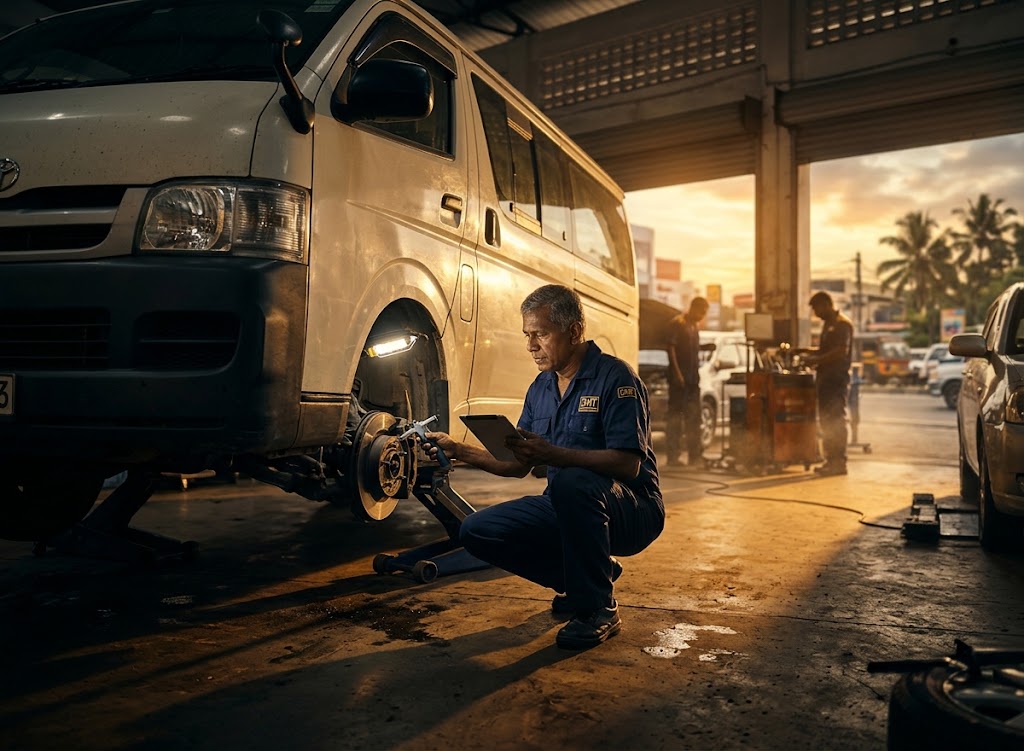
New system to require safety certification in addition to emission tests; inspection intervals and vehicle categories yet to be finalised
By The Pulseline News Desk
Sri Lanka is planning to introduce mandatory roadworthiness tests for vehicles from early 2027, requiring vehicle owners to obtain safety certificates in addition to the emission test certificates currently in force.
The proposed system is being developed by the Department of Motor Traffic (DMT) as part of efforts to improve road safety and address risks posed by mechanically defective vehicles.
Commissioner General of Motor Traffic, retired Air Marshal Thushara Fernando, has said the initiative was still under discussion and had been referred to the department’s legal division for review.
Speaking at a media briefing today (22), Fernando has said the programme was being developed under the guidance of the Transport Minister, with the aim of strengthening vehicle safety standards.
Under the proposal, vehicle owners would be required to obtain a roadworthiness certificate from an authorised garage, in addition to the existing vehicle emission test certificate.
The department is considering conducting inspections at intervals of approximately 5,000 kilometres or three months. However, the final inspection frequency and requirements have yet to be confirmed.
Garages to be selected
The DMT has called for applications from garages interested in carrying out the proposed inspections.
Fernando has said suitable garages would be selected based on criteria established by the department, indicating that the system would rely on authorised facilities to assess whether vehicles meet the required safety standards.
However, the department has not yet clarified whether the requirement would apply to all vehicles or be limited to particular categories, such as passenger transport and commercial vehicles.
The scope of the programme, the specific components to be inspected and the procedures for issuing certificates remain under consideration.
Akurana accident highlights safety concerns
The proposed initiative comes amid renewed concerns over the mechanical condition of vehicles following serious road accidents.
Fernando has referred to the recent fatal accident in Akurana involving a heavy vehicle transporting cement, which reportedly suffered brake failure while travelling downhill before crashing into several other vehicles.
The incident highlighted the potential consequences of mechanical failures, particularly involving heavy vehicles operating on roads with steep gradients.
A mandatory roadworthiness testing system could provide an additional mechanism for identifying mechanical defects before vehicles are permitted to continue operating on public roads.
While the existing emission testing programme focuses on vehicle exhaust emissions, the proposed system would introduce a separate assessment of vehicle safety and mechanical condition.
Legal review underway
The proposed roadworthiness testing system has not yet been finalised, with the DMT continuing discussions and reviewing the legal framework required for its introduction.
Although the department is targeting early 2027 for implementation, the final requirements, inspection intervals, eligible vehicle categories and procedures for enforcing compliance have yet to be announced.
Further details are expected once the department completes its review and establishes the criteria governing the inspections.
The effectiveness of the proposed system will depend on the standards adopted, the capacity of authorised garages to conduct reliable inspections and the enforcement mechanisms introduced to ensure that vehicles meet the required safety conditions.













Leave a comment