
Visit by European ambassadors draws demonstrators demanding international accountability and the repeal of the PTA as a condition of trade concessions
By The Pulseline News Desk
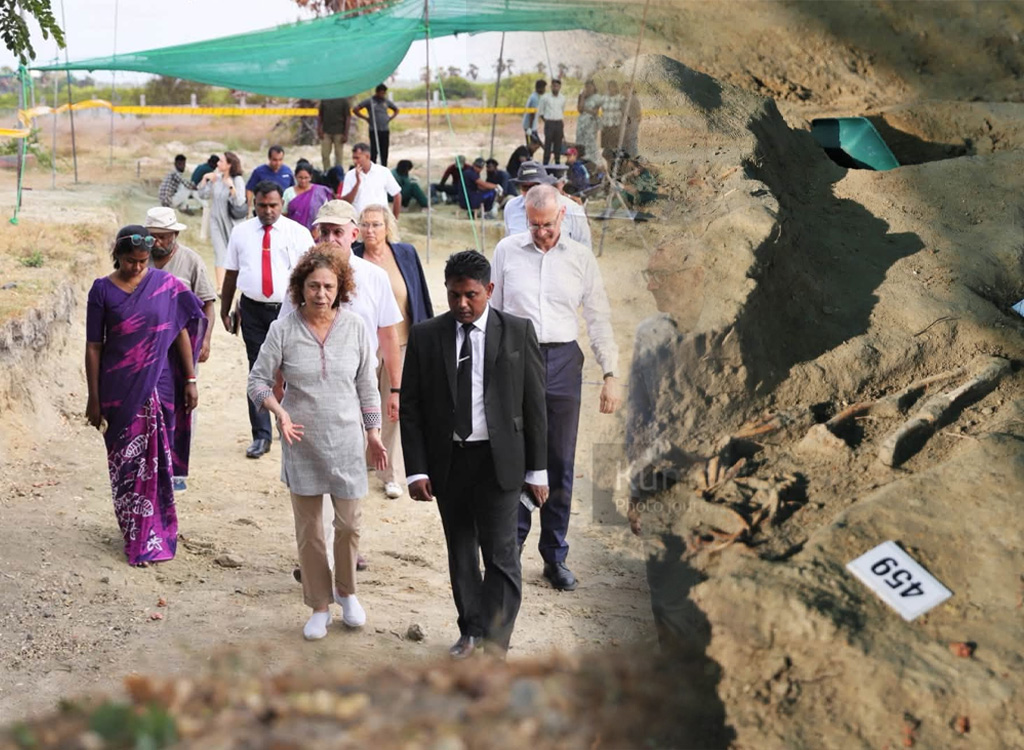
A European Union (EU) delegation visiting Sri Lanka’s largest mass grave, at Chemmani on the outskirts of Jaffna, was met by a protest demanding international intervention and accountability, as excavators confirmed that 467 bodies have now been recovered from the site.
Forensic archaeologist Prof. Raj Somadeva briefed the visiting delegation on the progress of the excavation and its findings so far. The visit unfolded under heavy police presence, with demonstrators gathering at the site to press their case directly to the diplomats.
Yogarasa Kanagaranjani, Chairperson of the Association of Relatives of the Enforced Disappeared in the Northern and Eastern Provinces, presented the group’s demands to the delegation. Protesters made clear they no longer trust Sri Lanka’s domestic justice system to deliver truth, justice, or accountability, pointing to decades in which, they argue, that system has failed to do so.
Demonstrators also tied their demands to a wider political lever: the repeal of the Prevention of Terrorism Act (PTA), which they want treated as a precondition for Sri Lanka’s continued access to the EU’s GSP+ trade concessions.
A grave that has loomed since 1998
Chemmani first entered public consciousness in 1998, when it emerged in connection with the abduction, gang rape and murder of schoolgirl Krishanti Kumaraswamy and three others by army personnel — a case that led to the conviction of a soldier and put a spotlight on the site for the first time. Excavations that year, conducted under international observation, recovered 15 sets of remains, two of which were later identified as men who had disappeared in 1996. Despite charges brought against seven military personnel at the time, the investigation stalled for years, with no further remains uncovered for nearly two decades.
The site returned to the centre of national attention in February 2025, when workers carrying out routine construction work had struck human remains. The Jaffna Magistrate’s Court ordered a judicial examination, and court-supervised excavations began that May.
What followed has been a slow, repeatedly interrupted dig. The first and second phases of excavation, running over dozens of days, pushed the recovered total past 240 sets of remains before work was suspended last September due to a funding gap at the Ministry of Justice. Recovered alongside the skeletons were objects that families and investigators alike have described as difficult to look past: infant feeding bottles, a doll, children’s toys, bags and shoes — physical traces suggesting that entire families may have been buried at the site.
Excavations resumed in April this year after the ministry released fresh funding, under a court order that authorised a third phase of work running 56 days. By late July, across all three phases, investigators had logged 92 total days of excavation and recovered 467 skeletal remains, including several belonging to children.
International attention, growing pressure
The renewed dig has drawn a level of international scrutiny rarely seen at a domestic Sri Lankan investigation. UN High Commissioner for Human Rights Volker Türk visited the site in mid-2025, describing it as an emotionally difficult place where the country’s past becomes starkly visible. The Jaffna Magistrate’s Court has since granted standing permission for diplomatic representatives from the EU, France, Germany, Italy and Romania to observe excavation work directly — an arrangement that reflects, in part, sustained pressure from Tamil families and rights groups who argue that domestic mechanisms alone lack the credibility to deliver a genuine accounting of what happened.
That credibility gap is precisely what protesters raised with the visiting EU delegation, led by EU Ambassador Carmen Moreno alongside envoys from Italy, Germany, France and the Netherlands. For families who have waited years — in some cases decades — for answers about relatives who disappeared during and after Sri Lanka’s civil war, the presence of foreign diplomats at the graveside is less a diplomatic courtesy than a demand: that the outside world not look away while the excavation, and the accountability process around it, continues to unfold.
The GSP+ leverage point
The protesters’ call to link the PTA’s repeal to GSP+ trade concessions is not a new demand, but it lands with particular weight against the backdrop of Chemmani. GSP+ grants Sri Lankan exporters preferential access to European markets, in exchange for the country’s continued commitment to a set of international human rights and governance conventions. The PTA — long criticised by rights groups for enabling prolonged detention without trial — has repeatedly been cited by the EU as a point of concern in that relationship.
By raising the issue directly at Chemmani, protesters are pressing the EU to treat the mass grave not as an isolated forensic story, but as part of a broader pattern the EU is already monitoring through its trade relationship with Colombo — and to use that economic leverage to push for legal reform that domestic politics alone has so far failed to deliver.








Leave a comment