
By The Pulseline News Desk
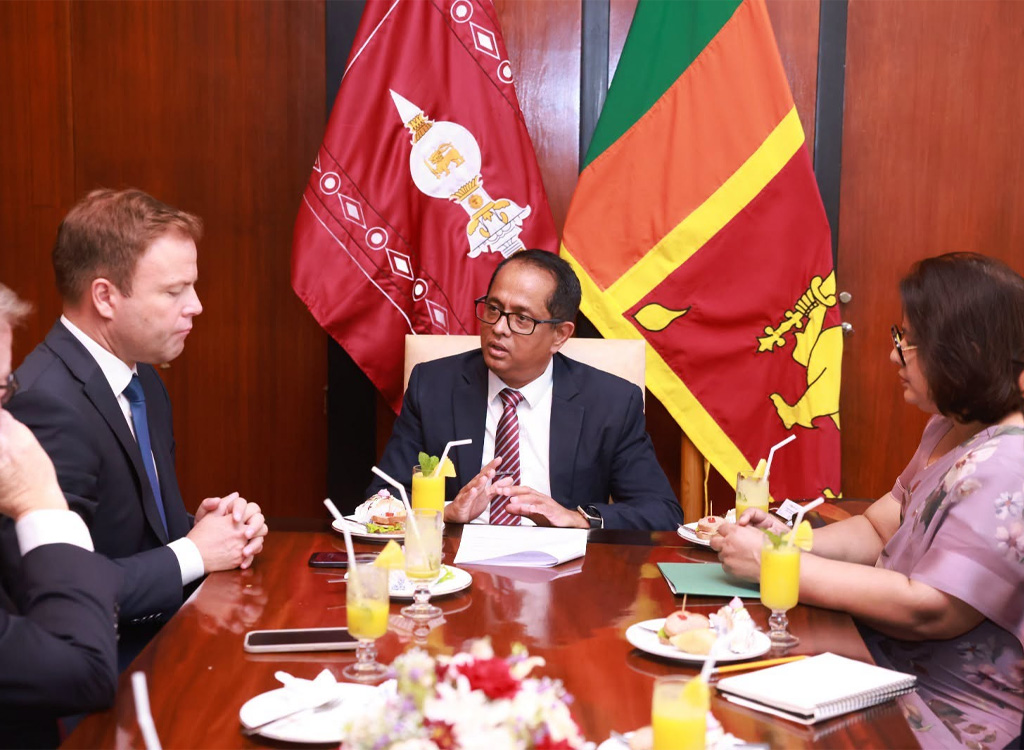
A visiting delegation from the European Parliament has held a series of discussions with Sri Lankan parliamentary leaders and lawmakers, focusing on democratic governance, constitutional reform, human rights and the country’s continued engagement with the European Union’s GSP+ framework.
The delegation, led by European Parliament Member Prof. Sven Simon, Chair of the European Parliament’s Committee on Constitutional Affairs (AFCO), had met Speaker of Parliament Jagath Wickramaratne on September 24, with parliamentary cooperation and Sri Lanka’s ongoing reform agenda among the key issues discussed.
During the meeting, the Speaker has highlighted Sri Lanka’s continued engagement with the EU under the Generalised Scheme of Preferences Plus (GSP+) and its contribution to the country’s socio-economic development and alignment with international standards.
Wickramaratne has also briefed the delegation on measures being taken in areas including law and order, combating corruption, reconciliation, human rights, women’s political representation and the rights of persons with disabilities.
The discussions come as Sri Lanka continues to navigate a broad reform agenda following its economic crisis, while seeking to strengthen democratic institutions and maintain access to key international markets.
The European Parliament delegation has also met Deputy Speaker Dr. Rizvie Salih, with discussions covering Sri Lanka’s socio-economic situation, political system and the ongoing constitutional amendment process.
Particular attention was given to the proposed 22nd Amendment to the Constitution, which has become a major issue of political and legal debate in Parliament and outside it.
The delegation had included MEP Ralf Seekatz, as well as policy advisers associated with the European People’s Party (EPP) Group, the Konrad-Adenauer-Stiftung (KAS) offices in Singapore and Brussels, and representatives of the Institute for Democratic Alignment and Governance (IDAG).
The European visitors have also held separate discussions with government and opposition MPs.
Those meetings had provided an opportunity for the delegation to hear different perspectives on Sri Lanka’s current political landscape, the challenges facing democratic institutions and the background to the proposed 22nd Amendment.
The focus on GSP+ is particularly significant for Sri Lanka, as the trade concession provides preferential access to the European market while being linked to commitments relating to human rights, labour standards, environmental protection and good governance.
Against this backdrop, the European Parliament delegation’s engagement with both government and opposition lawmakers also underscored the EU’s interest in Sri Lanka’s institutional and constitutional development alongside its economic relationship with the country.
The series of meetings have therefore provided a broad platform for discussions extending beyond trade preferences, encompassing Sri Lanka’s political reforms, democratic institutions and constitutional changes at a time when the country is seeking to consolidate its post-crisis recovery and strengthen its international partnerships.











Leave a comment