
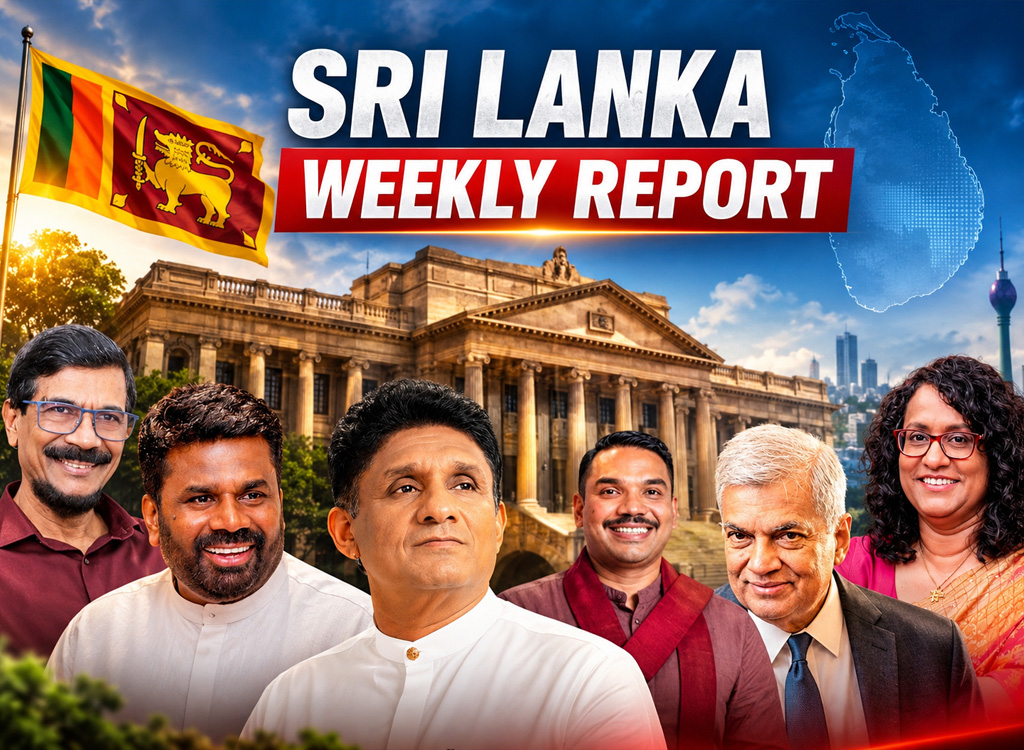
What happened, what mattered and what comes next
WHAT HAPPENED
ECONOMY, FISCAL POLICY AND COST OF LIVING
Fuel prices increased during the week, with Ceypetco raising Auto Diesel by Rs.5 to Rs.397, Super Diesel by Rs.15 to Rs.543, Octane 92 by Rs.10 to Rs.424 and Octane 95 by Rs.15 to Rs.490 per liter. Lanka IOC and Sinopec initially matched the increases before raising their Octane 95 prices by a further Rs.20 to Rs.515.
Sri Lanka’s official reserve assets increased by 3.2% to US$7.086 billion in October, from US$6.867 billion in September. The figure includes proceeds from the People’s Bank of China swap arrangement.
The country’s outstanding tax arrears reached Rs.2.1 trillion by end-2025, according to an IMF technical assistance report. Approximately three-quarters of the amount involves tax assessments subject to appeals or other disputes.
The Government has introduced a Medium-Term Revenue Strategy for 2027–2031, targeting an increase in tax revenue to 17% of GDP by 2031 through broadening the tax base, improving compliance and strengthening revenue administration.
Implementation of compulsory TIN submission for eight essential transactions has been postponed until April 1, 2027.
Sri Lanka’s fuel import expenditure could reach a record US$5.5 billion this year. Meanwhile, household expenditure averaged Rs.116,191 per month in early 2025, reflecting the continuing pressure of higher prices.
The national poverty line increased to Rs.17,742 per person monthly in September 2026, an 8.1% increase year-on-year. Separately, the poverty headcount ratio rose to 16% in the first quarter of 2025, compared with 14.3% in 2019.
ENERGY, INFRASTRUCTURE AND STATE-OWNED ENTERPRISES
The National System Operator (NSO) withdrew its request for a 2.88% electricity tariff increase for the fourth quarter following public consultation. The Public Utilities Commission of Sri Lanka (PUCSL) had recommended a lower increase of 1.46%.
Investigations into the October 17 islandwide power failure identified a sudden collapse in generation at Norochcholai Unit 1. Its output reportedly plunged from 187MW to just 5MW within 450 milliseconds, triggering a chain of events that resulted in the nationwide blackout.
Cabinet approved major electricity infrastructure contracts involving Ceylex Engineering and China’s Xingneng Electric Power Construction. These include the Sampur–Kappalthurai transmission project and Sri Lanka’s first utility-scale battery energy storage system.
The Government has commenced liquidation proceedings involving 33 selected State-Owned Enterprises as part of its restructuring programme. This is despite 51 SOEs collectively reporting profits of Rs.259 billion during the first six months of 2026.
The Cabinet-appointed negotiating committee recommended permanently cancelling the proposed Hambantota Sinopec oil refinery agreement, citing unfavourable investment conditions and concerns over economic sovereignty.
POLITICS, GOVERNANCE AND THE RULE OF LAW
The Government proposed establishing a Parliamentary Select Committee to investigate the 1983 Black July violence and its consequences.
President Anura Kumara Dissanayake warned that a powerful criminal shadow state had emerged, with drug traffickers and organised criminal networks allegedly using their financial resources to infiltrate political structures.
A delegation from the Chinese Communist Party is expected to visit Sri Lanka to share experiences in party organisation, internal discipline and organisational management with the JVP.
The Elections Commission announced changes under the revised parliamentary electoral system, increasing Colombo District’s parliamentary representation from 18 to 19 seats while reducing Badulla’s from nine to eight. It also classified the Sri Lanka Freedom Party as experiencing internal conflicts.
The Judicial Service Commission transferred Gampaha Magistrate Bandula Gunaratne to the Judges’ Training Institute. The transfer attracted considerable public criticism, particularly because the magistrate had initiated contempt proceedings against IGP Priyantha Weerasooriya.
The Commission to Investigate Allegations of Bribery or Corruption (CIABOC) reportedly decided to investigate the assets of Deputy Minister Sunil Watagala and former Energy Minister Kumara Jayakody following preliminary inquiries.
LAW ENFORCEMENT, CORRUPTION AND CRIMINAL INVESTIGATIONS
Law enforcement agencies reported several major drug seizures during the week.
These included 13.34kg of heroin and 1.062kg of ICE discovered at a checkpoint in Pooneryn; 3.649kg of heroin, 2.109kg of ICE and 558g of kush recovered from a property in Madiwela; and more than 2kg of kush and 5kg of hashish recovered from an Indian national at BIA.
In a major maritime operation, the Navy intercepted a fishing trawler off the southern coast carrying more than 50kg of heroin and 100kg of ICE, valued at over Rs.3 billion. Five crew members were arrested.
Twelve Chinese, three Bangladeshi and six Indian nationals were arrested in Maradana over alleged involvement in online scams.
An underworld figure, Manoj Muthukumar alias Kaiwaru Muthu, was deported from Sharjah and arrested by the CID upon arrival. An inmate at Dumbara Prison was shot dead by prison guards while allegedly attempting to escape.
A total of 4,056 firearms and weapons have reportedly been seized over the past two years, including 97 T-56 rifles, one AK-47, 143 pistols, 105 revolvers and 397 shotguns.
The Government is planning to install CCTV cameras at every police station to strengthen accountability and prevent custodial deaths and abuses.
In other investigations:
Chief Inspector Varuni Bogahawatte was arrested by the CID over alleged money laundering and remanded until November 6.
An official of a private bank was arrested in Kotahena over an alleged scheme involving fictitious entities used to transfer dollars into foreign bank accounts.
Customs seized 457 cartons of cigarettes smuggled from India using forged documents, valued at Rs.792 million.
A Colombo court ordered the arrest of individuals allegedly involved in using loudspeakers without a permit during a protest at Vihara Mahadevi Park.
The Colombo High Court ordered a three-month freeze on bank accounts and restrictions on vehicles belonging to Rakitha Rajapakshe, son of former Minister Wijeyadasa Rajapakshe.
The Police Media Spokesperson disclosed that 11,131 children, including 233 girls, had been taken into police custody for various offences since October 30, 2025.
SECURITY LEGISLATION, HUMAN RIGHTS AND JUDICIAL DEVELOPMENTS
Twenty-six Special Determination petitions were filed before the Supreme Court challenging the constitutionality of the proposed Prevention of Organised Crimes Bill.
President’s Counsel Eraj de Silva warned that the Bill’s broad definitions and extensive investigative powers could expose legitimate businesses, professionals and ordinary citizens to arbitrary arrest and detention.
The proposed Prevention of Organised Crimes Bill and Protection of the State from Terrorism Bill, together with amendments to the century-old Trusts Ordinance, generated considerable parliamentary controversy. Opposition MPs and commercial sector representatives raised concerns about the expanding legislative powers of the State and potential implications for civil liberties and investment confidence.
The Supreme Court ruled that a police constable attached to Dompe Police Station had violated a woman’s fundamental rights through physical assault. The officer was ordered to pay Rs.100,000 in compensation personally within six months.
COURTS, POLITICAL FIGURES AND HIGH-PROFILE CASES
Several cases involving prominent political figures progressed during the week.
MP Namal Rajapaksa was released on bail by the Colombo Chief Magistrate after being remanded over an alleged Rs.70 million bribery case involving the Krrish Group. However, he remains in remand over another case.
Daisy Forrest was released from the money laundering proceedings involving Yoshitha Rajapaksa after the Colombo High Court determined that she was mentally unfit to face the continuation of the case.
An amended indictment on money laundering charges was read to Yoshitha Rajapaksa, with the pre-trial conference scheduled for December 2.
The Colombo High Court granted bail to former Foreign Minister Rohitha Bogollagama, who had been remanded for failing to appear in court after previously being released on bail over corruption charges.
The Permanent High Court Trial-at-Bar scheduled January 28 for the pre-trial conference in the Central Bank bond scam case involving former Governor Arjuna Mahendran and nine other defendants.
A decision on former President Gotabaya Rajapaksa’s request to lift his foreign travel ban is scheduled for November 25.
MP Chamara Sampath and his private secretary were remanded until November 10 over allegations of irregularly issuing an export licence for phosphate.
TRADE, INVESTMENT AND INTERNATIONAL RELATIONS
Sri Lanka’s monthly exports reached a historic high in September 2026, led by industrial exports, including petroleum and machinery. However, the external current account returned to a deficit during the same month after recording a surplus in August.
Sri Lanka Customs exceeded its monthly revenue target for the 10th consecutive month in October, achieving the target before the month ended.
The Government is preparing to reapply for the European Union’s GSP+ preferential trade concessions under a new 10-year framework beginning in 2027.
Cabinet approved a €10 million grant agreement with the European Union for a sustainable trade promotion project.
Sri Lanka launched One TRADE, a national single-window digital platform for cross-border trade transactions, providing legal recognition for electronic documentation across key import and export processes.
The Export Development Board and SLASSCOM engaged with senior police officials to expedite police clearance reports for ICT professionals, following concerns that delays were affecting access to international business opportunities.
Opposition MPs questioned the Government’s decision to introduce technical import barriers on tyres without adequately assessing domestic production capacity or market shares, warning of possible market favouritism and duopolistic exploitation.
The Port City Commission disclosed to Parliament’s Committee on Public Finance that approximately 14,300 visas had been facilitated through its recommendation arrangements, despite the Commission having a staff of only 16.
EDUCATION, HEALTH AND SOCIAL DEVELOPMENT
Sri Lanka is also expected to receive 47 new ambulances through ADB loan assistance.
Eight of Sri Lanka’s 12 featured public universities recorded declines in the QS Asia University Rankings 2027. The University of Colombo fell 46 places to 364th, while Peradeniya and Sri Jayewardenepura dropped to 389th and 398th respectively.
UN Women launched its report, Beyond Numbers, examining the impact of Sri Lanka’s 25% women’s representation quota in local government. It called for greater emphasis on meaningful political participation, leadership and decision-making rather than numerical representation alone.
A study by Global Unites South Asia and the Centenary Movement found that nearly half of Sri Lanka’s young people would leave the country if given the opportunity, citing economic hardship, limited employment opportunities and uncertainty about the future.
TOURISM, ENERGY SECURITY AND NATIONAL DEFENCE
Three LP Gas shipments are expected between November 12 and 28. Laugfs Gas is also reportedly working with authorities to obtain approvals for domestic supplies through its Hambantota terminal.
Sri Lanka plans to procure four advanced unmanned aerial vehicles from Israel at a cost of Rs.4.261 billion to strengthen maritime surveillance, monitor suspicious vessels and improve disaster-response capabilities.
Severe Cyclonic Storm Murasu passed along Sri Lanka’s northern coastline, from Mannar to Trincomalee via Kankesanthurai, without causing reported damage. However, a torrential downpour in Colombo flooded the city, resulting in the Mayor calling for an emergency meeting.
WEEK IN NUMBERS
Official foreign reserves (October)| US$7.086 billion
Increase in foreign reserves| 3.2%
Outstanding tax arrears| Rs.2.1 trillion
Government’s 2031 tax revenue target| 17% of GDP
Projected 2026 fuel import expenditure| US$5.5 billion
Poverty line (September 2026)| Rs.17,742 per person/month
Household expenditure (early 2025)| Rs.116,191 per month
Poverty headcount (Q1 2025)| 16%
Narcotics seized from southern fishing trawler| Over Rs.3 billion
Total firearms and weapons seized (two years)| 4,056
Cigarettes seized by Customs| Rs.792 million
Children taken into police custody (since October 30, 2025)| 11,131
ADB financing – Water and Sanitation| US$100 million
ADB financing – Skills Development| US$100 million
Proposed UAV procurement| Rs.4.261 billion
Proposed EU sustainable trade grant| €10 million
Monthly export performance (September)| Historical record
Consecutive months Customs exceeded revenue targets| 10
Young people considering leaving Sri Lanka| Nearly 50%
Public universities recording declines in QS Asia rankings| 8 of 12
WHAT MATTERED – The deeper story
The first week of November highlighted the growing divide between Sri Lanka’s improving macroeconomic indicators and the continuing economic insecurity experienced by ordinary households.
Rising foreign reserves, record monthly exports and sustained Customs revenue collection provide encouraging signs of economic stabilisation. Yet higher fuel prices, increasing poverty, rising household expenditure and substantial outstanding tax arrears demonstrate that recovery remains incomplete. The challenge is no longer simply restoring economic stability but ensuring that its benefits are more widely distributed.
The Government’s decisions on state-owned enterprises, energy infrastructure and the proposed Sinopec refinery agreement will have significant implications for the country’s long-term economic direction. These decisions need to be guided by transparent commercial assessments rather than political considerations.
Governance and institutional independence remain equally important concerns. The controversy surrounding the transfer of the Gampaha Magistrate, the proposed security legislation and continuing questions about police accountability have placed the Government’s commitment to the rule of law under scrutiny.
The President’s warning about a criminal shadow state is particularly significant. The scale of narcotics seizures and the reported infiltration of political structures by organised criminal networks underline the seriousness of the threat. However, the Government’s credibility will ultimately depend on whether investigations extend to influential political and institutional connections, irrespective of position or affiliation.
The proposed Prevention of Organised Crimes Bill and Protection of the State from Terrorism Bill also present a critical test. Combating organised crime and terrorism is a legitimate responsibility of the State, but legislation must not create opportunities for arbitrary enforcement, suppress dissent or undermine judicial safeguards. The implications extend beyond human rights to commercial confidence and investor perceptions of institutional stability.
The findings on youth migration, declining university rankings and persistent poverty point to deeper structural challenges that cannot be resolved through fiscal adjustments alone.
Ultimately, the defining event of the coming week will be the presentation of Budget 2027. It will provide a clearer indication of whether the Government intends to move beyond crisis management towards an economic model capable of delivering sustainable growth, employment and improved living standards.
The central challenge remains translating economic recovery into tangible improvements in people’s lives while preserving the democratic institutions and safeguards essential to the country’s long-term stability.
WEEK AHEAD
November 10: Further proceedings in the phosphate export licence case involving MP Chamara Sampath.
November 12: President Anura Kumara Dissanayake is scheduled to present the 2027 Budget. Its proposals will be closely scrutinised for their impact on household incomes, taxation, public expenditure, investment and IMF commitments.
November 20: Further remand proceedings involving Chief Inspector Varuni Bogahawatte and four others.
November 25: Court decision on former President Gotabaya Rajapaksa’s application to remove his foreign travel restriction.
December 2: Pre-trial conference in the money laundering case against Yoshitha Rajapaksa.
January 28, 2027: Pre-trial conference in the Central Bank bond scam case involving former Governor Arjuna Mahendran and nine other defendants.







Leave a comment