
By The Pulseline News Desk
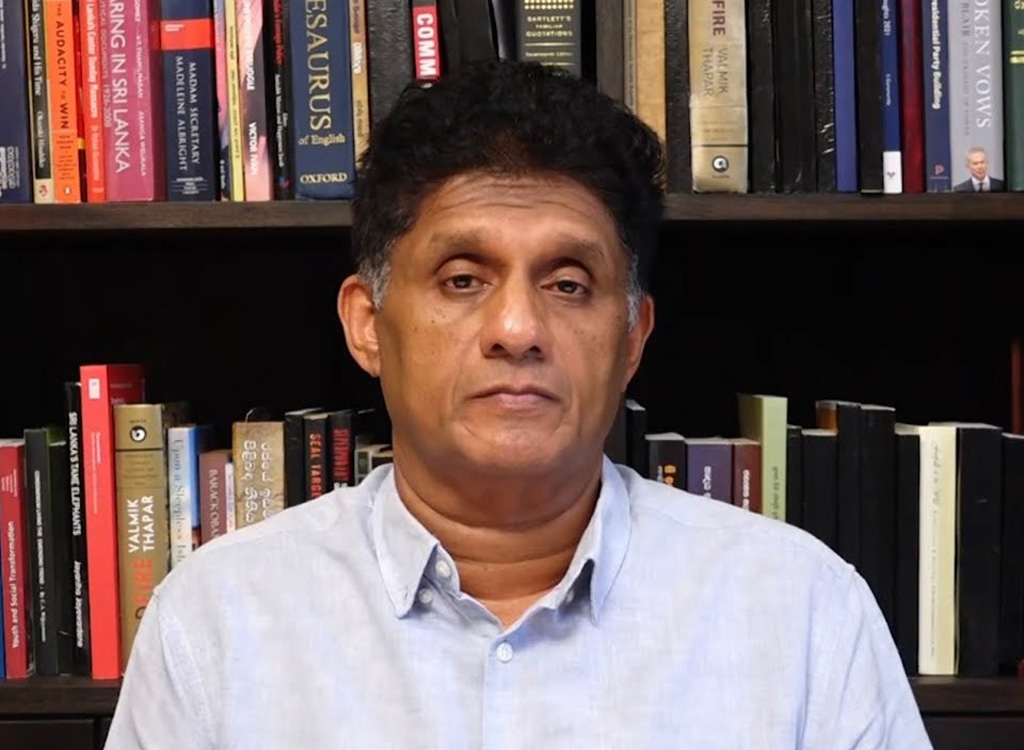
Opposition Leader Sajith Premadasa has launched a strong challenge against the Government’s newly released socio-economic data report, accusing the authorities of presenting an incomplete picture of poverty and living conditions by relying on outdated household data.
Premadasa made the allegations on Tuesday (29), a day after the Central Bank of Sri Lanka (CBSL) released its “Sri Lanka Socio-Economic Data – 2026” publication, the 49th edition of its annual data folder covering areas ranging from economic indicators and socio-economic conditions to employment, trade, government finance and monetary statistics.
The Opposition Leader questioned why the Government had incorporated relatively recent information for several major economic indicators while relying on much older household income, expenditure and poverty data in its assessment of socio-economic conditions.
According to Premadasa, the discrepancy raises a fundamental question over whether the Government is presenting an accurate picture of the economic hardship being experienced by households following the country’s economic crisis.
The poverty data controversy
Premadasa argued that the section of the report dealing with socio-economic conditions relies heavily on data from the 2016-2019 Household Income and Expenditure Survey (HIES) period, including indicators relating to household income and expenditure, poverty, housing, energy consumption and dietary consumption.
The CBSL itself describes the 2026 publication as a concise compilation of socio-economic data intended for policymakers, researchers, academics, professionals and the public.
The criticism therefore centres not on the inclusion of historical statistics itself, but on whether such data can adequately describe the current scale of poverty and household hardship in 2026.
Premadasa accused the Government of using recent data when discussing areas such as macroeconomic indicators, trade, finance, employment and other economic developments, while failing to similarly update the poverty and living-standards indicators.
He questioned why poverty should be measured using an older statistical base at a time when Sri Lankan households have undergone major changes in incomes, prices, employment and consumption following the 2022 economic crisis.
Fresh poverty data is still pending
However, the statistical picture is more complicated than simply comparing the 2026 publication with a single poverty figure.
The Department of Census and Statistics is in the process of releasing results from the 2025 Household Income and Expenditure Survey. Its current release calendar lists the HIES 2025 poverty indicators bulletin for 30 October 2026, with a revised date of 31 December 2026.
This means that the latest comprehensive household survey-based poverty indicators were not yet available when the CBSL’s 2026 data folder was released on September 28.
At the same time, the Department of Census and Statistics does publish an updated monthly official poverty line. The national poverty line stood at Rs. 17,679 per person for July 2026, according to the Department’s latest available figures.
That distinction is significant: a monthly poverty-line figure and a nationwide poverty headcount derived from a household survey are not the same statistic.
Sajith questions the Rs. 17,315 figure
Premadasa nevertheless challenged the use of the figure of Rs. 17,315 in the Government’s presentation, arguing that such a threshold could not adequately reflect the cost of surviving in present-day Sri Lanka.
The Department of Census and Statistics’ published series shows that Rs. 17,315 was the national poverty line for May 2026, while the figure had risen to Rs. 17,679 by July.
The Opposition Leader argued that poverty measurement should take into account the rapid changes in household purchasing power, food prices, employment and real incomes since the economic crisis.
He also questioned whether the Government’s forthcoming 2027 Budget, scheduled for November 12, would be prepared using an accurate assessment of poverty and household vulnerability.
World Bank figures add another dimension
Premadasa also referred to World Bank poverty estimates to argue that the country’s economic recovery has not translated into a full recovery in household welfare.
The World Bank’s recent assessments have indeed stressed that Sri Lanka’s recovery remains incomplete and that poverty remains significantly elevated compared with the pre-crisis period. Its 2025 Sri Lanka Development Update estimated poverty at 24.5% in 2024 using the $3.65-per-person-per-day poverty line, more than twice the 2019 level.
However, poverty rates depend heavily on the poverty line and methodology being used. The World Bank maintains multiple international poverty thresholds, including the $8.30-a-day line for upper-middle-income countries, measured at 2021 purchasing-power-parity prices.
Consequently, the 65.4% figure cited by Premadasa should not be treated as directly equivalent to Sri Lanka’s official national poverty rate without specifying the World Bank methodology, reference year and poverty threshold behind the estimate.
The World Bank’s current Sri Lanka data page also shows how different poverty measures can produce substantially different results and notes that the latest survey-based $3-a-day figure currently displayed for Sri Lanka dates to 2019.
The wider issue: measuring the post-crisis household
The dispute nevertheless points to a larger statistical problem facing Sri Lanka, which is the country’s economic recovery has moved faster than some of the comprehensive household-level data needed to measure its social consequences.
Sri Lanka has experienced significant changes in prices, wages, employment, migration, household consumption and access to welfare since the last major economic crisis.
The Central Bank’s 2026 publication contains a wide range of current indicators, while the Department of Census and Statistics is separately preparing the latest HIES-based poverty indicators.
This creates an important distinction between current macroeconomic statistics and survey-based measurements of household welfare.
The former can often be updated monthly or quarterly. The latter requires a comprehensive household survey, which takes substantially longer to conduct, process and publish.
Political dispute with a statistical consequence
Premadasa has framed the discrepancy as evidence that the Government is attempting to create a misleadingly positive picture of the country’s economic recovery.
He called on President Anura Kumara Dissanayake, the Government, the CBSL and the Department of Census and Statistics to explain why older poverty-related data appear alongside newer economic indicators.
He also urged the Government to release a revised assessment based on the latest available household information before presenting the 2027 Budget.










Leave a comment