
By The Pulseline News Desk
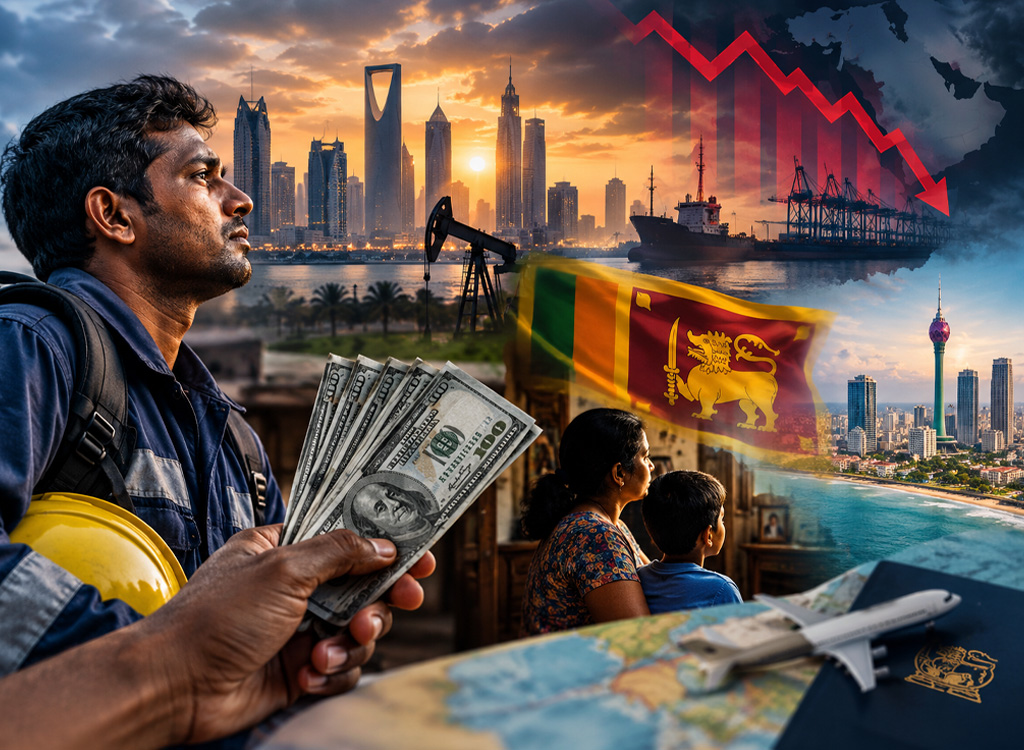
Sri Lanka’s remittance-driven economic recovery could face a fresh test as the International Monetary Fund (IMF) projects severe economic contractions across several Gulf countries that employ a large share of the country’s migrant workforce.
The IMF’s October 2026 World Economic Outlook (WEO), released on October 13 at the IMF-World Bank Group Annual Meetings in Bangkok, has forecasts sharp recessions in Kuwait, Qatar, Bahrain, the United Arab Emirates (UAE) and Saudi Arabia this year, raising concerns over the sustainability of one of Sri Lanka’s most important sources of foreign exchange.
Although remittances have remained resilient despite the ongoing conflict in the Middle East, recent data indicate that their growth has begun to moderate, potentially exposing Sri Lanka to the economic fallout from disruptions affecting its key overseas labour markets.
According to the IMF, Kuwait’s economy is projected to contract by 16.7% in 2026, followed by Qatar at 15.6% and Bahrain at 11.3%. The UAE is forecast to shrink by 3.9%, while Saudi Arabia is expected to record a contraction of 3.3%.
Oman is a notable exception, with economic growth projected at 4.1%.
The IMF has attributed the deteriorating outlook to disruptions to energy production and transportation, incorporating a prolonged closure of the strategically important Strait of Hormuz into its forecasts.
Saudi Arabia is expected to be less severely affected than some of its neighbours because of its more diversified export routes.
Growth across the Middle East and Central Asia is now projected at -0.3% for 2026, representing a downward revision of 2.2 percentage points from the IMF’s April forecast.
While the Fund expects the downturn to be temporary, the immediate economic consequences could have significant implications for countries such as Sri Lanka, whose foreign exchange earnings depend heavily on workers employed in the Gulf.
Remittances remain resilient, but growth slows
Sri Lanka has so far continued to record strong remittance inflows despite the escalating regional uncertainties.
Central Bank of Sri Lanka (CBSL) data has shown that workers’ remittances totalled US$6.13 billion during the first eight months of 2026, compared with US$5.12 billion in the corresponding period last year.
The increase has provided an important source of foreign exchange, supporting the country’s external position during its ongoing economic recovery.
However, the pace of growth has eased in recent months. Remittances increased by 26.5% year-on-year in the first quarter, before growth slowed to 9.3% in June and 10% in August.
The moderation does not, by itself, indicate that remittances are declining. Nevertheless, it raises questions about whether the strong growth recorded earlier in the year can be sustained if economic activity and employment conditions deteriorate across the Gulf.
The Central Bank has also cautioned that remittance figures may include other inflows, including funds received following Cyclone Ditwah, which could complicate assessments of underlying trends.
In March, CBSL Governor Dr. Nandalal Weerasinghe had said the Central Bank was closely monitoring early warning indicators, including labour market conditions in the Middle East.
Such monitoring is particularly important because a prolonged downturn could affect Sri Lanka through several channels, including reduced demand for migrant labour, slower wage growth and disruptions to workers’ ability to send money home.
Sri Lanka’s dependence on the Gulf
The potential risks are amplified by Sri Lanka’s continued reliance on the Middle East as a major source of remittances.
Research by the Institute of Policy Studies of Sri Lanka (IPS) has estimated that approximately half of the country’s remittance inflows originate from the region, highlighting the extent of Sri Lanka’s exposure despite efforts to diversify overseas employment opportunities.
Remittances are a critical source of foreign exchange for Sri Lanka, helping finance imports, strengthen external stability and support household consumption.
For many families, money sent by relatives working overseas also pays for essential expenses, including food, housing, education and healthcare.
A sustained deterioration in Gulf labour markets could therefore have consequences extending beyond the country’s balance of payments, potentially affecting household incomes and domestic demand.
The impact would depend on how the economic slowdown translates into employment conditions for migrant workers. A contraction in national output does not automatically mean widespread job losses among foreign workers, but prolonged disruptions to energy production, transport and other economic activities could increase the risks.
The slowdown also comes as Sri Lanka continues to work towards consolidating its post-crisis economic recovery, making the stability of foreign exchange inflows particularly important.
Sharp rebound expected in 2027
Despite the severe near-term outlook, the IMF expects Gulf economies to recover strongly in 2027 as energy production, exports and logistics return to normal.
Qatar’s economy is projected to expand by 18.8%, while Kuwait is expected to grow by 17.1% and Bahrain by 13.9%.
Saudi Arabia and the UAE are forecast to record growth of 7.9% and 7.7%, respectively.
These projections suggest that the economic shock could be followed by a substantial rebound if regional disruptions ease as anticipated.
However, the timing and strength of the recovery will be important for Sri Lanka. Even if Gulf economies return to growth next year, the consequences for employment and remittance flows could depend on how quickly businesses resume operations and labour demand recovers.
The IMF’s broader outlook also identifies remittances, tourism receipts and higher energy costs as important factors shaping the prospects of emerging and developing economies.
Small island developing states are particularly vulnerable, with the Fund warning that weaker tourism and remittance inflows, combined with rising energy costs, could constrain growth.
For Sri Lanka, these risks are interconnected. Any sustained weakness in remittances could reduce foreign exchange earnings at a time when higher energy costs could increase the import bill.
Diversification remains a longer-term challenge
The latest IMF projections underscore the importance of reducing Sri Lanka’s exposure to economic shocks in a single region.
Although the expected Gulf downturn may prove temporary, the country’s reliance on the Middle East means that external disruptions can quickly become a concern for foreign exchange stability and household welfare.
Expanding overseas employment opportunities in other markets, improving access to skilled and higher-paying jobs, and strengthening worker protections could help reduce some of these vulnerabilities over time.
For now, the resilience of remittances offers a degree of reassurance. The US$6.13 billion recorded in the first eight months of 2026 indicates that inflows have remained strong despite regional instability.
But the moderation in growth, combined with the IMF’s sharply downgraded forecasts for several Gulf economies, highlights the need for continued vigilance.
The central question for Sri Lanka is whether remittances can maintain their momentum if the economic shock in the Gulf deepens before the projected recovery in 2027.
For a country still rebuilding its external buffers and economic resilience, the answer could have significant implications for both macroeconomic stability and the livelihoods of households that depend on money earned overseas.













Leave a comment