
By The Pulseline News Desk
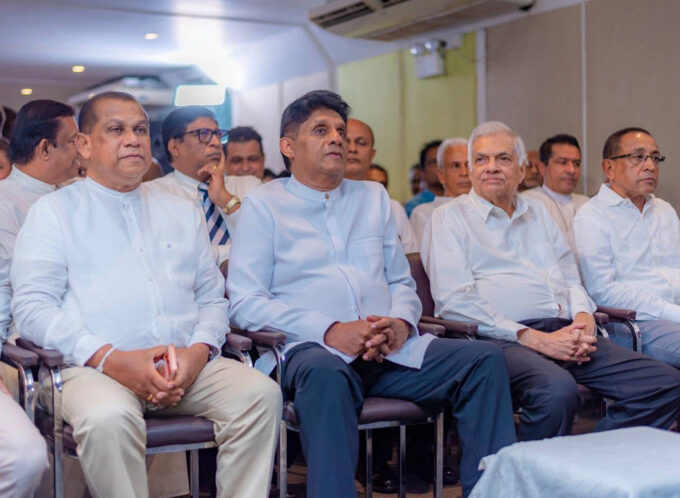
More than 20 political parties, trade unions and civil society groups came together in Colombo on Thursday (17) to unveil a joint accord focused on democratic governance, judicial independence and the protection of fundamental rights.
The agreement brings together major opposition parties represented in Parliament as well as political groups outside Parliament and representatives of organised civil society.
Among the parties listed to join the initiative are the Samagi Jana Balawegaya (SJB), United National Party (UNP), Sri Lanka Podujana Peramuna (SLPP), Sri Lanka Freedom Party (SLFP), Mahajana Eksath Peramuna, People’s United Opposition, Tamil Progressive Alliance, New Democratic Front, United Republic Front, Pivithuru Hela Urumaya, National Freedom Front and the Communist Party of Sri Lanka.
The initiative comes at a politically significant moment, with constitutional questions surrounding the independence and tenure of the superior judiciary having become a major point of public and political debate.
Judiciary at centre of wider constitutional debate
The proposed 22nd Amendment to the Constitution, which seeks to increase the retirement age of Supreme Court judges from 65 to 67 and Court of Appeal judges from 63 to 65, has already triggered a major constitutional challenge.
The Supreme Court heard petitions challenging the Bill, including arguments that changes affecting judicial independence and the sovereignty of the people could require approval at a referendum.
The controversy has consequently moved beyond the question of the retirement age itself, with lawyers and opposition groups debating the broader relationship between the Executive, Parliament and the Judiciary.
Professor G.L. Peiris, who convenes the People’s United Opposition, has repeatedly raised concerns about the proposed extension of judges’ tenure and has called for opposition groups to use democratic and legal means to challenge measures they consider harmful to democratic institutions.
An unusual coalition
The significance of the latest initiative lies partly in the breadth of the groups expected to participate.
Sri Lanka’s opposition remains divided across parties with markedly different political histories, ideological positions and constituencies. The proposed accord therefore does not necessarily represent the formation of a conventional political alliance.
Instead, the immediate focus appears to be on identifying issues on which these otherwise competing groups can work together — particularly the independence of state institutions, constitutional safeguards, the rule of law and fundamental rights.
The organisers have said discussions on the need for such a common platform have intensified in recent weeks amid concerns about the functioning of independent institutions and the preservation of democratic traditions.
The participation of parties outside Parliament, trade union representatives and civil society activists could also broaden the initiative beyond the traditional parliamentary Opposition.
From party politics to institutional questions
The emerging coalition also reflects a wider question confronting Sri Lanka’s political system: whether political parties with competing agendas can establish common ground on the rules governing the political system itself.
The proposed accord is expected to focus on institutional safeguards rather than a common economic or electoral programme.
That distinction could prove important.
The parties involved have previously taken sharply different positions on constitutional reforms, executive power and the functioning of state institutions. Bringing them together around institutional questions would therefore represent a different form of political cooperation from an electoral alliance.
The 22nd Amendment controversy has provided an immediate backdrop to that discussion. At the Supreme Court hearings, President’s Counsel M.A. Sumanthiran, appearing for the Bar Association of Sri Lanka, argued that judicial independence is closely connected to the sovereignty of the people under the Constitution. Other petitioners similarly argued that the proposed amendment could affect the constitutional balance between the three branches of government.
The Government, however, has disputed those arguments, with its legal representatives maintaining that the Bill does not amend provisions requiring approval by referendum.
Economic dimension
The debate over institutional independence also has implications beyond politics.
Sri Lanka’s recovery from its recent economic crisis has placed renewed emphasis on investor confidence, policy predictability, public-sector accountability and the credibility of state institutions.
For businesses and investors, questions surrounding the consistency of laws, enforcement of contracts and independence of regulatory and judicial institutions can influence perceptions of risk.
The opposition groups are therefore expected to argue that the rule of law and economic governance cannot be treated as separate issues.
However, whether the latest agreement can develop into sustained cooperation will depend on what happens after the document is signed.












Leave a comment