
By The Pulseline News Desk
Opposition Leader Sajith Premadasa has signalled a new phase of cooperation between the Samagi Jana Balawegaya (SJB) and the United National Party (UNP), declaring that the two parties will join forces to challenge what he described as the Government’s attempts to weaken democratic institutions and consolidate political power.
Addressing a discussion titled “J.R., Governance and the Middle Path” at the National Library and Documentation Services Board auditorium in Colombo yesterday (17), Premadasa said the SJB and UNP were preparing to work together around a common policy platform rather than compete for political positions or personal advantage.
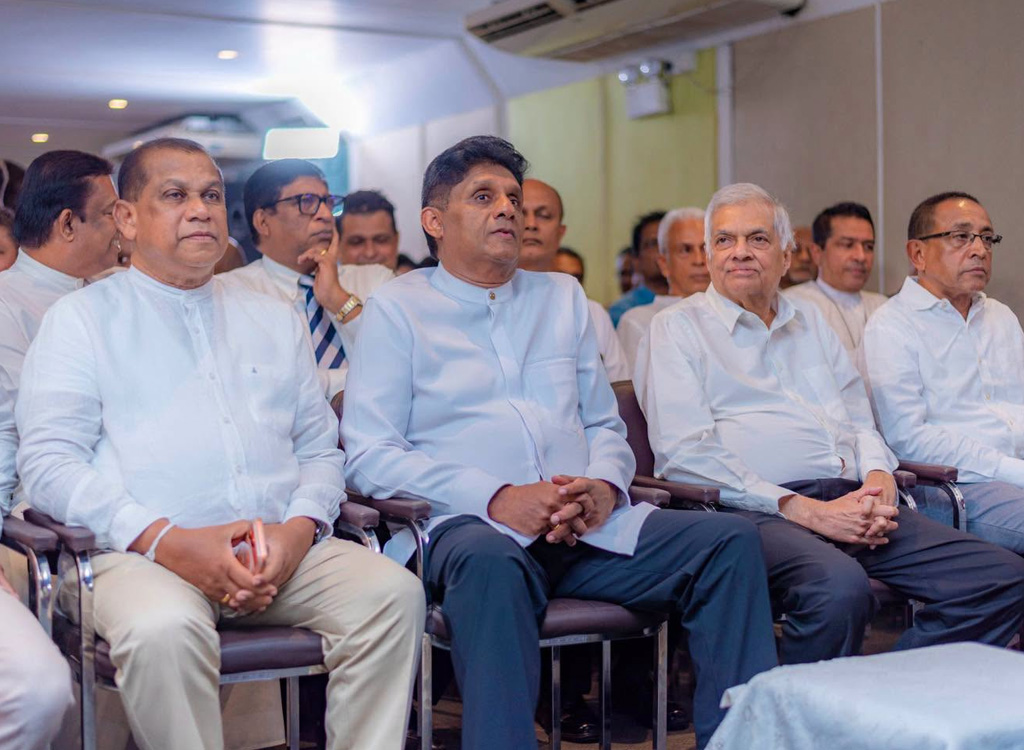
Former President and UNP leader Ranil Wickremesinghe was also present at the event organised by the Alumni Association of the D.S. Senanayake Political Academy, which is affiliated with the SJB.
The development marks another step in efforts to bring the two parties, which emerged from the same political tradition but have operated separately in recent years, into closer cooperation as the Opposition seeks to present a more coordinated challenge to the Government led by President Anura Kumara Dissanayake.
From rivalry to cooperation
Premadasa stressed that the proposed cooperation should not be viewed simply as an arrangement aimed at securing political positions.
Instead, he said the SJB and UNP should come together around a progressive and people-oriented policy framework capable of addressing the country’s economic and political difficulties.
The Opposition Leader accused the Government of moving towards the concentration of political power within a single party and warned that Sri Lanka was at a critical political juncture.
According to Premadasa, the two parties would therefore work together to defend democratic institutions and oppose measures that they believe could weaken the country’s democratic system.
The remarks represent a significant political signal given the historical relationship between the SJB and UNP.
The SJB was formed following the political split within the UNP, with Premadasa subsequently leading the new party. The two groups have since competed separately, although calls for cooperation have periodically emerged as both have faced the challenge of responding to the rise of the National People’s Power (NPP).
The economic “middle path”
Premadasa also sought to define the economic philosophy that could underpin the proposed political cooperation.
Drawing on the legacy of former President J.R. Jayewardene, he advocated what he described as a middle path combining the market economy with social welfare and social democracy.
The approach, he argued, should seek to encourage economic growth and private-sector activity while ensuring protection for vulnerable sections of society.
This position could become an important element of any future common programme between the SJB and UNP, particularly as both parties seek to distinguish their economic approach from that of the incumbent administration.
Premadasa said the country’s economic difficulties continued to affect a large section of the population, claiming that between 30% and 40% of Sri Lankans were living in poverty.
He also pointed to difficulties faced by micro, small and medium-sized enterprises, which he said were struggling under prevailing economic conditions.
The Opposition Leader argued that the proposed cooperation between the SJB and UNP should ultimately be judged by whether it could produce practical solutions to these problems rather than merely create another political alliance.
What comes next?
The latest announcement follows earlier moves towards closer cooperation between the two parties.
In May, Premadasa said the SJB and UNP had already come together and were prepared to move forward collectively.
Thursday’s remarks further reinforce that direction, but stop short of announcing a formal merger between the two parties.
There was also no formal announcement on an electoral agreement, leadership structure or the division of organisational responsibilities.
That leaves several key questions unanswered.
Whether the proposed cooperation develops into a formal electoral alliance, a broader political coalition or eventually a merger will depend on negotiations between the two parties and their respective leaderships and grassroots organisations.
The presence of Wickremesinghe alongside Premadasa at Thursday’s event nevertheless provided a visible indication of the political significance being attached to closer SJB-UNP cooperation.
For the Opposition, the immediate challenge will be transforming an announcement of political cooperation into an organisational structure and a credible common programme.
For the SJB and UNP, the question is no longer simply whether they can work together, but whether their longstanding differences can be accommodated within a common political framework.
Premadasa’s latest declaration suggests that the process of bringing the two parties closer has moved beyond informal discussions and into a more explicit political phase.
The contours of that alliance, however, remain to be defined.








Leave a comment