
By The Pulseline News Desk
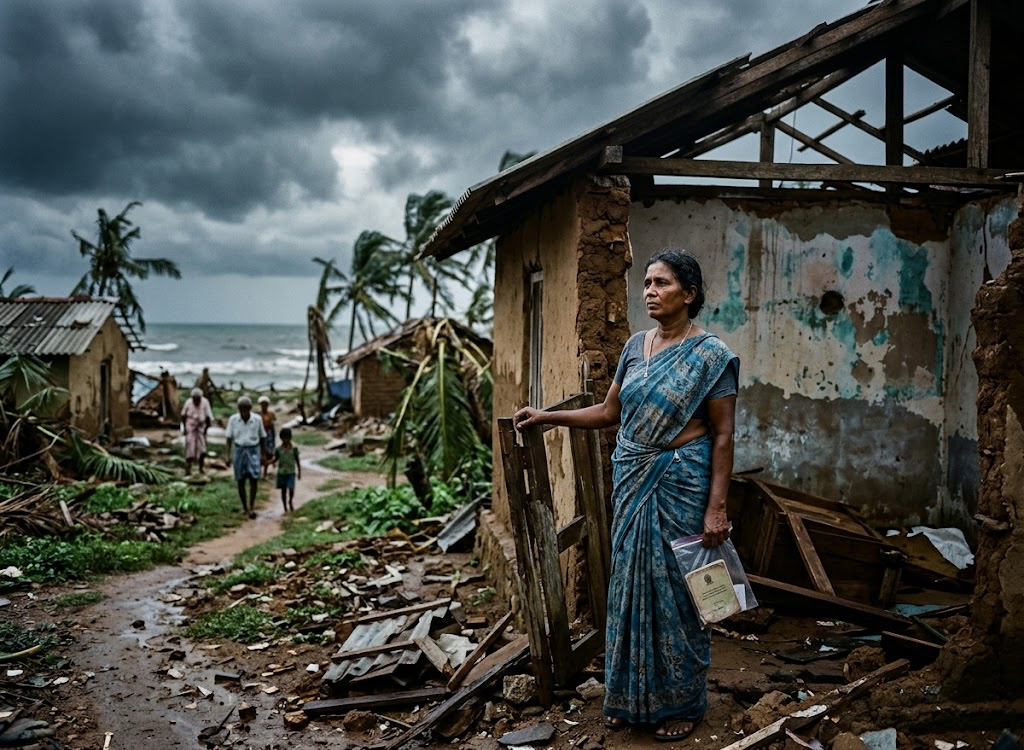
More than 53,000 households whose homes were partially damaged by Cyclone Ditwah are still waiting for the second instalment of government compensation, while thousands of other families affected by the disaster have yet to receive payments for damaged or destroyed houses, Parliament was told.
Deputy Minister of Defence Major General K. P. Aruna Jayasekara (Retd) has reportedly disclosed the figures on October 22, responding to a question raised by Opposition Leader Sajith Premadasa on September 23.
According to the Deputy Minister, 98,463 households with partially damaged houses were covered under the government’s compensation programme. However, payment figures have indicated substantial gaps between the number of households identified and those that have received assistance.
Under the first phase of the scheme, which provides compensation without an individual damage assessment, 57,851 households were selected to receive Rs. 300,000 each. Of these, 46,565 households have received payments, while 11,286 remain unpaid.
A further 57,850 households were selected to receive Rs. 200,000 each, under the second phase. Only 4,221 households have received this payment, leaving 53,629 awaiting compensation.
According to reports, under a separate assessment-based scheme, 15,886 families were identified for compensation for partially damaged houses. Of these, 12,990 have received payments, while 2,896 are still waiting. Among the payments made, 7,611 households had received less than Rs. 300,000, while 5,379 had received amounts exceeding Rs. 300,000.
Payments under this scheme are reportedly made in three phases, with 50% paid in the first phase and the remaining amounts divided equally between the second and third phases.
The Deputy Minister has also disclosed that 23,034 cases involving partially damaged houses, along with 1,145 newly identified houses, had been referred to a committee for decisions on compensation. Payments have commenced for 1,547 households in these categories.
Thousands of fully damaged houses await assistance
The compensation programme for fully damaged houses also faces a substantial backlog.
A total of 32,147 houses were identified under categories covering fully damaged homes, high-risk houses, temporary houses and cases involving households moving between districts. These have comprised 7,370 fully damaged houses, 17,240 high-risk houses, 7,213 temporary houses and 324 cases involving inter-district transfers.
For fully damaged houses, the government has introduced four compensation options: constructing a house on the recipient’s own land, building a house on government land, purchasing a house, or purchasing land and constructing a house.
Under the option of rebuilding on the recipient’s own land, 8,815 houses were identified for assistance. Payments have been made for 4,613 houses, while 4,202 remain unpaid.
Another 7,035 households were identified as requiring assistance to construct houses on government land. Only 880 have received payments so far.
Under the option of purchasing a house, 5,175 households were identified, of which 678 have received payments. The remaining 4,497 are awaiting assistance.
A further 1,964 houses were identified under the option of purchasing land and constructing a house. Payments have been made to 208 households, while 1,756 are still waiting.
The compensation package for fully damaged houses is paid in three instalments: Rs. 2 million in the first phase, followed by Rs. 1.5 million each in the second and third phases.
The Deputy Minister has said 7,536 cases involving fully damaged houses had also been referred to a committee for decisions on compensation. Payments have commenced for 1,268 identified estate houses.
Technical and administrative delays
The government has attributed delays in compensation payments for partially and fully damaged houses to several technical and administrative issues.
These include pending approval from the National Building Research Institute (NBRI), difficulties verifying ownership, discrepancies in applications, rejected applications, unauthorised constructions and other technical problems.
The figures presented in Parliament were based on the Global Post Disaster Needs Assessment report, compiled using information from relevant institutions following Cyclone Ditwah, together with data gathered by district Disaster Relief Service Officers up to September 16, according to reports.
The figures highlight the continuing challenge of delivering financial assistance to households affected by the cyclone, particularly those whose homes were partially damaged and those requiring substantial reconstruction.
While the government has identified thousands of households for compensation across several categories, a significant number remain dependent on the completion of payment procedures and the resolution of outstanding verification and approval issues.









Leave a comment