
By The Pulseline News Desk
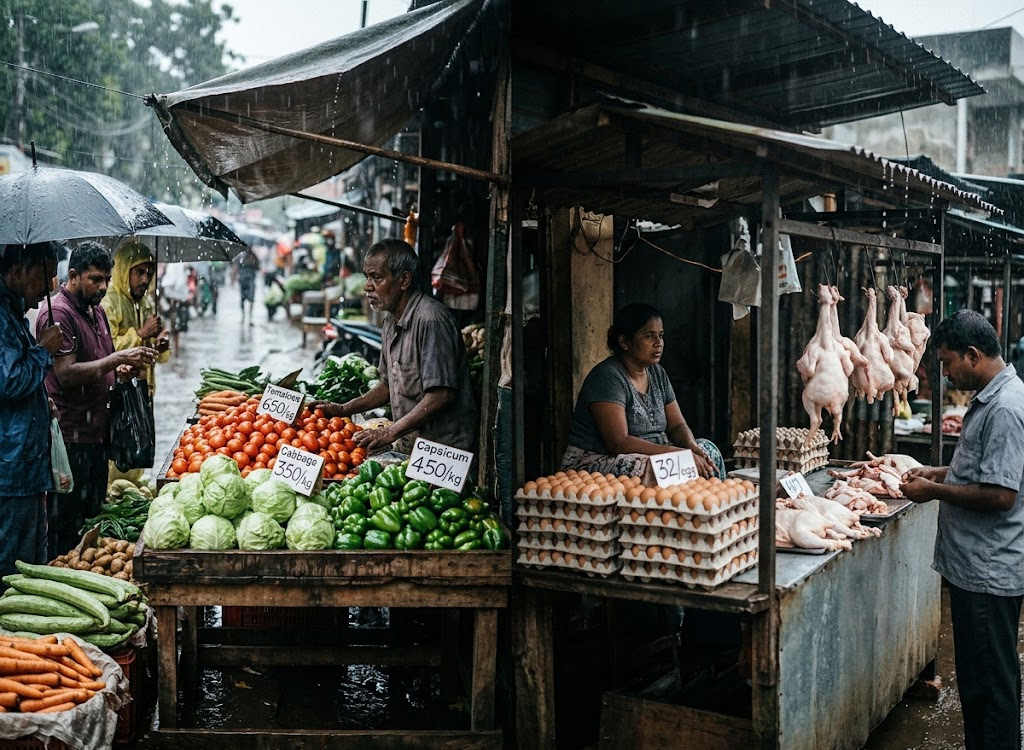
Vegetable prices have surged in Sri Lanka amid prevailing rainy weather, with wholesale prices of tomatoes, cabbage and capsicum recording sharp increases, while demand for eggs and chicken has declined by around 20% amid weakening consumer purchasing power.
Wholesale prices of several upcountry and low-country vegetables have reportedly risen significantly compared with last week, adding further pressure on household budgets as the country approaches the festive season.
The price of a kilogram of tomatoes, which ranged between Rs. 350 and Rs. 400 last week, has climbed to between Rs. 600 and Rs. 650.
Capsicum prices have increased from around Rs. 250 to between Rs. 400 and Rs. 450 per kilogram, while cabbage prices have risen from Rs. 150 to Rs. 350.
Former Chief Organiser of the Manning Market Traders Union Anil Indrajith has reportedly attributed the increases primarily to prevailing weather conditions, warning that vegetable prices could rise further as December approaches.
“Vegetable prices have increased these days. The main reason for this is the prevailing weather conditions in the country. Tomatoes are currently the most expensive, with wholesale prices reaching around Rs. 600 per kilogram,” he has told the media.
Beans are currently priced between Rs. 400 and Rs. 500 per kilogram, while carrots sell for between Rs. 200 and Rs. 250. Leeks are priced at around Rs. 200 per kilogram, while green chillies cost between Rs. 350 and Rs. 400.
Prices of low-country vegetables have also increased. A kilogram of snake gourd is selling for around Rs. 400, while ridge gourd is priced between Rs. 200 and Rs. 250. Pumpkin prices have exceeded Rs. 200 per kilogram.
Ash gourd and cucumber remain among the few vegetables available at prices below Rs. 100 per kilogram.
According to Indrajith, prices had increased compared with the previous month and cautioned that consumers should not expect significant relief in the immediate future.
“Generally, vegetable prices tend to rise every year as December approaches. Therefore, a price reduction cannot be expected in the coming period, and prices could increase further,” he has said.
Egg and chicken demand weakens
Meanwhile, the poultry industry is experiencing a slowdown in demand, with purchases of eggs and chicken declining by around 20%, according to All-Island Poultry Association Chairman Ajith Gunasekara.
He has reportedly attributed the decline to reduced consumer purchasing power amid prevailing economic conditions, saying the drop in demand was affecting producers’ profitability despite continued production.
Gunasekara has said the production cost of an egg ranged between Rs. 30 and Rs. 32, while farms were selling eggs at similar prices, leaving producers with little or no profit.
“The production cost of an egg is generally between Rs. 30 and Rs. 32. However, farms are currently releasing eggs at prices ranging between Rs. 30 and Rs. 32 as well. Therefore, producers are not in a profitable position,” he has said.
Chicken prices have also declined amid weaker consumption, with Gunasekara noting that consumers were purchasing less as household budgets came under pressure.
“When we conduct market surveys, we can see that purchases of eggs and chicken have decreased. We observe that consumption in the market has declined by around 20%,” he has told the media.
Despite the downturn in demand, the association has said poultry production was continuing without interruption and has pledged to maintain adequate supplies of eggs and chicken during the upcoming festive season.
Gunasekara has expressed hope that demand would recover after November 15, when the festive season begins to gather momentum. “We are taking steps to provide the market with the required supplies during the festive season without any shortages. Therefore, we hope that the situation will return to normal with the commencement of the festive season after November 15,” he has added.
The contrasting trends in the vegetable and poultry markets highlight the pressures facing consumers and producers alike, with weather-related price increases affecting vegetable buyers while subdued purchasing power weighs on demand for essential protein sources.













Leave a comment