
By The Pulseline News Desk
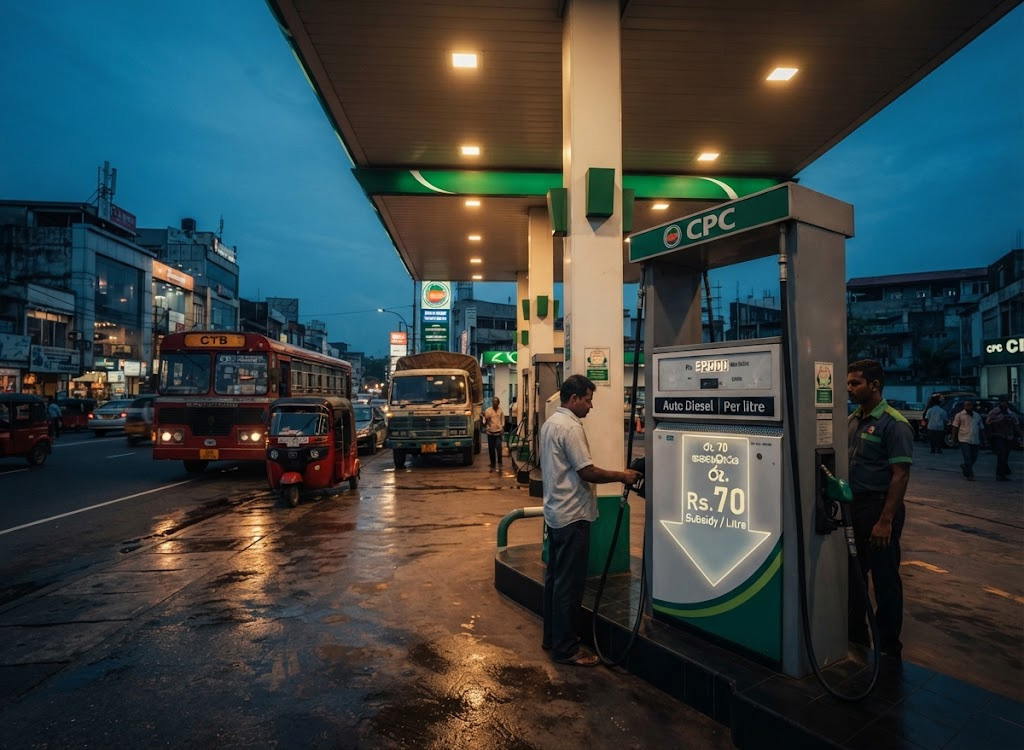
Sri Lanka’s fuel market is coming under renewed financial pressure, with the Government approving a Rs. 41 billion subsidy package after the Ceylon Petroleum Corporation (CPC) began facing a loss of around Rs. 70 on every litre of diesel sold under the current pricing structure.
The Cabinet-approved subsidy is aimed at absorbing part of the widening gap between the cost of diesel and its domestic selling price, preventing the entire increase in global oil prices from being transferred to consumers.
The move effectively places the Government between international oil prices and the domestic fuel market, with billions of rupees being committed to contain the immediate impact on motorists and businesses.
Rs. 70 gap becomes Government burden
The Rs. 70-per-litre figure represents the scale of the pressure currently facing the CPC.
With diesel being one of the country’s most widely used fuels for public transport, freight, agriculture, industry and other economic activities, any sharp increase in its retail price could quickly feed into transportation and distribution costs.
The Government has therefore opted to shoulder part of the additional cost rather than allowing the entire burden to fall on consumers.
The Rs. 41 billion subsidy will be released over three months, with Rs. 15 billion allocated for October, Rs. 13.5 billion for November and Rs. 12.5 billion for December.
The subsidy will be calculated according to the quantity of diesel sold by each fuel distribution company during the relevant month.
Not just a CPC problem
The intervention follows reports from fuel distributors of substantially higher losses under the existing pricing structure.
Energy Minister Anura Karunathilaka has said different companies had reported losses ranging from Rs. 120 to Rs. 247 per litre of diesel, highlighting the extent of the pressure created by the surge in international fuel prices. The Rs. 70-per-litre Government subsidy will therefore not completely eliminate the losses reported by distributors.
Fuel companies will continue to absorb part of the increase, while the Government absorbs another portion through the subsidy.
For the CPC, however, the pressure is particularly significant because of its role as the dominant player in Sri Lanka’s petroleum market.
Why diesel matters
The impact of diesel prices extends well beyond filling stations.
Diesel is a key input for the country’s transport and logistics network. Higher diesel costs can increase the cost of moving food and other goods, operating buses and commercial vehicles, running machinery and transporting agricultural produce.
A substantial increase in diesel prices could therefore create a second-round impact on consumer prices at a time when households are already sensitive to increases in the cost of living.
The Government’s decision to inject Rs. 41 billion into the market is consequently not simply a measure to keep pump prices down. It is also an attempt to prevent a fuel-price shock from spreading through the wider economy.
Can CPC absorb the pressure?
Despite the additional burden, Karunathilaka has maintained that the CPC is unlikely to record an overall loss by the end of the year.
The Minister has said the corporation’s wider revenue streams — including petrol, diesel and aviation fuel sales and refinery operations — would help offset the additional costs associated with the diesel subsidy and elevated global prices.
That expectation will be closely watched as the subsidy programme progresses.
The Government is effectively betting that the CPC’s overall operations can withstand the pressure while the Treasury provides Rs. 41 billion to prevent consumers from facing the full international price shock.
Three months, Rs. 41 billion
The immediate relief, however, comes with a significant fiscal price tag.
October: Rs. 15 billion
November: Rs. 13.5 billion
December: Rs. 12.5 billion
Total: Rs. 41 billion
The subsidy provides a three-month window for the Government to manage the immediate shock. But it does not remove the underlying problem: the cost of importing fuel remains exposed to global oil prices.
Karunathilaka has said fuel prices would be reviewed at the end of the month.
That review will determine how much of the international price increase can continue to be absorbed by the Government, the CPC and fuel distributors — and how much may ultimately have to be reflected in prices paid by consumers.











Leave a comment