
By The Pulseline News Desk
As Sri Lanka marks World Elephant Day, the country’s long-running human-elephant conflict is once again at the centre of national attention, with the Government announcing a series of measures aimed at creating safer habitats for elephants while protecting rural communities.
The Ministry of Environment says Sri Lanka is moving towards a permanent, scientific and sustainable approach to the conflict, rather than relying solely on reactive measures such as electric fencing and the relocation of problem elephants.
At the same time, Opposition Leader Sajith Premadasa has called for the Sri Lankan elephant to be recognised as the country’s National Animal, arguing that such recognition should become a national commitment to protecting both elephants and communities affected by the conflict.
Three elephant corridors gazette
Under the direction of President Anura Kumara Dissanayake, three major elephant corridors — Watahira Kanda, Hadapanagala and Koholankala — have been officially gazetted and opened in the Hambantota and Monaragala districts.
Preliminary work is also underway to establish an additional corridor in Anuradhapura.
The corridors are intended to provide elephants with safer routes between habitats and reduce their movement into villages and agricultural areas.
The Government is also attempting to address one of the key reasons elephants leave protected areas: the lack of adequate food and water.
Invasive plants around reservoirs including Kalawewa and Tabbowa have been cleared to establish enrichment zones and grasslands, encouraging elephants to remain within protected areas.
The restoration of tanks and water sources inside forests is also underway.
From fencing to habitat management
Enrichment zones are being activated in protected forests under the national “Wanaspathi” programme, with the Ministry reporting a reduction in elephant intrusions into villages.
One of the areas receiving attention is Nilgala, described by the Ministry as Sri Lanka’s second-largest forest.
The Government’s approach reflects an attempt to address the conflict at its source by improving elephant habitats rather than depending exclusively on barriers to keep animals away from settlements.
New electric fences are nevertheless being constructed using national budget allocations, while additional personnel are being recruited to strengthen conservation and conflict-management operations.
These include Elephant Fence Assistant Officers, alongside 5,000 Civil Defence Force personnel and Multi-Purpose Development Officers.
Protecting elephants from trains
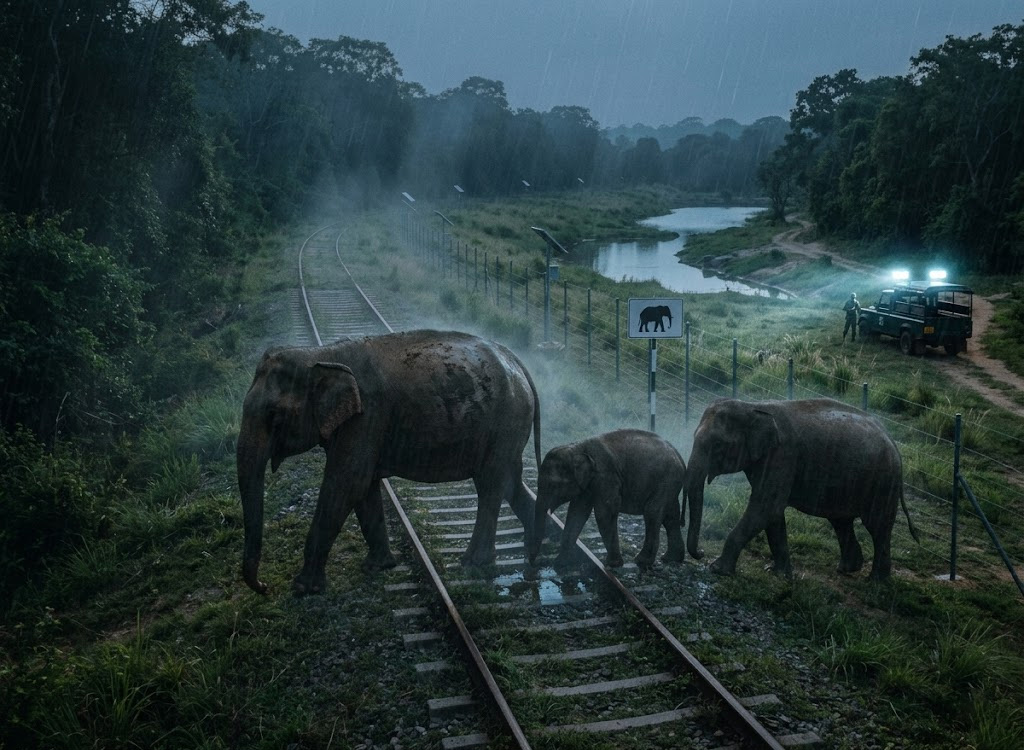
Railway lines remain another major threat to Sri Lanka’s elephant population.
The Government is installing camera systems and warning signboards along key railway routes, including the Gal Oya–Trincomalee, Gal Oya–Batticaloa, Northern and Mannar lines, in an effort to prevent elephant-train collisions.
The measures are intended to provide early warnings in areas where elephants frequently cross railway tracks.
Mobile hospital for wild elephants
The Department of Wildlife Conservation is also establishing a mobile hospital service for wild elephants, aimed at providing faster medical treatment to animals injured through conflict, accidents and other emergencies.
An Expert and Monitoring Committee on Human-Elephant Conflict Management has also been appointed, bringing together representatives of relevant ministries, conservation agencies, experts and local communities.
The committee is expected to develop a systematic, long-term action plan for managing the conflict.
New rules for captive elephants
The Government is also reviewing the management of elephants kept in captivity and used in cultural and religious ceremonies.
A committee has been appointed to examine draft regulations covering the registration and licensing of captive elephants, with animal welfare standards expected to form a key component of the proposed framework.
At Pinnawala, meanwhile, the Government has opened what it describes as Asia’s first “Free Elephant Sanctuary”, allowing elephants in musth to move freely without chains.
Opposition calls for National Animal status
Against this backdrop, Opposition Leader Premadasa has called for the Sri Lankan elephant to be recognised as the country’s National Animal.
Premadasa said the elephant is far more than a wildlife species, describing it as an integral part of Sri Lanka’s history, culture, traditions and civilisation.
He said elephants have lived alongside Sri Lankan communities for thousands of years and have become an enduring symbol of the country.
But he warned that the relationship between people and elephants is now facing a “painful crisis”, with elephants losing habitats and traditional ranges while rural communities face fear, loss and uncertainty.
Farmers are losing crops and livelihoods, while elephants are losing their lives, he said.
Premadasa argued that the conflict cannot be resolved by protecting elephants alone or people alone.
“We must protect both,” he said.
He proposed that recognising the elephant as the National Animal should go beyond a symbolic designation and instead serve as a national commitment to science-based conservation, protection of elephant habitats and corridors, responsible development, and practical measures to safeguard rural communities.
National commitment to coexistence
The Opposition Leader said the ultimate objective should be a Sri Lanka where people can live without fear and elephants can live without persecution.
His call comes as the Government seeks to build a broader institutional framework around human-elephant conflict management, combining habitat restoration, protected corridors, electric fencing, community participation, railway safety and emergency veterinary services.
The Ministry of Environment has similarly stressed that protecting elephants is inseparable from protecting Sri Lanka’s biodiversity, ecosystems, tourism industry, economy and cultural heritage.
The challenge, however, remains immense.
For decades, human settlement, agricultural expansion, habitat fragmentation and changes to elephant movement patterns have brought people and elephants into increasingly dangerous proximity.
The latest Government measures suggest a shift towards managing that relationship through habitat and landscape planning rather than treating individual elephant incursions as isolated incidents.
Premadasa’s proposal adds another dimension to the debate — turning the elephant from a conservation concern into a symbol of a broader national commitment to coexistence.
As Sri Lanka marks World Elephant Day, the central question is no longer simply how to save elephants or how to protect villages.
It is whether the country can develop a system in which both people and elephants have space to survive.
That, ultimately, is the measure by which Sri Lanka’s human-elephant conflict strategy will be judged.
“Let us honour our heritage, accept our responsibility and work together for our future,” Premadasa said, calling for coexistence to become a national commitment.










Leave a comment