
By The Pulseline News Desk
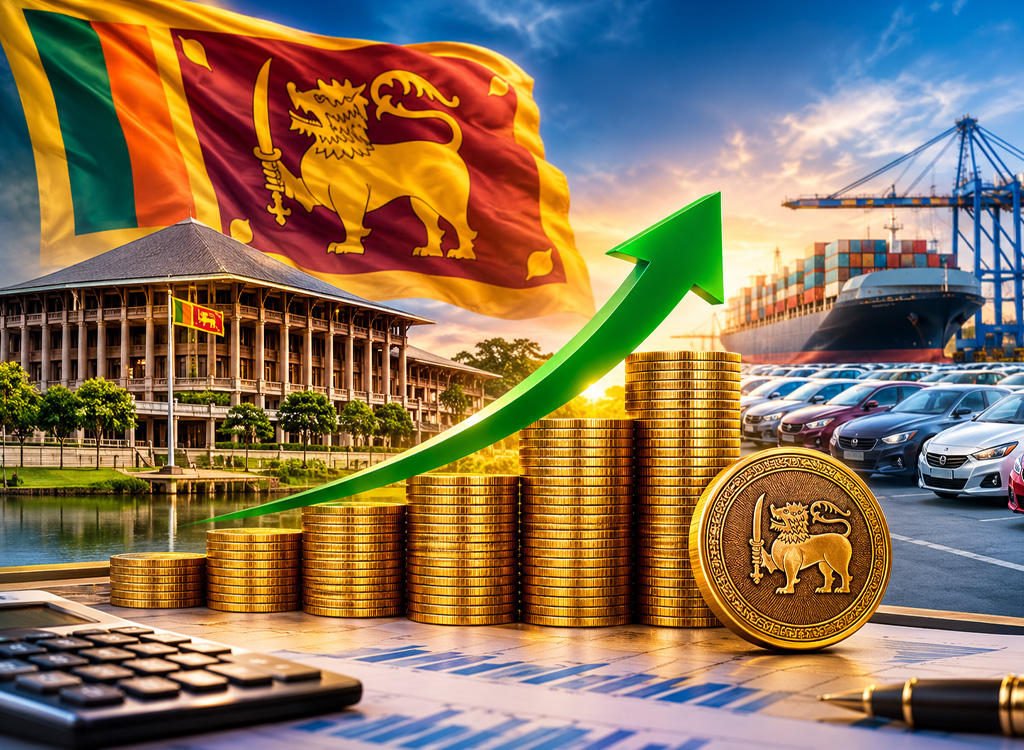
Sri Lanka has recorded a budget surplus of Rs. 22.3 billion during the first nine months of 2026, marking a significant fiscal turnaround from the Rs. 441.4 billion deficit reported during the corresponding period last year, largely driven by higher tax revenue from vehicle imports and restrained government expenditure.
According to the Ministry of Finance’s Fiscal Review Report for January–September 2026, the improvement was supported by a 20 percent increase in government revenue, alongside a relatively moderate expansion in public spending.
Total government revenue and grants have increased to Rs. 4,601.6 billion during the nine-month period, compared with Rs. 3,834.9 billion in 2025, achieving 86.8 percent of the full-year revenue target of Rs. 5,300 billion.
Tax revenue has increased 19.3 percent to Rs. 4,252.1 billion, with Sri Lanka Customs and the Inland Revenue Department (IRD) emerging as the two largest contributors, each accounting for approximately 47 percent of total tax collections.
Vehicle imports drive Customs revenue
Revenue from Sri Lanka Customs has reached Rs. 1,981 billion, equivalent to 89.8 percent of its annual target, with the continued inflow of motor vehicle imports playing a significant role in boosting collections.
Import VAT has increased 14 percent to Rs. 690.3 billion, while excise duty collected by Customs has increased 15 percent to Rs. 636.1 billion.
Vehicle-related excise revenue alone has climbed 9.1 percent to Rs. 381 billion, accounting for approximately 60 percent of total excise duty collected by Customs.
The Finance Ministry attributed Customs’ strong performance primarily to increased revenue from motor vehicle imports, noting that the department had achieved around 90 percent of its annual revenue estimate within the first nine months.
Meanwhile, the IRD has collected Rs. 2,014 billion, achieving 83.9 percent of its annual target.
Income tax revenue has increased 20 percent to Rs. 996.4 billion, while domestic VAT collections have recorded a sharper 29 percent expansion.
Expenditure remains relatively restrained
On the expenditure front, total government spending has increased 7.1 percent to Rs. 4,579.3 billion, considerably below the 20 percent growth recorded in government revenue.
Recurrent expenditure has increased 5.6 percent to Rs. 4,036.6 billion, while capital expenditure and net lending has increased 19.2 percent to Rs. 542.8 billion.
Interest payments, which continued to account for a substantial portion of government spending, has declined five percent to Rs. 1,821.6 billion from Rs. 1,906.6 billion during the corresponding period in 2025.
Interest costs have represented approximately 45 percent of recurrent expenditure, highlighting the continuing burden of debt servicing on government finances despite the improvement in the overall fiscal position.
The primary surplus, which excludes interest payments, has also strengthened to Rs. 1,843.9 billion from Rs. 1,465.1 billion a year earlier.
Growth moderates despite fiscal improvement
However, the improvement in public finances comes amid a moderation in economic growth.
The Finance Ministry report showed that Sri Lanka’s economy expanded by 4.2 percent in the second quarter of 2026, compared with 5.0 percent during the corresponding quarter of 2025.
While stronger revenue collection and expenditure management have helped restore the budget to a surplus, the heavy contribution from vehicle imports raises questions about the sustainability of revenue growth as import-related tax collections remain dependent on market demand and import activity.
The latest figures nevertheless indicate a marked improvement in the government’s fiscal position, although maintaining the momentum will depend on sustaining revenue mobilisation while meeting expenditure requirements and managing the country’s substantial debt-servicing obligations.








Leave a comment