
By The Pulseline News Desk
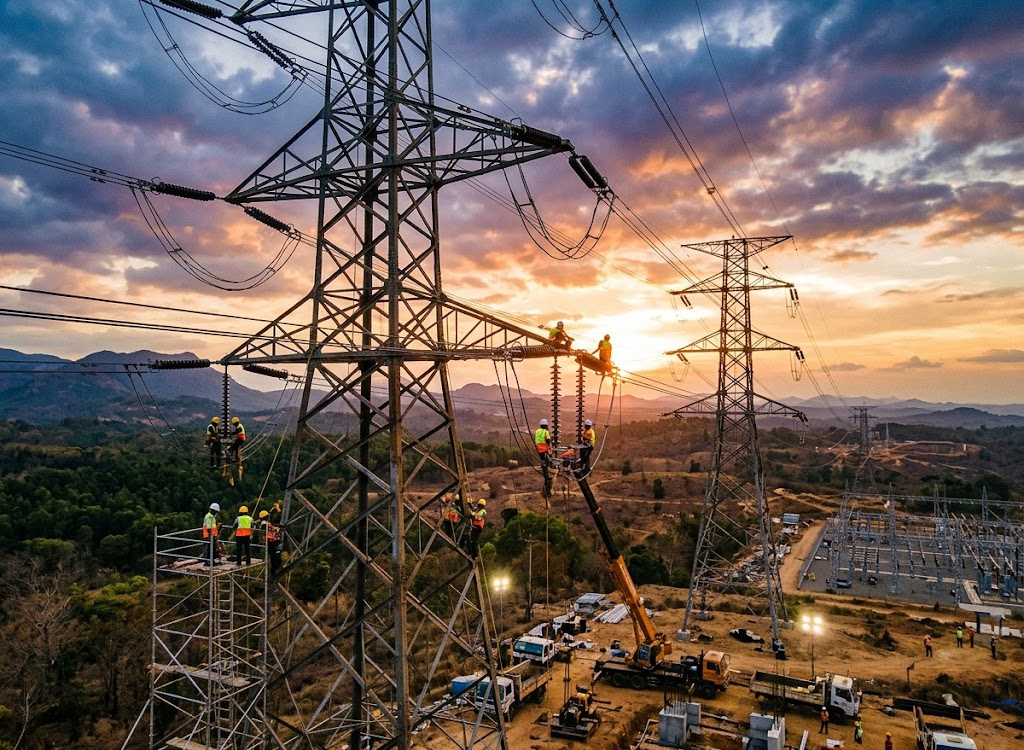
Sri Lanka is preparing to open major electricity transmission projects to private investment, with four high-voltage transmission lines set to be tendered shortly as the Government seeks to modernise the national grid and accommodate a growing share of renewable energy.
President Anura Kumara Dissanayake announced the planned tenders at the Sri Lanka Economic and Investment Summit 2026, organised by the Ceylon Chamber of Commerce, saying private sector participation would help expand transmission capacity without placing excessive financial pressure on the State.
“We have an expectation to bring in private investments for transmission systems. For that, we have already identified four grid lines; we will tender those four very soon. Then, I believe, the private sector can also join our transmission system,” he said.
The proposed move marks a significant policy shift in a sector historically controlled entirely by the State, potentially creating new opportunities for private investors in Sri Lanka’s electricity infrastructure.
The identified transmission routes include Puttalam–Wariyapola, Dambulla and Habarana–Veyangoda, while the Government will retain responsibility for the Kilinochchi–Habarana high-voltage transmission line, which is being supported through ongoing assistance from the Asian Development Bank (ADB).
Grid modernisation challenge
The proposed private sector participation comes amid the need for substantial investment to strengthen Sri Lanka’s electricity transmission network and improve its capacity to accommodate renewable energy generation.
Energy experts have estimated that modernising the national grid could require between US$4 billion and US$5 billion, highlighting the scale of the investment challenge facing the country.
Dissanayake said the Government’s energy policy was guided by two principal considerations: ensuring a stable and uninterrupted electricity supply while keeping costs affordable for consumers.
“If you take the energy sector, we focus our attention on two things: the stability and continuity of power, and the cost borne for power. It is upon these two factors that our power and energy policy is built,” he said.
By inviting private investment into transmission infrastructure, the Government expects to reduce the financing burden on the Treasury while expanding the grid’s capacity to integrate renewable energy sources.
An upgraded transmission network would be important to connect renewable energy projects to the national grid and ensuring that electricity generated in different parts of the country can be delivered to consumers efficiently.
However, the financial structure of the proposed projects and the terms under which private investors would participate will be important in determining their implications for electricity costs and the long-term sustainability of the power sector.
Restructuring the electricity sector
The initiative follows a major restructuring of Sri Lanka’s electricity industry, with the former Ceylon Electricity Board (CEB) dissolved in March 2026 and its functions transferred to six newly established State-owned successor companies.
The restructuring separated the functions previously carried out under the CEB, including electricity generation, transmission and distribution.
The national transmission network remains under State ownership and operation through the National Transmission Network Service Provider (Private) Limited, which manages the high-voltage transmission infrastructure operating at 220 kilovolts and 132 kilovolts.
The proposed tenders would introduce private sector participation in the development of selected transmission projects while the national grid continues to operate under the restructured electricity sector.
Balancing investment and affordability
The Government’s challenge will be to attract sufficient private capital to expand transmission capacity while ensuring that the resulting investments do not undermine its objective of maintaining affordable electricity tariffs.
The planned tenders could provide a new financing avenue for large-scale infrastructure development at a time when public investment remains constrained by the need to maintain fiscal discipline.
At the same time, the success of the initiative will depend on the commercial viability of the projects, the regulatory framework governing private participation and the ability to integrate additional renewable energy into the national network.
Dissanayake’s announcement signals the Government’s intention to broaden private sector participation beyond electricity generation and into the transmission infrastructure needed to support Sri Lanka’s evolving energy mix.











Leave a comment