
By The Pulseline News Desk
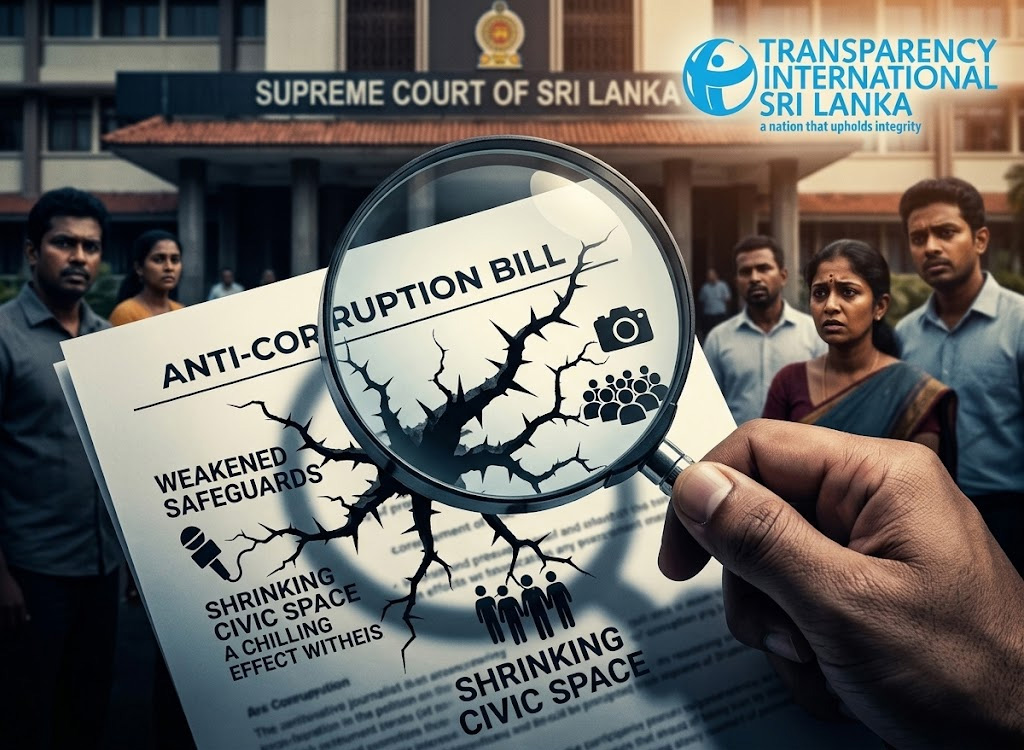
Transparency International Sri Lanka (TISL) has taken the proposed Anti-Corruption (Amendment) Bill 2026 before the Supreme Court, warning that several provisions could weaken existing safeguards against corruption, restrict access to information and create a chilling effect on journalism and civic activism.
The petition, filed on August 31, has argued that key provisions of the Bill are inconsistent with several constitutional protections, including the sovereignty of the people, equality before the law, freedom of expression, the Right to Information (RTI) and the exercise of judicial power.
TISL has challenged the provisions under Articles 1, 3, 4, 12, 13, 14(1)(a), 14A, 126, 140 and 156A(1)(c) of the Constitution.
At the centre of the challenge is TISL’s contention that the proposed amendments represent a significant policy regression at a time when stronger institutional safeguards are needed to combat corruption and improve public accountability.
Concerns over judicial oversight
One of the most contentious provisions is Clause 4, which would remove the requirement for judicial oversight when deciding whether accomplices in corruption cases should be prosecuted.
Under the proposed amendment, the Director-General of the Commission to Investigate Allegations of Bribery or Corruption (CIABOC) would have the power to decide whether to refrain from prosecuting an accomplice without obtaining authorisation from a Magistrate.
TISL has argued that removing this layer of judicial oversight could have wider constitutional implications by shifting a function traditionally subject to judicial supervision towards an administrative authority.
The organisation has therefore challenged the provision on the basis that it could impinge on judicial power and the constitutional balance between institutions.
State-linked companies and asset declaration net
The proposed changes to asset declaration requirements have also come under scrutiny.
Clauses 6 and 18 have sought to increase the state shareholding threshold from 25% to 50%.
TISL has argued that this change could exclude a significant number of companies linked to the State from existing asset declaration requirements, even where such companies remain involved in managing or controlling public assets.
The organisation has warned that raising the threshold could create gaps in the transparency framework and potentially allow individuals connected to state-linked entities to fall outside mandatory disclosure requirements.
For an anti-corruption framework, the issue is significant because ownership is not necessarily the same as control.
A company in which the State holds less than 50% could still play a major role in managing public resources or performing functions of public importance.
Cohabitants and disclosure loophole
Clause 7 is another provision challenged by TISL.
The proposed amendment would repeal the requirement to declare the assets of cohabitants.
TISL has argued that this could create a loophole through which illicit wealth could be concealed or held indirectly.
The concern is that financial assets may not always be held in the name of a public official or their legally recognised spouse.
Removing disclosure requirements relating to cohabitants could therefore make it more difficult for investigators and the public to identify unexplained wealth where assets are held through close personal relationships.
Redacted declarations and press freedom
Perhaps the most significant concerns for journalists and civil society arise from Clause 11.
The provision would give CIABOC broad powers to redact information contained in asset declarations and would criminalise the use of redacted asset declarations beyond formal submissions.
According to TISL, violations could attract fines or imprisonment.
The organisation has argued that the provision could go beyond protecting genuinely sensitive personal information and create restrictions affecting journalists, researchers and civil society organisations seeking to scrutinise the wealth and interests of public officials.
TISL has warned that the resulting uncertainty could have a chilling effect on freedom of expression and investigative journalism, which are protected under Article 14(1)(a) of the Constitution.
The organisation has also linked the provision to the constitutional Right to Information, arguing that restrictions on the availability and use of information contained in asset declarations could undermine transparency.
Bail, remand and proportionality
The petition has also challenged proposed changes relating to bail.
TISL has argued that provisions which make bail the exception and remand the norm are vague and overly broad and could violate constitutional principles of proportionality.
The concern is not merely about the length of detention but about whether the proposed framework would create a system in which individuals accused of offences under the anti-corruption law are routinely deprived of their liberty before trial.
Such provisions, TISL has argued, must be assessed against constitutional protections relating to personal liberty and due process.
A broader constitutional battle
The Supreme Court challenge places the Anti-Corruption (Amendment) Bill within a much wider constitutional debate over the balance between fighting corruption and protecting fundamental rights.
The Government’s objective in strengthening the anti-corruption framework may be difficult to dispute politically. Sri Lanka has repeatedly identified corruption and weak accountability as major institutional problems.
But TISL’s challenge raises a different question: can anti-corruption legislation itself weaken transparency, judicial oversight and fundamental rights in the process of combating corruption?
That question could become particularly important if provisions intended to strengthen enforcement simultaneously reduce public scrutiny of asset declarations or judicial oversight of key decisions.
TISL has asked the Supreme Court to determine that the contested provisions cannot become law unless they are passed by a two-thirds majority in Parliament and subsequently approved by the people at a referendum.
The case could therefore become an important constitutional test of the Government’s proposed anti-corruption reforms — and of how far Parliament can go in reshaping the country’s accountability framework without triggering the Constitution’s higher safeguards.
At stake is not simply the wording of an amendment Bill, but the broader question of whether Sri Lanka’s anti-corruption regime will become more transparent and accountable, or whether new legal provisions could create fresh gaps in the system designed to expose corruption in the first place.













Leave a comment