
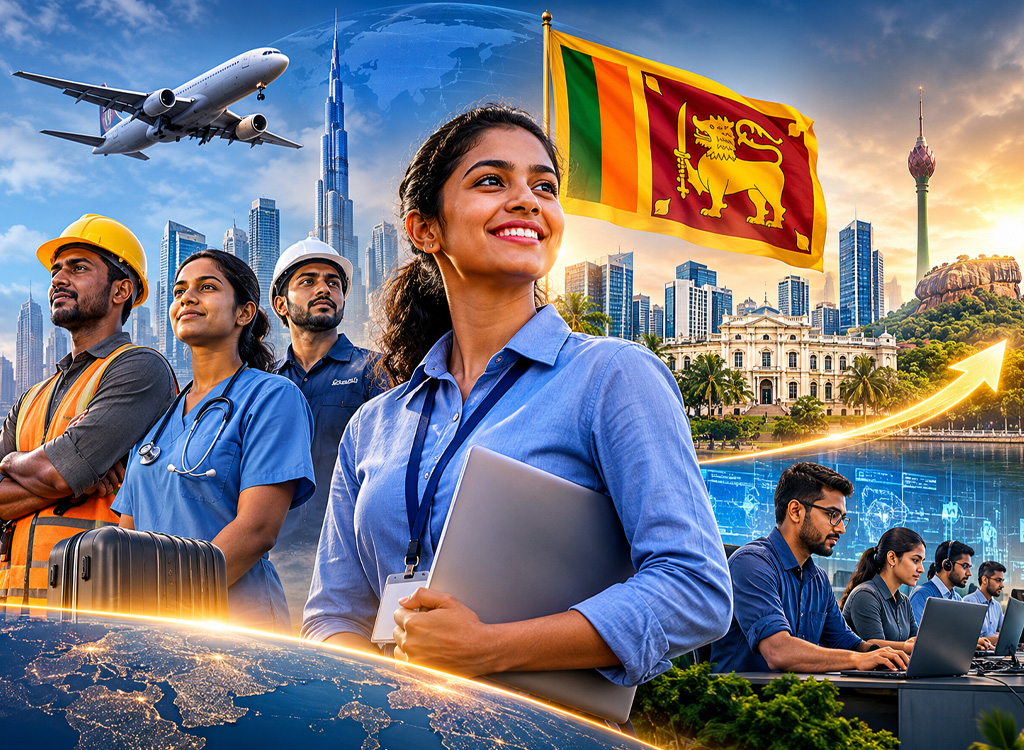
Our migrant workers have helped keep Sri Lanka afloat; the next challenge is to build an economy in which our people can earn international incomes without having to leave home
By Janahitha
In a recent article in Pulseline, ‘The People Who Bring Home Billions Deserve More Than a Queue’, I argued that Sri Lanka’s overseas workers deserve far greater dignity, recognition and respect. I wrote about the mother returning from Kuwait after years of domestic work, the father on a construction site in Dubai, the nurse in Saudi Arabia and the technician in Qatar. These are people who have given up birthdays, anniversaries and precious years with their children to support their families.
Their contribution has been extraordinary. In 2025, workers’ remittances reached approximately US$8.1 billion, up from US$6.6 billion in 2024 – more than US$22 million entering our economy every day.
After that article appeared, a friend raised a point that has stayed with me. Should we celebrate the fact that Sri Lankans send billions of dollars home, or should we ask why so many must leave home to earn that money in the first place? The two questions are not contradictory. We can respect those who sustain the economy today while working to ensure that future generations can prosper without leaving their families behind.
Foreign exchange is not the same as development
Earning foreign currency and building long-term productive capacity are different things. Remittances are immensely valuable: they pay for household consumption, education, healthcare, housing and small businesses, and they help finance imports in an economy that has repeatedly struggled with external imbalances. For many families, a job overseas has been the difference between poverty and stability. But remittances alone do not show that our domestic economy is becoming more productive.
Consider two Sri Lankan accountants. One moves to Dubai, earns US$3,000 a month and sends US$1,500 home. The other stays in Colombo and works remotely for an international firm, earning the same US$3,000. Both bring foreign exchange into the country, but the second also lives and spends most of her income here. She buys local goods and services, pays local taxes and remains part of our professional workforce. In time, she may employ five accountants, then fifty, and build a firm that exports accounting services to Australia, Singapore, the United Kingdom and the United States.
Not every overseas worker would be better off at home. Migration can offer higher earnings, valuable experience and opportunities that do not exist here. The example does, however, illustrate a basic principle: when we export labour, we earn from the individual; when we export the output of labour through a competitive domestic business, we can build an industry around that individual.
The hidden cost of exporting our workforce
Sri Lanka spends heavily on educating its people, from primary schools and universities to technical institutes and professional training. Too often, the returns on that investment are realised elsewhere. Our doctors work in British and Australian hospitals, our engineers build infrastructure in the Middle East, and our accountants, nurses, technicians and IT professionals strengthen other economies.
Their families may benefit enormously, and remittances flow back. Yet the country loses skills, experience and entrepreneurial energy that might have been put to work at home. The cost is not simply one employee; it may be a future employer, mentor, researcher or company founder.
Migration is not a one-way loss, of course. Sri Lankans abroad build international networks, gain new skills, invest in local businesses and sometimes return with capital and expertise. The diaspora can be a great national asset. The task is to capture more of these benefits while giving people a real choice about where they live and work. We should never try to stop Sri Lankans from pursuing opportunities abroad, but staying should be an equally credible option.
The opportunity in IT and BPO
Information technology, business process outsourcing (BPO) and knowledge process outsourcing offer a small island economy something particularly valuable: the ability to sell internationally without our people having to relocate. A software engineer in Colombo can build an application for an American company. An accountant in Kandy can manage financial reporting for an Australian business. A healthcare specialist in Galle can support revenue-cycle management for a US hospital, a legal-process professional in Jaffna can assist an international law firm, and a data analyst in Matara can serve a multinational in Singapore. The work travels, the worker stays at home, and the foreign exchange arrives through the export of services.
According to the Central Bank’s 2025 Annual Economic Review, computer and IT/BPO services generated approximately US$800 million in recorded service inflows in 2025. That is a meaningful figure, but it is only about a tenth of what workers’ remittances brought in. What would it take to raise these exports to US$2 billion, US$5 billion or even US$10 billion a year? Such targets should be national goals, backed by credible plans rather than political announcements.
From outsourcing to building businesses
BPO was once associated mainly with call centres, data entry and low-value administrative work. Today, international businesses outsource far more sophisticated functions in healthcare, financial services, legal operations, cybersecurity, software engineering, cloud infrastructure, artificial intelligence and data analytics. Sri Lanka already competes in these markets, but its next step must go beyond supplying inexpensive labour, towards managed services, specialist expertise, proprietary technology and intellectual property.
Supplying ten programmers to an overseas client is very different from building a software company whose product is used by thousands of customers worldwide. The second creates recurring income, intellectual property, management expertise and lasting enterprise value at home. In the same way, a firm that begins by processing healthcare claims can go on to develop its own automation and analytics tools; an accounting outsourcer can become an international financial management provider; and a legal-process company can create technology for law firms in several jurisdictions. The aim should be for Sri Lanka to become one of the best places in the world to deliver such work, rather than merely the cheapest.
Why artificial intelligence raises the stakes
Artificial intelligence is changing the economics of services. Tasks that once required large teams can increasingly be automated or handled by small groups of highly skilled people. If Sri Lanka continues to compete mainly on low-cost labour, AI could erode much of that advantage. If, on the other hand, we invest in AI literacy, engineering and specialist industry knowledge, we can move into higher-value markets.
The goal is not simply to train more people to use computers, but to train them to solve complex business problems for international clients. That requires investment in education, technical training, English-language proficiency, digital infrastructure and internationally recognised professional standards. It also requires an environment in which entrepreneurs can establish, finance and grow export businesses without needless bureaucratic obstacles.
What a national strategy should include
Six priorities stand out for a long-term plan to expand knowledge-based service exports.
First, digital and professional service exports should be treated as a national economic priority, with measurable targets, clear accountability and continuity across governments.
Second, education must be linked directly to international demand. Universities and training institutions should work with employers to build skills in software engineering, AI, finance, healthcare administration, cybersecurity and data analytics.
Third, we should attract international companies to set up operations here. That depends on predictable taxation, reliable infrastructure, straightforward regulation, effective protection of intellectual property and confidence in the legal system.
Fourth, Sri Lankan firms need help to move from labour-intensive outsourcing into higher-value services and technology products, which means access to growth capital, international distribution networks and export-market expertise.
Fifth, we should engage the diaspora more strategically. Sri Lankans abroad have relationships, knowledge and market access that could help local businesses win customers. They should be seen as a source of investment, entrepreneurship and expertise, not only of remittances.
Finally, opportunities must reach beyond Colombo. With reliable connectivity, proper training and well-run businesses, international service work can create jobs in regional towns. A young professional should not have to move to Colombo, let alone Dubai or London, to take part in the global economy.
We must not abandon those who sustain us today
None of this diminishes the contribution of Sri Lankans working overseas, and a debate about economic development must not turn into criticism of the people who supported the country through some of its hardest years. Many leave because opportunities at home cannot offer the income, stability or career development they need. That reflects a weakness in our economy, not a failing on their part, and until better opportunities exist, overseas employment will remain an essential part of Sri Lanka’s economic life.
We must therefore continue to protect migrant workers from exploitation, improve recruitment practices, strengthen consular support and treat returning workers with respect. A returning domestic worker deserves courtesy at immigration, a construction worker deserves fair treatment at customs, and a nurse coming home after years abroad deserves recognition. These are basic standards of dignity owed to every citizen, whatever the economic statistics say. Alongside that responsibility, however, we must pursue a more ambitious goal: an economy that offers the next generation a real choice.
Two possible futures
In the first, we continue to measure success by the number of citizens who leave for work abroad and the billions they send home. Remittances may rise and households may benefit, but our dependence on foreign labour markets remains.
In the second, overseas work remains available to those who choose it, while Sri Lanka steadily builds internationally competitive industries at home. Our technology companies export software, our accounting firms serve international clients and our healthcare services companies support hospitals around the world. Local entrepreneurs build companies that employ thousands, and the diaspora contributes investment, expertise and customers as well as remittances.
The second future is not guaranteed. It will require education reform, disciplined economic management, competent institutions, private investment and a willingness to look beyond the next election. Nor should service exports replace our ambitions in manufacturing, agriculture, tourism, logistics and other industries; a resilient economy needs several competitive sources of foreign exchange. Digital and professional services are, however, an especially promising route, because they allow Sri Lanka to compete globally on the skills of its people.
A better measure of success
Should we be proud that our citizens send home US$8 billion a year? Certainly, and their contribution deserves recognition and gratitude. Should we be content that so much of our foreign exchange depends on Sri Lankans working thousands of kilometres from their families? We should not.
In the long run, Sri Lanka’s economic success should be judged less by how much money its citizens are driven by necessity to send home, and more by how many can earn internationally competitive incomes while living, working and building businesses here. How many globally competitive companies have we created? How much intellectual property do we own? How many high-value jobs have we generated? And how many parents can give their children a prosperous future without spending years away from them?
There is no shame in leaving Sri Lanka to work, and there is dignity in all honest employment, wherever it is done. But there should also be opportunity in staying. Our migrant workers have helped finance Sri Lanka’s survival; the next task is to build an economy that can finance its own prosperity. We should honour those who leave, welcome those who return and create opportunities for those who wish to remain, so that Sri Lanka becomes a nation that exports what its people produce rather than the people themselves.












Leave a comment