
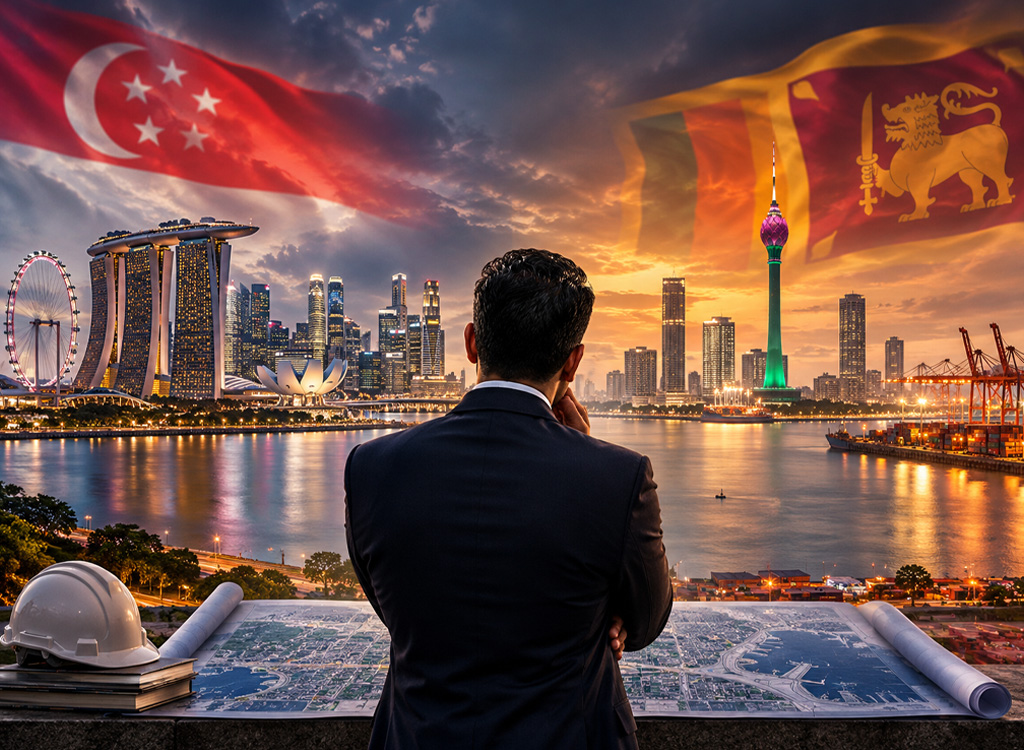
What separates a political system built to govern from one built to stay in power?
By Janahitha
When Singapore became independent in 1965, it had little of what is usually thought to make a country rich. Land was scarce, there were no natural resources to speak of, unemployment was high, communal tensions ran deep and nobody could say with confidence how the new state would pay its way.
Sri Lanka, independent since 1948, started from a far better position. We inherited working institutions, an education system that was strong by regional standards, established commercial infrastructure, a port of international importance and an export economy built on tea, rubber and coconut. On paper, we had every chance.
Six decades on, the gap between the two is hard to believe. Singapore is among the richest countries in the world. Sri Lanka, for all its human capital and natural advantages, has lurched from one economic crisis to the next and, in 2022, defaulted on its sovereign debt. According to World Bank figures for 2025, Singapore’s GDP per capita was about US$98,800; Sri Lanka’s was roughly US$5,000. On average, a Singaporean produces almost twenty times as much as a Sri Lankan.
Luck does not explain a difference of that size. The explanation, I believe, lies in how the two countries think about government. In Singapore, the job of government has been to deliver results. In Sri Lanka, too much political energy has gone into winning power and holding on to it. Singapore has its political shortcomings, and plenty of Sri Lankan politicians are capable people, but the contrast in outcomes deserves a serious look.
What we pay our leaders
Pay is a good place to start. Under its 2026 framework, Singapore’s prime minister receives an annual package of around S$3.6 million. The revised benchmark for an entry-level minister is about S$1.8 million a year, although actual pay varies and existing ministers do not automatically receive the full amount. In Sri Lanka, the published basic monthly salary is about Rs. 71,500 for the prime minister and Rs. 65,000 for a cabinet minister, before allowances and other benefits.
The numbers are startling, but what they reveal about each country’s view of political office is more interesting. Singapore takes the position that running a sophisticated economy needs people of unusual ability, and that such people could earn a great deal in banking, law, technology or business. The state therefore tries to reduce what they give up by entering public life. Sri Lanka has kept official salaries low and topped them up with allowances, vehicles, residences and other privileges. Neither approach guarantees good government, but Singapore has at least tried to link pay to the task of attracting and keeping capable leaders. We have no comparably coherent or transparent policy.
Singapore’s system is also unusual in that its method is published. The benchmark for an entry-level minister is tied to the median income of the 1,000 highest-earning Singapore citizens, discounted by 40 per cent to reflect the public-service nature of the job. Pay also includes variable components linked to individual performance and to national results such as economic growth, employment and real incomes. The idea is that a government should be judged, at least in part, by whether ordinary people are better off.
The approach has obvious limits. Global conditions shape national economic results, and much good policy cannot be captured by a performance indicator; a government could meet its economic targets and still fail its citizens in other ways. Even so, the framework treats leadership as a serious professional responsibility. If we ask a minister to oversee billions in public spending, it is reasonable to expect that person to be competent to do so.
Campaigning is not governing
Winning an election calls for organisation, communication, coalition-building and the ability to persuade. Governing calls for something else, like, economic literacy, institutional management, financial discipline, negotiating skill, long-term planning and the judgement to appoint and supervise able professionals. The two overlap, but a gifted campaigner is not necessarily a good administrator, any more than a successful chief executive is necessarily a good politician.
In Sri Lanka, advancement has too often depended on party loyalty, popularity, connections and influence within the party. Technical competence and administrative experience have rarely been decisive in ministerial appointments. As a result, people have been handed complex economic ministries with little experience of economic management, education portfolios with no record in educational reform, and large infrastructure briefs without any background in project evaluation, procurement or governance.
I am not arguing that every minister needs a degree or a particular professional qualification. Some of the world’s most effective leaders have succeeded through practical experience, sound judgement and a talent for assembling strong teams. But an election gives a government the right to govern; it does not give it the skills to govern well.
Governing beyond the next election
Singapore’s development owes much to policy continuity. Successive governments invested steadily in education, industry, housing, infrastructure, trade and a professional civil service. The Economic Development Board brought in foreign investment and built new industries, public housing became a central instrument of social policy, and education and training were adjusted again and again to suit a changing economy. Over decades, the country became a global centre for finance, logistics, advanced manufacturing and commerce. None of it happened quickly.
Sri Lanka has struggled to keep policies alive from one government to the next. New administrations arrive with new programmes, new appointees and new priorities, and sometimes with a determination to undo whatever their predecessors started. Projects stall, investors wait, institutions lose experienced leaders and long-term goals give way to short-term calculation.
Governments must, of course, be free to change course; that is the point of elections. But ports, airports, railways, power generation, schools and hospitals cannot be planned around five-year cycles alone. Singapore has governed with the next generation in mind. We have too often governed with the next election in mind.
The real cost of a minister
Sri Lankans are right to question what their politicians cost. Salaries, official vehicles, residences, allowances and security are fair subjects for debate, especially when so many families are struggling. We ask far less often what bad leadership costs.
A badly negotiated infrastructure deal can cost the country hundreds of millions of dollars. A poorly designed energy policy can lock in unnecessary expense for decades. An ill-judged tax change can damage businesses, deter investment and weaken public revenue, and the wrong appointment at the head of a major public institution can do lasting harm. Losses on that scale can exceed a cabinet minister’s lifetime pay many times over. A modestly paid minister who makes disastrous decisions may end up costing far more than a well-paid one who governs effectively.
Higher salaries do not automatically produce better decisions, and they will not end corruption on their own; that requires strong institutions, transparent procurement, independent enforcement and real legal consequences. Pay should, however, be judged against the responsibilities of the post and the results expected from it. Cheap political leadership and economical government are not the same thing.
Why copying Singapore would be a mistake
It would be tempting to conclude that Sri Lanka should simply adopt Singapore’s salary scales. That would be wrong. Singapore’s framework operates in a far richer economy, with stronger institutions and very different public finances. No Sri Lankan government could justify large pay rises for politicians while essential services remain underfunded and households are still recovering from the crisis.
Nor was pay the source of Singapore’s success. Its transformation began long before the present framework existed, and it rests on many things together like economic openness, institutional capacity, geography, education, investment, administrative skill and continuity. Singapore’s record on political competition, civil liberties and the concentration of power also deserves scrutiny, and economic success does not excuse any government from democratic accountability. The lesson for us lies in the system of government that surrounds those salaries, not in the salaries themselves.
What Sri Lanka should change
First, political leadership should be professionalised. Parties ought to show that the people they put forward for major portfolios are competent to handle them, and experience in public administration, business, economics, education, health, engineering or other relevant fields should count for something. That does not mean shutting out capable people without formal qualifications. It means making competence an explicit consideration rather than a lucky bonus.
Second, political pay should be made transparent. The public should be able to see the full compensation of elected officials, including salaries, allowances and benefits in kind. An independent remuneration commission could design a framework suited to Sri Lanka’s circumstances.
Third, ministers should work to published objectives. An education minister should be judged on educational outcomes; a transport minister on safety, reliability, efficiency and delivery; a minister for economic development on credible targets for investment, productivity and jobs. Such measures need careful design and independent verification, so that nobody is rewarded for massaging statistics or chasing short-term numbers at the expense of long-term welfare.
Fourth, the civil service must be strengthened. A capable minister cannot achieve much through a weak institution, while a good public administration can shield a country from some of the damage done by poor political leadership. Independent institutions, appointment on merit and continuity of expertise are essential.
Finally, Sri Lanka needs a national development strategy that outlasts changes of government. There should be broad agreement on the fundamentals: education, energy security, infrastructure, export competitiveness, digital transformation and fiscal stability. Parties can argue about how to get there, but the country cannot afford to change direction every few years.
Changing what we reward
For too long, political success here has been measured by elections won, majorities secured and years spent in office. Those are measures of survival rather than national progress. A government can win election after election while leaving the country poorer, and a politician can spend decades in office, gathering considerable influence, without improving anyone’s life or showing any particular skill as an administrator.
We should judge leaders instead by gains in prosperity, education, health, public safety and opportunity, and by the effectiveness of our institutions. We should admire ministers who build institutions that work rather than those who draw the largest crowds and respect those who take hard but necessary decisions over those who promise instant rewards. And we should hold to account those who fail.
Singapore is not a perfect country, and its model cannot be transplanted wholesale. Its achievement over six decades, however, is beyond dispute: a small nation with few natural resources has become exceptionally prosperous through investment in people, competent administration, openness and patient institution-building. Sri Lanka, for its part, has talented people, real entrepreneurial ability and a valuable strategic position. Sri Lankans run businesses, practise medicine, build technology and manage institutions all over the world. Our problem has never been a lack of ability; it has been our failure to turn that ability into good government at home.
The question, then, is less whether our politicians deserve higher salaries than what kind of leadership the country deserves. Better pay may be worth considering as part of a transparent, accountable and professionally run system that draws in exceptional people. Without competence, though, it is merely another privilege, and competence without accountability is not enough either. The aim should be a wealthy country, not wealthy politicians.
Sri Lanka has to decide whether it will keep rewarding the ability to win power or start rewarding the ability to govern. A government’s success should be measured by how much better the country is for having had it, not by how long its leaders stay in office.
Disclaimer: The views and opinions expressed in this article are those of the writer and do not necessarily reflect the official position of this publication.











Leave a comment