
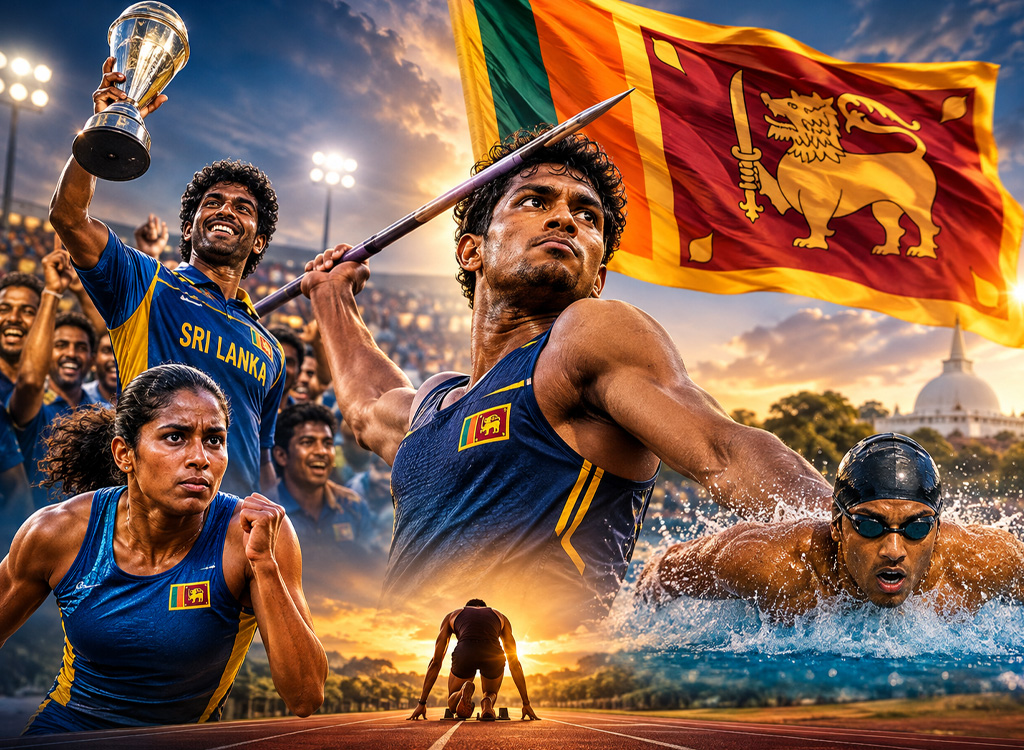
A country that has drawn so much hope from its sportsmen and women must ask itself an uncomfortable question: are we truly backing our best talent, or are red tape, favouritism and bruised egos getting in the way?
By Janahitha
Few things bring Sri Lankans together quite like sport. Through the war years, the economic crises and the long spells of political turmoil, it was often the one thing that gave us reason to hope.
The 1996 World Cup was much more than a cricket victory. For a few weeks that year, a wounded country forgot its divisions. Nobody cared whether you were Sinhalese, Tamil, Muslim or Burgher; we were simply Sri Lankan. Every Muralitharan wicket was celebrated in homes across the island, the whole nation held its breath whenever Sanath Jayasuriya walked out to bat, and when Arjuna Ranatunga lifted the trophy, he lifted a country that badly needed something to believe in.
Our track athletes gave us the same feeling. Sugath Thilakaratne, Damayanthi Darsha and Susanthika Jayasinghe made us proud on the world stage, and their achievements meant even more because they came from a small country with poor facilities, little money and no shortage of obstacles. They proved that Sri Lankan talent could stand alongside the best.
Sport has never been just entertainment for us. It is part of how we cope, how we see ourselves and how we find joy together. That is exactly why the way we treat our athletes now matters so much.
A new generation worth backing
We are lucky to have another crop of remarkable talent. The javelin thrower Rumesh Tharanga is one of the most exciting prospects Sri Lankan athletics has produced in decades, and people already mention him in the same breath as Duncan White and Susanthika Jayasinghe. The swimmer Akalanka Peiris has made the kind of sacrifices that competing internationally demands. Behind them are many others, in athletics, in the pool and in a range of other sports, who have given their lives to representing a small island against nations with far deeper pockets.
We cheer for them when they win medals. Far fewer of us think about what it takes to get there like the early starts, the punishing training, the strict diets, the weddings and birthdays missed, the money worries, the injuries and the constant mental strain. Years of work can come down to a hundredth of a second or a few centimetres.
At the elite level, there is no room for a careless meal, a skipped session or a late night. The mental side is just as demanding as the physical one. Yet many of our athletes are trying to meet those standards with a fraction of the funding and institutional backing enjoyed by their rivals from wealthier countries.
Some train abroad on very modest sponsorship. Some live thousands of kilometres from their families. Some juggle financial uncertainty while trying to keep the discipline of a world-class competitor. Life overseas is not easy for them. They do it because they want to be the best they can be, and because, in the end, they want to win for Sri Lanka.
Training abroad is not turning your back on the country
Some in our sports administration seem to misunderstand athletes who choose to train overseas. Going abroad to train is not a rejection of Sri Lanka; it is an investment in our sporting future.
The world’s leading sporting nations have known this for years. Jamaican sprinters have long made use of the American college system, with its coaching, competition and sports science. Serbia’s best basketball players test themselves in the NBA every week. Middle- and long-distance runners from all over the world head to Kenya, Norway and other established training hubs to learn from the coaches and systems that have produced generation after generation of champions.
The reason is simple, it is that, you cannot become excellent without access to excellence. No athlete can realistically become a world champion without the coaching, facilities, competition and scientific support that level demands.
Sri Lanka cannot build every world-class facility or coaching set-up at home, and it should not try. Our job is not to insist that every athlete trains here. Our job is to make sure every Sri Lankan athlete has the best possible chance of winning for Sri Lanka. That difference matters enormously.
When paperwork becomes the opponent
This leads to a more troubling issue like the perception of favouritism, inconsistent decisions and needless red tape within our sports administration. These concerns should be examined independently, neither brushed aside nor accepted without evidence.
No athlete should have to wonder whether their chances depend on who they know, which official is on their side, or whether their choice of coach or training base has upset someone in authority. What they need is straightforward – clear rules, transparent selection criteria, sensible deadlines for decisions and an independent appeals process for anyone who feels they have been treated unfairly.
When decisions on overseas training, eligibility, selection or participation are delayed without a proper explanation, the damage is not merely administrative. It is personal. An athlete who has spent years preparing for a major championship should not spend the last few weeks before it chasing paperwork and approvals. Top performance depends on a settled mind, and needless worry can undo years of physical preparation.
A missed competition or a broken training cycle cannot simply be made up next month. Sporting careers are short, chances are few, and the gap between a medal and a near miss can be a matter of milliseconds. The effects of poor administration, however, can last a lifetime.
Yesterday’s champions should build tomorrow
There is another awkward question we need to face. Are the experiences, frustrations and personal views of former athletes shaping how we treat the next generation?
Many of our past champions achieved great things with poor funding, basic facilities and almost no institutional support, and they deserve enormous respect for it. But their hardships should never become the benchmark for today’s athletes. The attitude of ‘we never had these opportunities, so why should they?’ has no place in modern sports administration. If anything, it should work the other way round, with each generation making the path easier for the one that follows.
A champion who trained without proper facilities ought to want better ones for those coming after. An athlete who struggled for money ought to want better sponsorship for future athletes. Anyone who was treated unfairly ought to be the first to demand fairness and transparency. That is how countries move forward, and how former champions become the architects of future success.
Sugath Thilakaratne, a celebrated Olympian who is now Deputy Minister of Sports, is in a unique position to lead on this. His own experience should work in favour of today’s athletes and help build a system that understands their sacrifices and clears obstacles out of their way, rather than adding new ones.
Institutions, not personalities
Sri Lanka needs to move away from a sporting administration that seems to rely on personalities, connections and discretion. We need institutions that work in a predictable, fair and professional way. The fixes are neither complicated nor especially expensive.
To begin with, every national sports body should publish clear selection and eligibility criteria, including the rules for athletes who train abroad. Decisions affecting athletes based overseas should also follow set service standards, so that applications are acknowledged promptly, judged against published criteria and settled within a reasonable time.
There should also be an independent body to hear athletes’ grievances and appeals, where disputes can be settled without fear of payback. Sri Lanka should create a structured overseas training programme for athletes with genuine international potential, drawing on government support, private sponsorship, university scholarships and partnerships with established training centres abroad. Finally, funding and support should be linked to measurable results, athlete welfare and independently assessed potential, not to personal relationships.
We do not need to spend like the United States or China. We need to think smartly, act fairly and make the most of the limited resources we have. Sometimes the most useful thing a sports ministry can do is not build another stadium but simply get out of the way of an exceptional athlete.
The whole country pays the price
When a talented athlete is denied a chance, left in limbo or worn down by a dysfunctional system, the loss is not theirs alone. The whole country loses because of a possible Olympic medal, the inspiration that might push a child in Jaffna, Kandy, Galle or Batticaloa to take up sport, and the pride of seeing our flag raised on a world podium. Above all, we lose the chance to show young Sri Lankans that discipline and hard work are recognised and rewarded fairly.
A country grappling with economic hardship, political division and the departure of so many of its brightest young people cannot afford to waste its sporting talent. Sport is one of the few arenas where a small nation can stand shoulder to shoulder with the biggest and richest. On the track, in the pool or on the cricket field, population and GDP do not decide the result. Talent, preparation, discipline and opportunity do, and that is what makes sport so powerful.
Put the athlete first, and Sri Lanka wins
We owe our athletes more than applause when they win. We owe them fairness when they compete, certainty while they prepare and dignity when they ask for help. We owe them an administration that understands its job is to serve athletes rather than to wield power over them, and a sporting culture in which egos, favouritism and politics play no part in deciding who represents the country.
Sri Lanka has produced extraordinary champions in spite of its limitations. Imagine what we could achieve if we started removing those limitations one by one. Imagine what Rumesh Tharanga, Akalanka Peiris and the athletes coming after them could do with proper support, good coaching and the freedom to chase excellence wherever in the world it is found.
Our athletes have already shown how much they are willing to sacrifice for Sri Lanka. It is time our sporting institutions showed the same commitment to them. When an athlete loses an opportunity because of poor administration, it is not only the athlete who loses. Sri Lanka loses too, and that is a loss we can no longer afford.
Disclaimer: The views and opinions expressed in this article are those of the writer and do not necessarily reflect the official position of this publication.








Leave a comment