
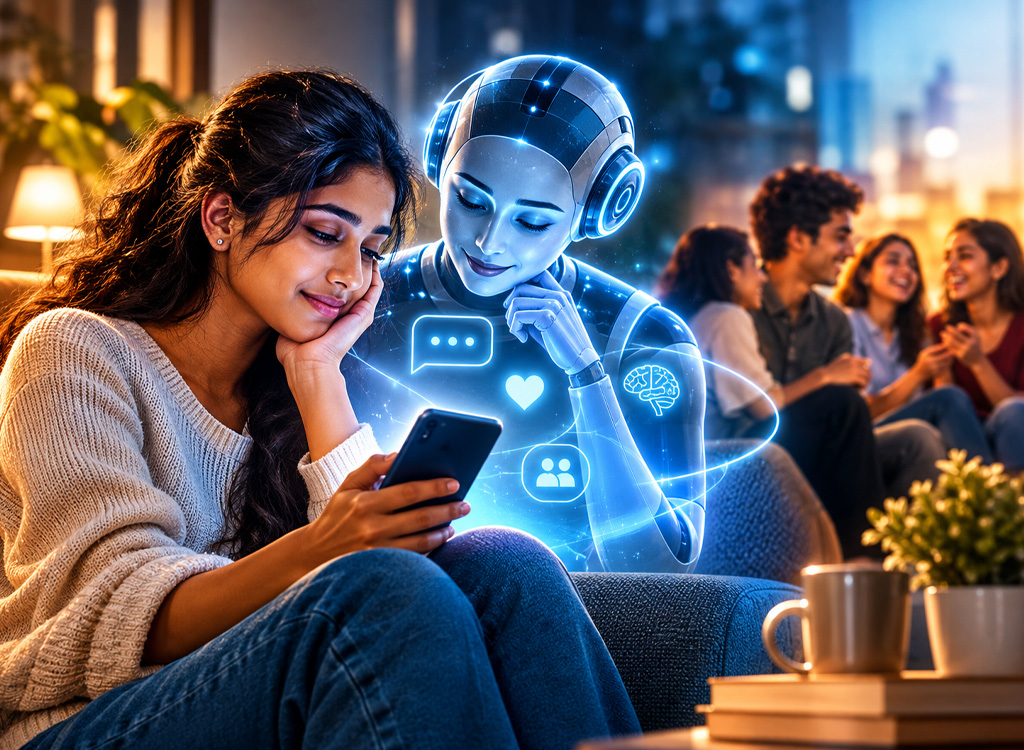
When machines become our listeners, advisers and companions, are we changing the meaning of human friendship?
By Dr. Nadee Dissanayake
Imagine coming home after a tiring day. Your mind is full of worries. Someone has upset you, work has been stressful, and you simply need someone to listen. You pick up your phone and type, “I had a terrible day.”
Within seconds, a reply appears. It is gentle, patient and understanding. It does not interrupt, judge or tell you that you are overreacting. You continue talking, sharing things you might hesitate to tell another person. Somehow, you begin to feel better.
But here is an interesting question: Who have you just spoken to? A friend? A machine? Or something that is slowly becoming both in our minds?
Artificial intelligence (AI) has moved far beyond answering questions, translating languages and helping us write emails. People now turn to AI to discuss relationships, personal problems, loneliness, ambitions and even their deepest fears. Some give their AI assistants names. Others seek advice from them before sp eaking to family members or friends.
This is a new kind of relationship. It is convenient, fascinating and, in some ways, comforting. But it also invites us to think more carefully about what friendship really means.
A friend who is always available
One reason people find AI attractive is its availability. A human friend may be busy, tired or unavailable. An AI assistant is usually ready to respond, whether it is early in the morning or late at night.
It also offers something many people find difficult in everyday life: a space to speak without feeling embarrassed. Someone who is shy, anxious or afraid of being judged may find it easier to express thoughts to a machine than to another person.
For a young person struggling with a personal problem, for example, an AI conversation may provide a starting point. It can help organise confusing thoughts, explain a difficult situation or suggest possible ways forward. For an adult facing a stressful day, it may offer a moment to pause and reflect.
There is nothing wrong with using technology in this way. The concern begins when the easiest conversation gradually becomes the only conversation we want to have.
Does AI really understand how we feel?
This is where we need to understand an important difference.
AI can recognise emotional language. It can identify words associated with sadness, fear, anger or disappointment. It can respond with comforting messages, ask thoughtful questions and suggest ways to manage a difficult situation. Sometimes, simply putting our feelings into words and receiving a calm response can help us think more clearly. But AI does not actually feel what we feel.
It has never experienced the pain of losing someone, the anxiety of waiting for medical news, the joy of achieving a long-awaited dream or the disappointment of being betrayed by a friend. It has no personal memories, emotional attachments or lived experiences. Its responses are generated from patterns in information, not from feelings or personal concern.
There is another important limitation. AI cannot fully understand every circumstance behind an emotional problem. It may misunderstand what someone means, overlook important details or offer advice that is unsuitable for that person’s situation. It can also sound confident even when its response is incomplete or wrong.
Most importantly, AI cannot take responsibility for a person’s emotional well-being. It cannot replace the presence of a trusted friend, the care of a family member or the professional support needed during a serious emotional crisis. Someone experiencing deep distress, persistent loneliness or thoughts of self-harm should reach out to a trusted person or a qualified professional rather than depend on an AI conversation alone.
This does not make AI conversations meaningless. They can provide a useful space to reflect, organise thoughts and consider possible solutions. But we should remember that the comfort is experienced by the person receiving the response. The machine itself is not feeling concern. AI can imitate the language of empathy, but it cannot experience empathy as a human being does.
The danger of a friendship without disagreement
Human friendships are not always easy. Friends misunderstand one another. They disagree, challenge our decisions and sometimes tell us things we do not want to hear. But these difficult moments help us grow. They teach patience, forgiveness, compromise and respect for different opinions. A genuine friend may not always give us the answer we want, but may tell us what we need to hear.
AI conversations can be different. An AI assistant is designed to respond helpfully and keep a conversation going. Although it can challenge an idea or offer another perspective, its responses do not replace the natural give-and-take of human relationships.
Imagine a teenager who discusses every personal problem with an AI assistant but gradually stops sharing experiences with parents, teachers or friends. The teenager may receive quick answers, but may miss opportunities to develop confidence, communication skills and emotional understanding through real relationships. The same concern applies to adults. If we turn to AI every time a conversation becomes uncomfortable, we may slowly lose the patience needed to understand one another.
What should families and schools do?
The answer is not to fear AI or keep it away from our lives. That would be unrealistic. Young people are growing up in a world where intelligent digital assistants will be part of education, work and everyday communication. Instead, we need to teach them how to use AI wisely.
Children should understand that an AI assistant can provide information and suggestions, but it is not a substitute for a trusted adult, a genuine friendship or professional help when serious problems arise. They should also learn to question the accuracy of AI responses and avoid sharing private information carelessly.
Parents and teachers have an important role. Rather than simply asking children how much time they spend online, they should also ask what they do online and whether technology is helping or reducing their connections with others. Perhaps the most important lesson is that technology should bring people closer, not push them further apart.
Let AI be a bridge, not a replacement
There is no doubt that AI can make life easier. It can help us learn, think, create and find answers. It may even help us put difficult feelings into words when we do not know where to begin. But friendship is more than a conversation that never ends. It is about being present, sharing experiences, making time, accepting differences and caring for another person. It involves responsibilities that cannot be handed over to a machine.
The next time you find yourself sharing your worries with an AI assistant, there is no need to feel guilty. Use it to reflect, learn or find a way forward. But remember to reach out to someone who knows you, someone who can sit beside you, laugh with you, disagree with you and share the moments that make life meaningful.
AI may become a very helpful companion. It may even become part of our daily lives in ways we cannot yet imagine. But the warmth of a human hand, the sincerity of a friend’s concern and the joy of being understood by another person remain irreplaceable.
The real question is not whether AI can become our best friend, but whether, as we grow closer to machines, we will still make time for one another.
Technology may make communication easier, but it is our human relationships that give it meaning, reminding us of the true value of kindness, empathy and care.
Disclaimer: The views and opinions expressed in this article are those of the writer and do not necessarily reflect the official position of this publication.













Leave a comment