

By Cathrine Weerakkody
When the Sri Lanka Institute of Directors (SLID) launched its Young Directors Forum in 2022, its inaugural panel made a case for younger directors that international research would later confirm: a fresher perspective, less resistance to change, a better read on younger customers, and a stronger grip on fintech and e-commerce. The Sri Lanka Corporate Director Summit 2026 made a similar case this year. Sri Lankan governance has made real progress on gender diversity in the boardroom. Age diversity has received far less attention, despite the Securities and Exchange Commission of Sri Lanka naming it, alongside gender, skills and experience, as a required disclosure factor. That requirement deserves to be taken just as seriously.
The evidence from mature markets is instructive. Conference Board data shows the share of S&P 500 directors aged 66 to 70 has grown from 22% to 26% since 2021, while younger cohorts stagnate. Boards there are ageing, not diversifying, and Sri Lanka has no equivalent dataset to track its own.
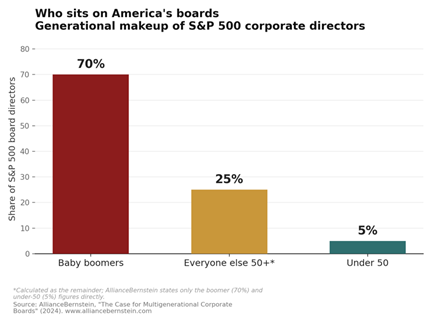
The business case is real. AllianceBernstein’s research on Russell 1000 firms found that companies with the widest board age variance produced the strongest annualised returns; those with the narrowest, the weakest. Baby boomers hold nearly 70% of S&P 500 seats, directors under 50 just 5%, and separate research on US banks found age-diverse boards, not simply younger ones, produce higher-quality earnings reporting, as a mixed-age board is less insular and more willing to challenge management. The evidence favours deliberate mixture, not youth over experience.
That trade-off is sharpest at the youngest end of the range. A director in their twenties will rarely have run a large team or carried operational responsibility in a downturn, and boards are right to weigh it. But the SLID panel also pointed to sustainability: younger directors typically bring a stronger sense of ESG issues, and are well placed to lead on them. Inexperience is a real cost. A board with no one under forty is a bigger one.
A cultural obstacle regulation alone cannot fix
What makes this harder to solve here than in London or New York is culture, and it cuts both ways. Respect for age runs deep, often linked to Buddhist and South Asian norms in which seniority functions as a proxy for wisdom, a dynamic Sri Lankan directors have described from experience: young directors, they say, must work harder than established colleagues simply to be heard. The same culture also runs the other way: younger professionals are often seen as inexperienced and not yet ready, regardless of what they have achieved. “Wait your turn” is a familiar, unspoken rule of Sri Lankan professional life, holding capable people in their twenties and thirties back from rooms where their judgement would be tested, on account of age alone.
Colombo Stock Exchange boards are also heavily populated by family conglomerates, where succession passes through trusted, senior circles. Younger faces that do appear are often the founder’s son or daughter, next in line, rather than an independent director appointed on merit. That is succession, not diversity, and it carries none of the same benefit. Age diversity here has to fix both problems: the gatekeeping that treats youth as a disqualifier, and the family succession that substitutes for real inclusion.
What boards should do
Nomination committees should treat age as they already treat gender: a criterion planned for, not left to chance. That means age-range targets, resisting the habit of filling vacancies from the same small pool of retired executives or founding-family heirs, and giving independent directors in their twenties, thirties and forties genuine committee roles, not symbolic ones. This is not an argument for discarding experience; a board of only young directors would be as unbalanced as one of only old. The goal is variance, deliberately built.
SLID’s Young Directors Forum and the 2026 Summit are welcome signs of that shift. What is still missing is a way to check compliance with the disclosure requirement, and a boardroom culture willing to let youth speak as loudly as seniority. A genuinely age-diverse board would be a low-cost, high-signal way to show governance reform here is substantive rather than cosmetic.
(The writer teaches Accounting and Finance at the University of Buckingham UK)
Sources
*The Sri Lanka Institute of Directors, Young Directors Forum Session 1 – Refreshing the Boardroom: In Conversation with Young Directors, 15 June 2022
*Sri Lanka Institute of Directors (SLID), Sri Lanka Corporate Director Summit 2026, 22 July 2026
*Securities and Exchange Commission of Sri Lanka, Consultation Paper on Revising Corporate Governance Rules
*The Conference Board, Board Composition Report 2025
*AllianceBernstein, The Case for Multigenerational Corporate Boards (2024)
*Janahi, Millo and Voulgaris, Age Diversity and the Monitoring Role of Corporate Boards: Evidence from Banks, Human Relations (2023)
Disclaimer: The views and opinions expressed in this article are those of the writer and do not necessarily reflect the official position of this publication.













Leave a comment