
By Veeragathy Thanabalasingham
23 September, exactly two years were completed since Anura Kumara Dissanayake (AKD), leader of the National People’s Power (NPP), took oath as the Executive President. In the trajectory of Sri Lanka’s political history, the presidential election held on September 21, 2024, marked a crucial turning point.
Since the introduction of the Executive Presidential system of governance in 1978, nine presidents have held office, including Dissanayake. For generations, the political power of the country was revolving solely within the hands of a specific traditional elite political class. Except for three individuals —Ranasinghe Premadasa, Maithripala Sirisena, and Anura Kumara Dissanayake — the remaining six presidents belonged to elite backgrounds, family legacies, and the structures of traditional political parties.
Among them, Dissanayake’s arrival is highly unique. Coming from a simple agricultural family background in Thambuttegama in the North Central Province, emerging as the leader of the Janatha Vimukthi Peramuna (JVP) — which carries a historical background of armed insurgencies — and rising to become the ninth Executive President of the country through the National People’s Power was described as a “class shift in political power.”
The shift in political power
After Dissanayake took oath as President on September 23, 2024, leading political science professor Jayadeva Uyangoda wrote in an article titled “Power Shift and Political Upheaval in Sri Lanka”: “The swearing-in of Dissanayake as the new President marks a historically significant new beginning. It symbolizes a sudden shift in the class foundations of political power. That is, power bases have shifted from a small, wealthy segment following a Westernized lifestyle centered in Colombo toward a coalition of non-elite social forces.
“If Sri Lanka’s democracy guaranteed an unbroken continuity of elite political power since gaining independence from colonial rulers in 1948, it has now brought about a departure from the past. This is a dramatic moment that democracy and free, fair elections can occasionally produce.
“In particular, the presidential election result represents a peaceful — bloodshed-free — transfer of power. The new President has received his mandate with the promise to completely transform a corrupt, outdated system of governance that had persisted like a birthright of wealthy social classes for nearly seven decades. The class monopoly over political power institutionalized through democracy has now been shattered by the general public themselves.
“As representatives who do not belong to elite social classes, President Dissanayake and the National People’s Power government carry the responsibility to prove that they can function as effective rulers and genuine democrats who respect the sentiments of the people demanding true change.”
In this context, as President Dissanayake completed two years in office, this column analyzes his governance, achievements, shortcomings, and potential future trajectories in comparison to the governance styles of previous presidents.
Policy decisions
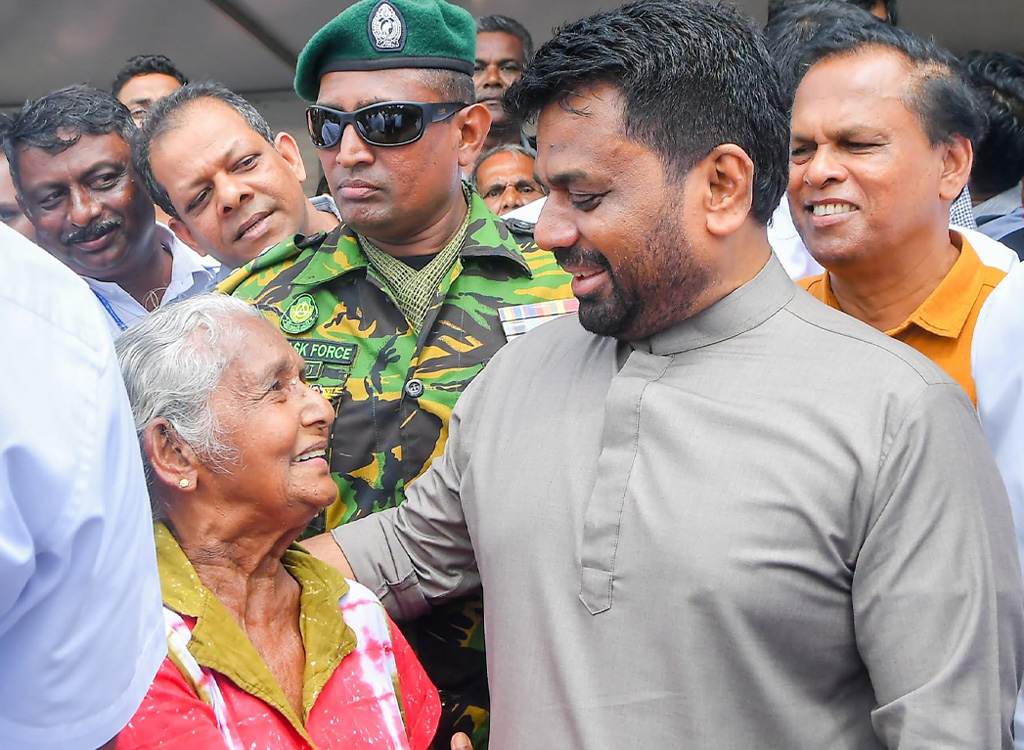
Traditional political elites, from J.R. Jayewardene to Ranil Wickremesinghe, maintained the presidency as the supreme center of power, surrounded by luxury and heavy security entourages. However, true to his simple background, Dissanayake focuses on presenting himself to the public as an unpretentious President in both appearance and practice.
In many previous administrations (particularly during the rule of the Rajapaksa brothers), family dominance was at its peak across all branches of governance. In Dissanayake’s administration, the complete absence of family-dominated politics stands out as a significant shift. One cannot even spot the President or ministers in public with their spouses.
Despite various criticisms regarding the JVP’s Marxist background, because the administration operates under the guidance of the NPP — which centers on a form of leftist discipline and collective leadership — priority is given to the party’s policy decisions rather than individual likes and dislikes. However, the fact that those very decisions face various criticisms is a separate matter.
Although coming to power by criticizing the International Monetary Fund (IMF) reform programme pursued by the Ranil Wickremesinghe government for economic recovery, the lack of a pragmatically viable alternative plan forced the NPP to continue the same agreement to prevent further economic decline. Whether the NPP possesses a distinct economic policy of its own remains unclear to anyone.
In line with campaign promises, the government finds itself bound by the conditions of international financial institutions, unable to offer tax cuts or substantial economic relief to middle- and working-class citizens. Although the NPP claimed during elections that the IMF agreement would be renegotiated, that has not proven possible over the past two years.
The public welcomes and supports the government’s efforts to expedite investigations into past corruption and financial frauds, as well as its attempts to introduce transparency into the public sector wherever possible. The steps taken by the government to curb drug trafficking and the activities of underworld gangs are noteworthy.
Issues of minority communities
However, regarding the issues of minority communities — specifically the legitimate political aspirations, power-sharing, and humanitarian issues arising from the three-decade war facing the Tamil-speaking people of the North and East — the NPP government displays hesitation similar to previous administrations.
President Dissanayake and government leaders repeatedly assert that treating all communities equally and ensuring that racism and religious extremism do not resurface are their firm policies. However, simply talking about the principle of equality without resolving the distinct problems faced by Tamil people as a consequence of the war is meaningless.
The government shows little inclination to release fertile lands belonging to civilians currently held by the military in the North and East, or to establish truth-finding mechanisms regarding past war crimes and enforced disappearances.
Having promised upon assuming office to hold Provincial Council elections within one year, the NPP has failed to fulfill this promise even as two years have passed. Instead, suspicions are growing among the public that the government is employing tactical maneuvers, such as parliamentary select committees, to further delay these elections.
The JVP carries a bitter history of fiercely opposing all past attempts at power-sharing. Therefore, there is little reason to believe that the NPP government holds any genuine interest in conducting Provincial Council elections or implementing the 13th Amendment to the Constitution.
Doubts over 13th Amendment
The Provincial Council system, introduced nearly 40 years ago due to Indian intervention, remains the only legal provision for power-sharing within the Sri Lankan Constitution. Under the current government controlled by the JVP, deep doubts naturally arise regarding its ultimate fate.
JVP leaders, including General Secretary Tilvin Silva, maintain that the Provincial Council system will continue until a new Constitution is introduced. Administering provinces through Governors — who are direct representatives of the President — without holding Provincial Council elections is tantamount to making a mockery of the principle of power-sharing. The government can earn the trust of the Tamil people on this matter only if it ensures that provinces are managed by elected representatives until a new Constitution is brought in.
Because the NPP is new to governance and lacks experience in handling the traditional state machinery and top-tier bureaucracy due to the class background of its leaders, it faces challenges in implementing certain policy decisions. Key ministers have expressed this openly with frustration. This demonstrates that effective change cannot be brought about while retaining the old state apparatus intact, which historically served the traditional political elite.
Challenges remain
President Dissanayake will face severe challenges during the remaining three years of his term. Drafting a new constitution toward the latter part of a government’s tenure involves facing various political strains. Strong doubts arise as to whether the Executive Presidential system will actually be abolished during Dissanayake’s current term.
The reality is that President Dissanayake is transforming into a “social democrat,” aligning with the capitalist global economic system rather than pushing leftist ideologies.
As IMF conditions and debt restructuring processes continue, if the government fails to fulfill public expectations, it will inevitably face resistance from trade unions and mass organizations.
The success or failure of President Dissanayake’s future governance rests heavily on his decisions regarding power-sharing and reforms that recognize Sri Lanka’s diversity and win the trust of minority communities.
Meanwhile, the political relationship between JVP General Secretary Tilvin Silva and President Dissanayake — and the perception of Silva as the force operating behind the President — is a key element closely observed in contemporary Sri Lankan politics.
While Dissanayake serves as the face of the JVP and its popular leader, Silva operates as the chief organizer holding control over party structures and ideological discipline.
Traditionally in Sri Lankan politics, the President serves as the absolute center of power within their party. However, in the case of the JVP, even though Dissanayake holds the office of Executive President of the country, Silva’s influence as General Secretary appears far greater when it comes to party decisions and policy formulation.
Although the cabinet led by Dissanayake handles state administration, Silva acts as the bridge coordinating party cadres’ expectations with government decisions. Political analysts point out the emergence of dual centers of power; the Presidential Secretariat on one side and the JVP Headquarters in Pelawatte on the other.
Observers widely opinionate that if public dissatisfaction grows in the future due to intensified IMF conditions or economic restructuring, ideological conflicts could emerge between Silva’s hardline leftist faction within the party and President Dissanayake, who faces practical administrative challenges.
At the same time, conflicting views exist regarding the current popularity of the NPP government and President Dissanayake. Although criticisms and a dip in support are visible in certain areas compared to the high initial expectations, overall public satisfaction appears relatively stable.
The NPP, which secured 61% of the vote in the 2024 Parliamentary election, managed to obtain only 43% in the 2025 Local Government elections. This decline is believed to be one of the reasons behind the government’s lack of urgency in conducting Provincial Council elections.
Even as dissatisfaction against the government emerges, the absence of a strong and credible opposition serves as an advantageous factor for the administration. The lack of a leadership personality among opposition parties capable of rivaling Dissanayake is another contributing factor.
As the initial “intense wave of support” subsides and citizens confront practical economic hardships, a natural decline in the NPP’s influence is bound to occur. It is likely for this reason that President Dissanayake decided to lead rallies district by district to mobilize public support for their positions.
(The writer is a senior journalist based in Colombo)
Disclaimer: The views and opinions expressed in this article are those of the writer and do not necessarily reflect the official position of this publication.








Leave a comment