
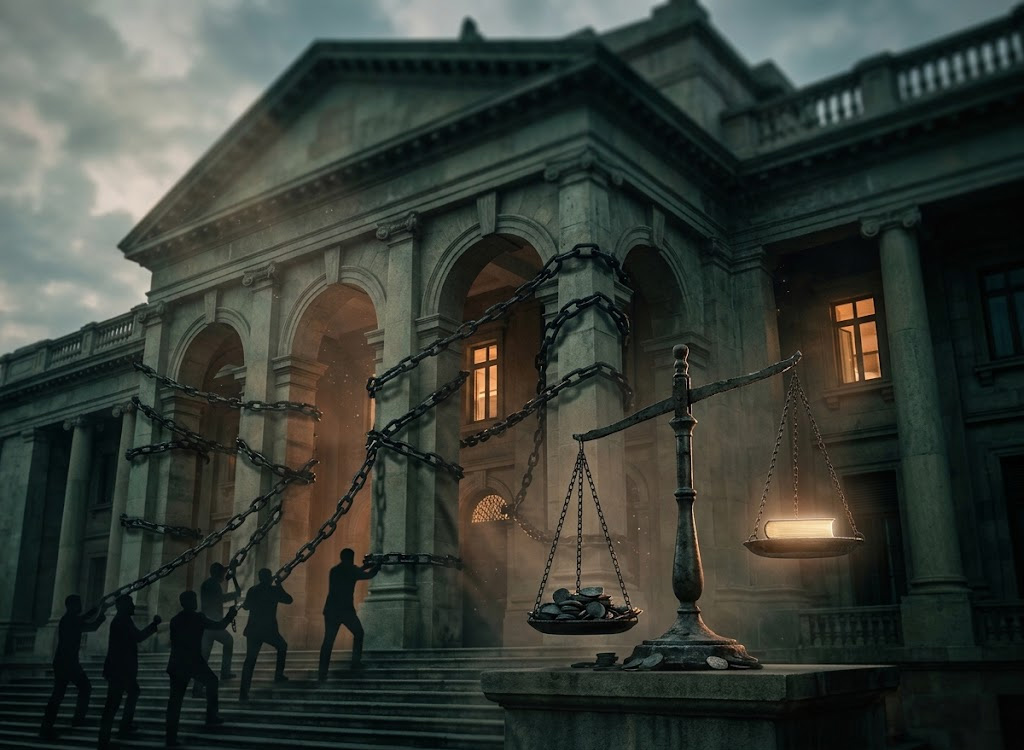
By Vox Civis
There comes a time every now and then in the life of a democracy when the danger is not that something dramatic happens, but that something profoundly consequential happens without the people noticing. Sri Lanka may be approaching just such a period.
The National People’s Power (NPP) government is seeking to introduce a constitutional amendment that would alter the retirement ages of judges of the superior courts. The proposal has generated extraordinary resistance from the legal community, including leading President’s Counsel and the Bar Association of Sri Lanka (BASL), while concerns have also been expressed by the collective political opposition and sections of civil society. Yet, outside Parliament, the legal profession and the media, there has been remarkably little public agitation.
That silence is perhaps the most disconcerting aspect of all. Consider for a moment what would have happened had the political circumstances been reversed. Imagine that a United National Party (UNP) or Samagi Jana Balawegaya (SJB) government had suddenly proposed, without prior consultation with the legal profession or other stakeholders, to extend the retirement age of judges in a manner capable of affecting incumbent judges. And imagine that the JVP/NPP were sitting in opposition.
Would the response have been confined to parliamentary speeches, press conferences and interviews? It is difficult to believe it would have been. The streets might well have filled with protesters. The issue would have become a major rallying point for mass mobilisation. Yet today, when the political roles are reversed, the streets remain largely quiet.
Silence of the public
One cannot entirely blame the public for that. Most citizens have little reason to mobilise over a constitutional amendment whose consequences are technical, abstract and difficult to understand. Judicial independence is an invisible public good. Its value becomes most apparent only after it has been compromised. The ordinary voter is also influenced less by constitutional jurisprudence than by political narratives. Facts, figures and institutional arguments rarely compete successfully with the loudest political voice.
This is why the absence of a powerful public response from the collective opposition is more than a political failure, and risks becoming a national failure. If the opposition believes that the proposed amendment poses a serious threat to judicial independence, it cannot expect the public to discover that threat by itself. Democracies do not protect institutions merely through legal submissions. They protect them through public vigilance.
The central question is deceptively simple: why is this amendment necessary? The increase in the retirement age of superior court judges was not, so far as the publicly articulated problem is concerned, a recommendation emerging from the various studies and reports dealing with Sri Lanka’s enormous backlog of cases.
Nobody disputes that the judicial system requires urgent reform. Cases take too long. Judges are overburdened. Courts require better infrastructure, more staff, greater use of technology and more efficient administrative systems. The Government Analyst’s Department, which is often a bottleneck in criminal proceedings, requires greater capacity. But none of these problems necessarily requires changing the retirement age of incumbent judges.
The government has presented the amendment as part of an effort to improve the administration of justice. But when a measure affecting the tenure of judges is introduced at extraordinary speed, against the objections of almost the entirety of the legal community and without first building consensus among those most directly affected, legitimate questions arise about the real purpose.
Ultimate irony
The irony is that the amendment may now produce the very constitutional confrontation that should have been avoided. Legal challenges are expected to be filed when Parliament considers the legislation. A group of President’s Counsel has already indicated that petitions will be brought before the Supreme Court, while the Joint Opposition, through Professor G. L. Peiris, has also indicated that it intends to challenge the legislation and seek a determination that a referendum is required.
The government has announced that the Bill will be presented to Parliament on August 18. Chief Opposition Whip Gayantha Karunathilleke has indicated that while there is no objection to tabling the Bill, the public should be allowed two weeks to submit objections, with the subsequent parliamentary timetable to be determined according to the Standing Orders.
The most consequential argument, however, concerns a 2022 Supreme Court determination. In the case involving the proposed constitutional amendment then under consideration, a three-member bench comprising Justices Buwaneka Aluwihare, Murdu N. B. Fernando and Janak de Silva held that a constitutional amendment affecting the retirement age or period of office of incumbent judges, directly or indirectly, could impinge upon judicial independence and therefore engage Article 3 of the Constitution, requiring approval at a referendum.
If that interpretation applies to the present proposal – as it must, the issue is not merely whether Parliament can pass the amendment with a two-thirds majority, but whether the people themselves must approve it. There is an extraordinary constitutional irony here. The very judges whose institutional independence is at stake could ultimately be called upon to determine the constitutional validity of legislation affecting the judiciary. That alone should make any government proceed with extraordinary caution.
Instead, the larger picture appears to be moving in the opposite direction. The retirement age is only one part of the proposed constitutional architecture. Other developments deserve equal scrutiny because they raise questions about the direction in which the state is moving.
The finer print
The proposed establishment of provincial courts has been presented in the name of administrative efficiency and faster justice. There is nothing objectionable about decentralising judicial services if it genuinely improves access to justice. But it is legitimate to ask why such a restructuring is being undertaken now, how it fits into the constitutional framework and what its long-term implications are.
Article 146 of the Constitution provides for a Court of Appeal. The introduction of provincial appellate structures therefore cannot be treated as a mere administrative adjustment. It potentially raises fundamental questions about the structure of judicial power itself. Would decentralised appellate institutions merely bring justice closer to citizens, or could they eventually create competing centres of judicial authority? What would happen when a provincial appellate determination conflicts with an interpretation of the national Court of Appeal? How would the hierarchy of judicial authority operate? These are not questions that should be dismissed as alarmism. They deserve answers before the architecture is changed.
The same applies to the proposed development framework for the Northern and Eastern Provinces recently announced by the government with World Bank funding. There is absolutely nothing wrong with investing in the North and East. On the contrary, those regions deserve development, investment, jobs, infrastructure and opportunity just as every other part of Sri Lanka does. But why should development be conceptualised as a joint North-East project?
Sri Lanka is one country comprising nine provinces. If the objective is development, why cannot the Northern Province have a Northern Development Programme and the Eastern Province an Eastern Development Programme, while both receive the resources they require? The terminology matters because history matters.
Sensitive terminology
The idea of merging the Northern and Eastern Provinces was one of the longstanding political demands associated with Tamil separatist politics and, with the LTTE. Even during the enormous pressure exerted on President J. R. Jayewardene by India in the aftermath of the Indo-Lanka Accord, the two provinces were not permanently merged.
Sri Lanka then entered three decades of war. Thousands of young Sri Lankans died. Others returned without limbs. Families were destroyed. Mothers buried sons; children grew up without fathers. Whatever one’s political interpretation of the war, one undeniable fact remains: an enormous human cost was paid in the name of preserving the territorial integrity of the country. That dark history cannot simply be erased from the national memory.
Nor should every development initiative in the North and East be interpreted as a conspiracy to recreate the conditions of the past. That would be equally irresponsible. Development is development, and the people of those provinces should never be deprived of it because of historical sensitivities.
But because history is a sensitive subject, constitutional and administrative changes touching the territorial structure of the state must be approached with maximum transparency.
There are also questions surrounding reports of substantial external financing for development in the North and East, and growing speculation about understandings reached with India. If agreements have been signed with India, the public deserves to know what they contain. If there is nothing controversial in them, transparency should not be difficult. The last thing Sri Lanka needs now is an era of secret agreements.
Policy of official secrecy
The recent visit of India’s Foreign Secretary, followed by significant developments in this sphere, has inevitably generated questions. In earlier times, high-level Indian visits were accompanied by detailed briefings, joint statements and extensive media coverage. If the substance of contemporary discussions is now increasingly handled behind closed doors, the government should understand that secrecy does not eliminate suspicion. It magnifies it.
Nor can development of the North and East be used as an excuse to neglect the rest of the country. There are people in the South, Central, North Central, North Western, Uva and Sabaragamuwa Provinces, especially those badly affected by cyclone Ditwah, who are unemployed, under-housed and economically desperate. If citizens are equal before the Constitution, development policy must ultimately reflect that equality.
No Sri Lankan should receive less opportunity because of ethnicity, religion, caste or geography. Equally, no Sri Lankan should receive more constitutional significance because of those characteristics. It is against this backdrop that allegations that the government is pandering to a particular diaspora agenda have gained traction. Statements made by MPs, including claims surrounding the controversial release of 323 containers allegedly destined for the North-East, have added fuel to the debate. Such claims must be investigated and the government’s response should be transparency, not dismissal.
The same principle applies to the broader question of state power. The NPP came to power promising a fundamental transformation of Sri Lanka’s political culture. Yet increasingly, critics argue that the government has moved beyond capturing government to capturing the state itself: placing politically aligned individuals in strategically important institutions and seeking influence over structures that are supposed to remain institutionally independent. That is a dangerous trajectory.
Hands off the State
The NPP must understand that governments win elections, but the state does not belong to the government of the day. The bureaucracy, the judiciary, the independent commissions, the audit function and other institutions of accountability belong to the Republic. Their purpose is to prevent whoever wins an election from acquiring unlimited power.
The judiciary is the ultimate safeguard in that architecture. If Parliament becomes politically dominant, the judiciary remains capable of reviewing Executive action. If the Executive becomes overbearing, the judiciary can enforce constitutional limits. If both political branches act together, citizens can still seek relief from the courts.
That is why judicial independence is the citizen’s last line of defence. It is also why the manner in which the President engaged the BASL is important. The President’s Media Division subsequently circulated a video titled as the views expressed by the President during his meeting with the BASL. Yet the video, as circulated, only presented the President’s own remarks rather than the questions and concerns raised by members of the Bar. That, understandably created a distorted impression of the consultation.
Further, a meeting held after legislation has already been gazetted cannot be portrayed as meaningful consultation if the fundamental decision has already been made. Consultation is not simply inviting stakeholders into a room and then proceeding regardless of what they say. Genuine consultation requires the possibility that the government might actually change course.
More importantly, the President’s reported exchange with President’s Counsel Upul Jayasuriya deserves to be understood in its entirety. Jayasuriya reportedly warned that the amendment could adversely affect the rule of law and that, even if passed by a two-thirds majority or approved by referendum, it could ultimately cost the President politically. The President’s reported response – that he was “prepared to take the risk and touch the judiciary” – is profoundly significant if accurately represented.
The Machiavellian resemblance
Likewise, the President’s statement that he did not intend to remain in office forever and was prepared to leave at any time should not be examined in isolation. If a leader genuinely has no personal interest in power, then the most convincing demonstration of that claim would be the willingness to retreat when almost every significant institutional constituency is warning that the proposed course is dangerous. The Maha Sangha, the legal profession, opposition parties, the UN and numerous intellectuals have expressed reservations. At the very least, the government should pause. Instead, the impression created is one of determination to proceed.
That is where the word ‘Machiavellian’ inevitably enters the political conversation. Not because the President should be casually labelled a Machiavellian figure, still less because every government action must be interpreted as a secret conspiracy, but because there is a striking contradiction between the language of humility and the pursuit of institutional power.
A leader who speaks like a reluctant holder of power but governs by progressively concentrating power invites the question: which should the public believe – the rhetoric or the record?
Over the past two years, critics argue, power has increasingly been concentrated at the center. Political influence has penetrated institutions traditionally expected to maintain independence. Local government structures have become intensely politicised. The law itself is increasingly perceived by opponents as a political instrument. If that perception becomes reality, Sri Lanka will have travelled a considerable distance from the promise of system change.
The greatest danger is not that one politician becomes too powerful, it is that a precedent is created whereby every future government believes it is entitled to do the same. Today it may be the NPP altering judicial tenure, tomorrow it could be an UNP, SJB or another government altering it in the opposite direction. Once the principle that the government may manipulate institutional tenure for political convenience is accepted, no judge can be completely insulated from political calculation.
That is why the issue transcends Anura Kumara Dissanayake and the NPP. It even transcends the present opposition. The question is whether Sri Lanka wants a state in which institutions constrain political power, or a state in which political power gradually captures institutions. And that brings us back to the quietness of the streets.
Danger of democratic erosion
Perhaps the public has not understood the danger because nothing has yet visibly been lost. The courts are still functioning: judges are still sitting and citizens can still file petitions. Parliament is still debating, and newspapers are still publishing criticism. But democratic erosion rarely announces itself with sirens because institutions are weakened incrementally: a tenure is changed here, an appointment is politicised there, an independent office is brought under pressure, a constitutional safeguard is reinterpreted, a convention is abandoned, and a precedent is established. The list goes on and by the time citizens finally understand what has happened, the institutional architecture may already have changed irreversibly.
Sri Lanka therefore needs neither hysteria nor conspiracy theories. It needs scrutiny. If the government’s objective is simply to clear the court backlog, then let it demonstrate why changing judicial retirement ages is indispensable. Let it explain why judges and the legal profession were not consulted before the legislation was gazetted. Let it address the 2022 Supreme Court determination. Let it explain the constitutional implications of provincial appellate courts. Let it publish the details of development agreements and international commitments. Let Parliament debate these matters transparently.
What Sri Lanka must not do is compromise judicial independence in order to solve an administrative problem. The judiciary cannot be treated as another department of government. Judges cannot be expected to dispense justice independently if their tenure can be altered by the political authority whose actions they may one day be required to review.
Nor should the public be distracted by arguments that reducing the judicial backlog justifies everything. The Constitution is not an inconvenience to be overcome by an elected government. It is the framework within which an elected government derives legitimacy. And this is ultimately what is at stake.
Disclaimer: The views and opinions expressed in this article are those of the writer and do not necessarily reflect the official position of this publication.










Leave a comment