
By Vox Civis
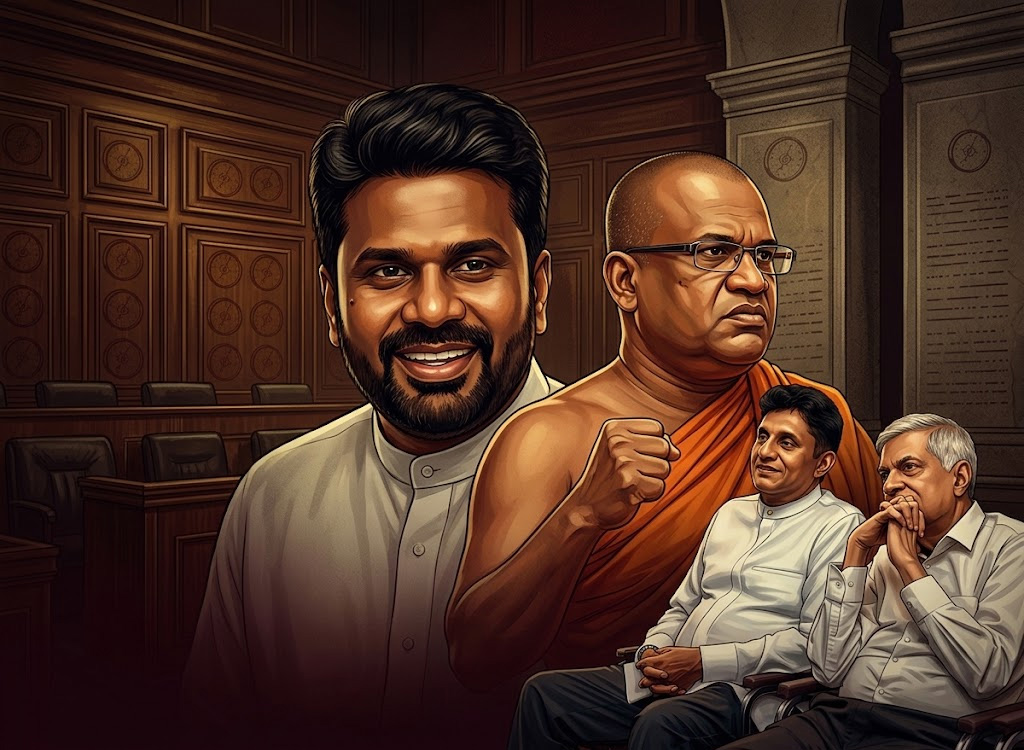
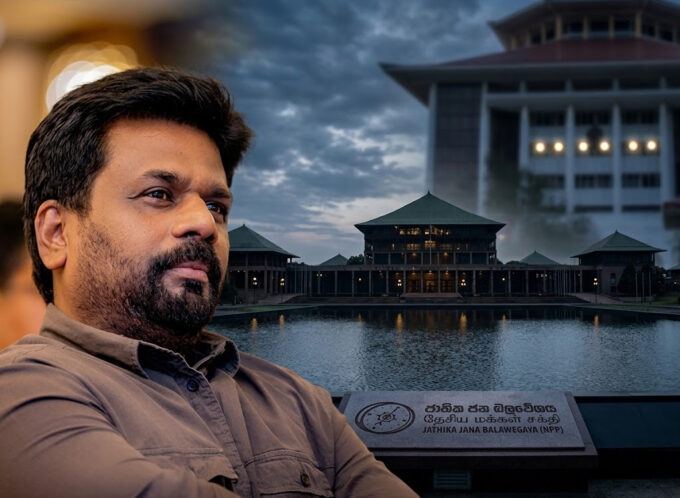
On Monday (21), the National People’s Power (NPP) government marks two years in office. That anniversary alone would not normally justify the flurry of rallies the President and his ministers have mounted across the country in recent weeks, staged with all the urgency of an election campaign though no election is in sight.
But two things are happening at once: the government appears to be trying to drown out mounting criticism of its proposed 22nd Amendment to the Constitution, and it is trying to arrest a visible erosion of its own popularity. These are not competing explanations; they are the same project, pursued on two fronts.
There is also another significant development that has been observed during these recent meetings, leading many to question as to whether it also signifies the JVP’s parting of ways with the ‘Malimawa,’ as none of the meetings featured the trademark purple colour branding seen thus far, or the presence of those representing that element of what is supposed to be an alliance.
Be that as it may, September 21 deserves to be marked, if only for the scale of what it represented two years ago, when Sri Lanka elected its first left leaning Marxist head of state. It was also the day that Sri Lanka elected, for the first time, a president who took office on the backing of a minority of voters, just 42 percent, a fact rarely mentioned in the government’s own account of its mandate. And it did so carrying the hope that the abolition of the executive presidency, promised by successive parties for three decades since 1994, might finally happen. Two years on, another anniversary is being celebrated while the promise has quietly joined the pile of pledges the NPP used to condemn its predecessors and has since inherited without comment.
Different proposition
What has become clear in the interim is that governing is a different discipline from opposing. Many of the government’s rally speeches still sound like opposition speeches, fluent in diagnosis, thin on delivery. The President has offered a rotating cast of excuses for unbuilt roads and unbuilt factories, a different one at each rally, and social media has had little difficulty lining them up side by side.
This is the ordinary cost of politics in an age when every promise is archived and searchable. But it is the newest excuse that deserves far more attention than it has received: the claim, now repeated by senior figures across the ruling party, that while the NPP holds “government,” it has not yet captured the “state.” And, it is that “failure” that is holding back the party from delivering all what it promised.
In ordinary parlance, the bureaucracy is what is referred to as the state and it is the mechanism that is in place to implement the policy decisions made by the elected government of the day. The two are distinct and constitutionally defined as separate entities with the state obliged to serve just one boss – the sovereign – which again is defined in the constitution as the people of Sri Lanka. Politicians in the past have endeavoured to blur the lines between the two but have taken the effort to make such attempts subtle; never as brazen as the ruling party of today.
The formulation of the term ‘state capture’ was coined by JVP General Secretary Tilvin Silva and has since been carried by figures including Deputy Minister Prasanna Gunasena and Senior Minister K.D. Lalkantha. On its face, it sounds like an abstraction, but it is not. To see why, it helps to ask what, concretely, this government cannot already do with the immense power the people have reposed in it already.
Sri Lanka’s state rests on three pillars: the executive, the legislature and the judiciary. The NPP holds the executive outright. It holds a two-thirds majority in Parliament, the strongest such majority in recent memory. It also holds the Cabinet and even the local government councils. It can implement any development project it wants, decide tax policy, formulate foreign policy, and also raise salaries, transfer officials, amend laws, and even amend the Constitution like it is doing at this very moment. Every power that any government has exercised in Sri Lanka since 1948 is a power this government already possesses in greater measure than most of its predecessors. So, what exactly is missing?
None ‘controlled’ the state
The honest answer is that no government in Sri Lanka’s history has ever held “state power” in the sense the NPP ministers now invoke, because that phrase does not describe a stronger government. It describes a different kind of state altogether: one in which the government is not merely powerful but total. The few such examples one can come up with is Stalin’s Soviet Union, Putin’s Russia, China, North Korea and Cuba.
Notably, none of the other countries on the planet today have governments with the kind of total control the NPP seems to be after. Even the most powerful man in the world, the President of the United States does not have such power, whatever his critics say of him; nor do the governments of Europe, Africa, the Americas or India. What distinguishes those latter systems, whatever their flaws, is exactly what ‘state power’ would erase: an independent judiciary that citizens can turn to when government overreaches, a free press government cannot silence, and constitutional guarantees on speech, worship and dissent that survive changes of government.
A party that already holds every lever available to a democratically elected government, and still insists it needs more, is not asking for the tools to govern. It is asking for the removal of the tools that hold governments accountable. And that is where the danger lies and where the Democratic Socialist Republic of Sri Lanka finds itself in at this point in time, if the “lack of state power” rhetoric is to be taken seriously.
This is not a hypothetical concern invented for effect. It sits inside the JVP’s own history. In a recent speech – uncontradicted to date – Minister Gunasena refers to the party’s failed attempts to seize power through force in 1971 and 1987-89, framing the party’s current position as a continuation of that unfinished project pursued through different means – a project that includes capture of the state – in the Minister’s words. Whether that was a slip of the tongue or a statement of intent, it validates the opposition’s argument that the deception runs deeper than unmet manifesto promises, and that the 2024 mandate is being treated by some in the party’s inner circle as a staging post rather than a settlement.
Dangerous confusion
People vote politicians into government power. They do not vote to hand any party a permanent, unaccountable state. The confusion of the two, whether born of ignorance or ambition, is the most serious test of Sri Lanka’s democratic architecture since independence – a test that cannot be ignored as mere political conjecture, given that the rhetoric is consistent and emanates from the very top.
Which is why the 22nd Amendment matters far beyond its stated purpose. The government’s justification is efficiency: clearing case backlogs and retaining experienced judges to speed up, among other things, corruption prosecutions.
The Bar Association of Sri Lanka (BASL) along with a host of other local and global legal sector entities have objected sharply, arguing that altering the tenure of sitting judges strikes at judicial independence and, per a 2022 Supreme Court determination on a similar question, may require a referendum rather than a simple parliamentary vote. Parliament is scheduled to be informed of the court determination this coming week and is to debate the bill on September 24, with its second reading the following day. Therefore, the week ahead may do more to determine the shape of Sri Lankan governance for a generation than anything said at any rally this month or the next.
None of this is unfamiliar territory for a country that has lived through the consequences of power concentrated in one office. The post war Rajapaksa years, are a grim reminder of what ultimate government power can do. The lesson from that period was not that any particular leader was uniquely dangerous, but that democracy survives only where institutions can constrain a leader regardless of how popular he is. Removing those constraints does not just weaken an opposition; it removes the thing that makes the system a democracy at all.
The Wickremesinghe example
It is worth recalling, in this context, that Ranil Wickremesinghe stabilised a bankrupt country in two years while commanding a single seat in Parliament and no popular mandate of his own. He did it through institutions, not around them. That is the counter-example the government’s rhetoric conveniently ignores.
The irony is that this entire campaign of rallies requiring elaborate security details, overtime pay and catering for personnel drawn from the police, the military and the Presidential Security Division, all funded by the public – for what are ultimately personal political events – has produced diminishing returns for the NPP. Two years ago, a speech by Anura Kumara Dissanayake moved public opinion and dominated social media. That effect has largely faded, and the party’s own organisers are reportedly curtailing the planned rally schedule in response.
The cost-of-living pledges that carried the NPP from a historic three percent vote share to the presidency – cheaper electricity, fuel priced to reflect actual cost, tax-free Japanese vehicles, cheaper food, medicine and education – remain largely unmet. Inflation, which sat near zero when the government took office in September 2024, has climbed to 8.0 percent as of August, its highest level in three years. In addition, GDP growth has slowed to 4.2 percent in the second quarter of 2026, down from 5.1 percent in the first. The rupee remains under pressure, and there are growing reports of fuel shortages in parts of the country despite the quota system still being in place.
With the IMF programme coming to an end in a few months and debt repayments looming on the horizon, the regime needs to urgently shore up forex reserves by a sizeable quantum in the months ahead. Whether it’s up to the task is to be seen, while it preoccupies itself with distractions.
The government’s anti-corruption message, built around “catching thieves,” has also been undercut by its own selectivity. A stalled e-passport tender, dogged by unresolved allegations of irregularity, has faded quietly from public discussion, while ministers facing outstanding court warrants continue to serve without consequence. People do not assess the rule of law by what politicians say about it; they assess it by what they see applied, and applied unevenly it looks like something other than the rule of law.
NPP unifying the opposition
What the government may not have anticipated is that its own overreach has done more to unite the fractured opposition than any strategy the opposition could have devised itself. On September 17, the 120th birthday of Sri Lanka’s first executive president and architect of the present constitution, J.R. Jayewardene, more than 20 political parties, trade unions and civil society groups, spanning the SJB, UNP, SLPP, SLFP and smaller parties across the spectrum, signed a joint accord in Colombo, centered on democratic governance, judicial independence and fundamental rights.
On the same day, Opposition Leader Sajith Premadasa announced a new phase of cooperation between the SJB and the UNP, appearing alongside former President Ranil Wickremesinghe to describe a shared policy platform rather than a contest for position. Parties that agree on little else now agree that an independent judiciary is not a partisan issue but a precondition for having politics at all.
That is the choice now before Sri Lanka, and it cannot or will not be settled by a rally or two. A government can hold enormous power and still be a democratic government, bound by courts it does not control and rights it cannot suspend. The moment it insists it needs more than that, the question stops being about roads, factories or fuel prices, and becomes a question about whether the next government, if any, will inherit a democracy or something considerably narrower wearing its name.
Disclaimer: The views and opinions expressed in this article are those of the writer and do not necessarily reflect the official position of this publication.









Leave a comment