
By Vox Civis
No issue stays current in Sri Lanka longer than the regime in office wants it to. Issues come and go on demand. The 22nd Amendment, for all the controversy that surrounded it, is now a dead topic. Yet the law remains, and so do the effects it was designed to produce. The public, as it has for decades, is expected to endure a change it never asked for, until the next dead topic comes along.
Over the years this pattern has dulled the public’s sensitivity. Even the worst excesses of those in power are glossed over or shrugged off with a weary “what to do, that is our fate.” This is exactly the mindset any politician would want to cultivate: do anything, and get away with it. The 22nd Amendment ventured into constitutional territory that no government had entered in almost half a century, and the public’s response was resignation rather than resistance. It is this rotten pattern that people voted to change two years back, but as French writer, Jean-Baptiste Alphonse Karr noted in his journal Les Guêpes in 1849, “the more things change, the more they stay the same.”
Last week another unusual episode arrived, this time involving a different institution. A journalist, a member of a profession long accustomed to the state’s long arm, was seen on camera striking a member of law enforcement.
Incident outside Court
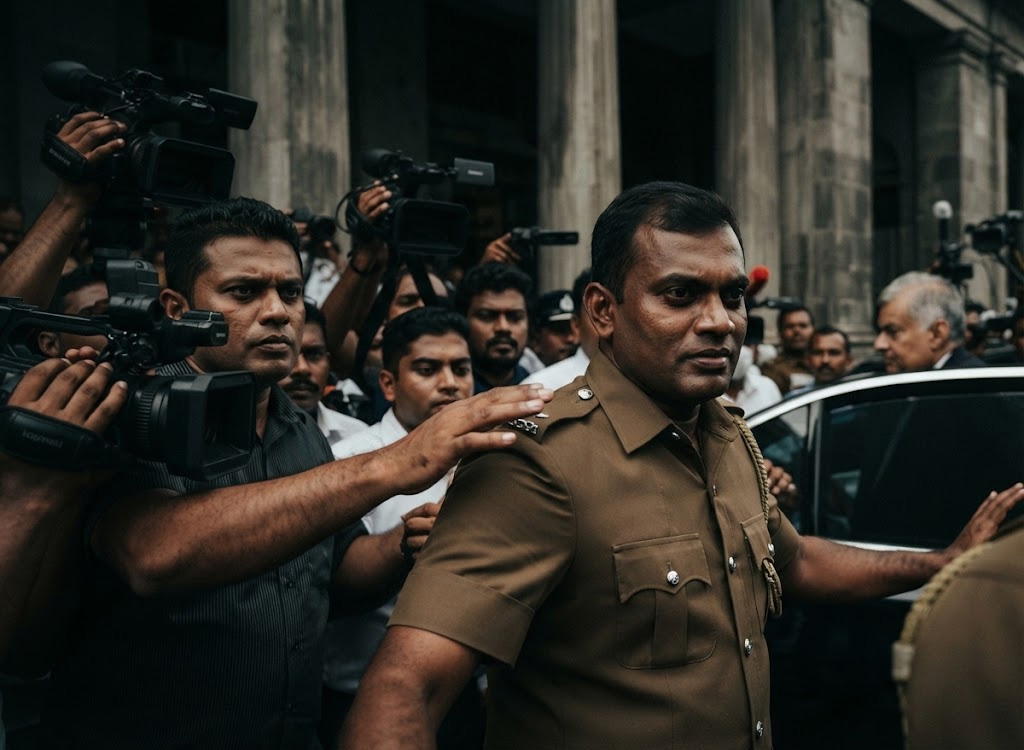
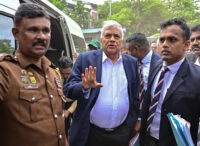
On September 30, a security officer attached to the personal protection unit of former President Ranil Wickremesinghe was openly struck on the head by a television cameraman outside the Colombo Fort Magistrate’s Court. Wickremesinghe was leaving after a hearing in a case filed against him by the Criminal Investigation Department (CID). Soon after the incident, the officer lodged a police complaint.
At a subsequent press conference, the UNP said the cameraman had struck the officer on the head with his camera while the officer was providing security to the Former President, and that the officer was hospitalised. The party also said other journalists covering the hearing had recorded the incident, and it questioned the adequacy of security at the court premises and whether there had in fact been a prior plan to harm Wickremesinghe.
These are allegations and the cameraman is entitled to the presumption of innocence. Whether the blow was deliberate or accidental, and whether there was any ‘plan’ behind it, as the UNP claims, are exactly the questions an investigation should answer. They are not matters for speculation by a political party, by the cameraman’s defenders, or by anyone else. But the footage that has circulated has left many viewers uneasy, and that unease deserves a serious institutional response rather than a shrug.
An echo from 1987
The incident recalls another from 1987, when Sri Lanka was preparing to enter the contentious Indo-Lanka Accord. At the time, the JVP was setting the backdrop for chaos in the south in opposition, and that opposition would eventually grow into a full-blown insurrection costing more than 60,000 lives and billions in damage to state property. Yet the seed of that episode was planted at a ceremonial event. A naval rating, part of the guard of honour for the visiting Indian Prime Minister Rajiv Gandhi opposite the President’s House in Fort, struck at Gandhi with his rifle. The blow, luckily, missed its intended target.
The actors and circumstances of 1987 and last week are glaringly different, and nothing here is meant to equate them. But the comparison is instructive for how the state responds. When the naval rating struck at Gandhi, he was treated as what he was, an individual acting alone. No one then or since has suggested that the Navy attacked Gandhi, and the police began investigating at once. Last week, by contrast, the cameraman’s own channel rushed to his defence even before a basic inquiry could establish what happened. An institution defending an individual before the facts are known is not defending journalism, but unnecessarily risking prejudging a case.
Suppose it was an accident, as some are suggesting. An accident has a recognisable shape. Most people who accidentally strike a stranger apologise on the spot, check that the person is all right, and settle the matter then and there. Why, then, did this one proceed to a hospital and then to a police station? And why, in a country where ordinary citizens have to wait a long time for the police to act on a complaint, was the cameraman reportedly granted police bail so swiftly in a case involving one of their own?
The question that follows is one every citizen can answer for themselves: could an ordinary member of the public who strikes an elite policeman on VIP duty at a court house expect the same leniency? Most Sri Lankans believe not, and that belief is at the heart of this matter. The issue is not whether the cameraman is a good or a bad man. It is that the law, when it chooses, can move with remarkable speed and gentleness, and that the choice appears, to many, to depend on who is involved. It is this very system that people assumed they changed, but apparently not.
A history that should counsel caution
In the days since, a few journalists have published lengthy character testimonials on social media for the man at the center of this controversy. They would do well to reflect that it is their own credibility they are putting on the line. Such testimonials before any inquiry has examined what happened, and a reputation for being a pleasant colleague is not a finding of fact. Equally, nothing before the public justifies assuming the worst about him. Character references and character assassination are both poor substitutes for a proper investigation, and a country that has learned hard lessons about the limits of public assumptions should insist on the latter.
Wickremesinghe may not be everyone’s cup of tea, but he remains one of Sri Lanka’s significant political figures. He steered the country through its bankruptcy, has served as prime minister five times, and sat in cabinet for a very long time. One need not admire his politics to see that an incident involving his protective detail while he himself was just inches away, is not trivial.
This country has witnessed more than enough attacks on its leaders, and far too many of them succeeded. It is a bitter irony that Wickremesinghe himself rose to the UNP’s leadership because that party’s senior ranks were wiped out in a single bomb attack at an election rally in 1994, months after President Ranasinghe Premadasa was assassinated on the streets on May Day 1993. President Chandrika Kumaratunga survived an assassination attempt, though she lost an eye, and both Mahinda and Gotabaya Rajapaksa faced persistent threats while in the highest office.
Against this history, a security establishment that treats an incident at a court gate as something to be explained away quickly would have forgotten what it is for. Any characterisation of the blow, whether as accident or otherwise, should come from law enforcement after an inquiry, not from a television channel or sympathetic commentators.
When Rajiv Gandhi was struck with a rifle butt, the police investigated immediately, because incidents of this kind cannot be ignored. They touch on national security. No one arrives with a signboard announcing a plan to attack, and threats come in many forms. Who would have thought the young sons of a successful businessman would turn out be suicide bombers as in the Easter terror attacks? That is why every such incident deserves a proper look.
There is also a matter of institutional trust. Police officers must be confident that the protection of the law and the support of their institution are guaranteed, from the lowest-ranking constable to the highest. The moment that trust is broken, the morale of the service suffers, and so does public confidence in law and order. It is therefore the duty of the Inspector General of Police to show that the honour of the uniform is not preserved merely by wearing it. It is upheld by applying the law fairly on behalf of the officers who perform their duties in that uniform. If that cannot be done, the uniform loses its meaning.
Two incidents, two perceptions
This brings us to another comparison that has done much to shape public opinion. Opposition MP Chaminda Wijesiri was recently sentenced to one and a half years in prison for verbally abusing two police officers and obstructing their duties. The courts reached that decision on the evidence before them, and it is not for this column to second-guess it. But the public never saw video footage of that incident. Here, by contrast, in front of a court and in the presence of senior police officers, a camera operator is seen on television footage from multiple angles, striking a police sergeant of the VIP security division. Not only the officers present, but viewers across the country and beyond, have seen the footage and come to their own conclusions.
The sergeant was carrying out a duty assigned to him by the government and the Police Department. According to accounts of the incident, the man involved was able to leave the scene without difficulty in front of senior officers.
Set side by side, the two cases invite a painful question. In one, an opposition politician faces a prison term for words, in a matter where the public saw no recording. In the other, a physical blow reportedly captured from several angles has so far been met with swift bail and a chorus of explanations. The cases differ in their facts and in their legal particulars, and the courts will have their say in the second as they did in the first, if and when the police decide to pursue the matter. But it is no surprise that many Sri Lankans see in the contrast, a legitimate question about equality.
Power, patience and public trust
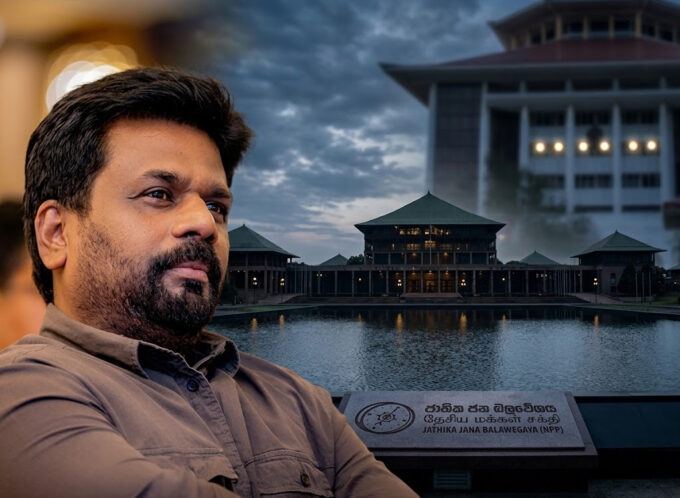
It is worth recalling how the present government arrived. For decades the JVP tried to seize power through rebellion and did not succeed. It then changed strategy, entered the democratic framework as a political party, and eventually won office. That journey deserves recognition as a transformation. Yet critics, including many in the opposition and in civil society, argue that the opportunity is now being used to entrench the party in office by weakening democratic and constitutional safeguards, and that political opponents are being pursued with undue zeal.
The government rejects such claims. Whatever one’s view, the suspicion that staying in power is being prioritised over the country’s development is widespread, and a government that wishes to dispel it must be seen to apply the law evenly.
This is the context in which the camera incident must be read. In isolation, it is a single confrontation at a court gate. Within a wider climate of suspicion about selective enforcement, it becomes a test of whether the law is an instrument of justice or of convenience. A government serious about the rule of law would want this matter investigated transparently, not because Wickremesinghe is owed special treatment, but because the principle at stake is simple: no one should be able to strike a police officer on duty and receive different treatment depending on his affiliations. That the incident occurred in the full glare of the media is all the more reason to ensure that justice is not only done, but also seen to be done.
What the public is entitled to expect
There is a growing perception in society that those in positions of power preach democracy, the catching of rogues and the protection of freedom, while their collective actions say otherwise. After all, actions speak louder than words. Therefore, if the NPP is serious about its role and what it supposedly stands for, it should urgently address this growing negative perception through action, not words.
It is not something complicated. An independent and prompt investigation should establish what happened, whether the blow was deliberate, whether there was any motive or plan, and whether security at the court was adequate. The same standards should apply to the cameraman as to any citizen accused of raising a hand against a police officer, and to every politician, journalist and ordinary person who has stood before the courts. The media, for its part, should defend its members’ right to report freely, but never at the cost of its own credibility, and never by presuming the outcome of an inquiry that has barely begun.
Until these things happen, the public will keep drawing the conclusion it has already drawn: that in Sri Lanka the law is too often a matter of who you are rather than what you did. For a country that has paid so heavily in the past for institutions that failed to take threats seriously, that is a perception no government should be comfortable allowing to take root.
Disclaimer: The views and opinions expressed in this article are those of the writer and do not necessarily reflect the official position of this publication.






Leave a comment