
By The Pulseline News Desk
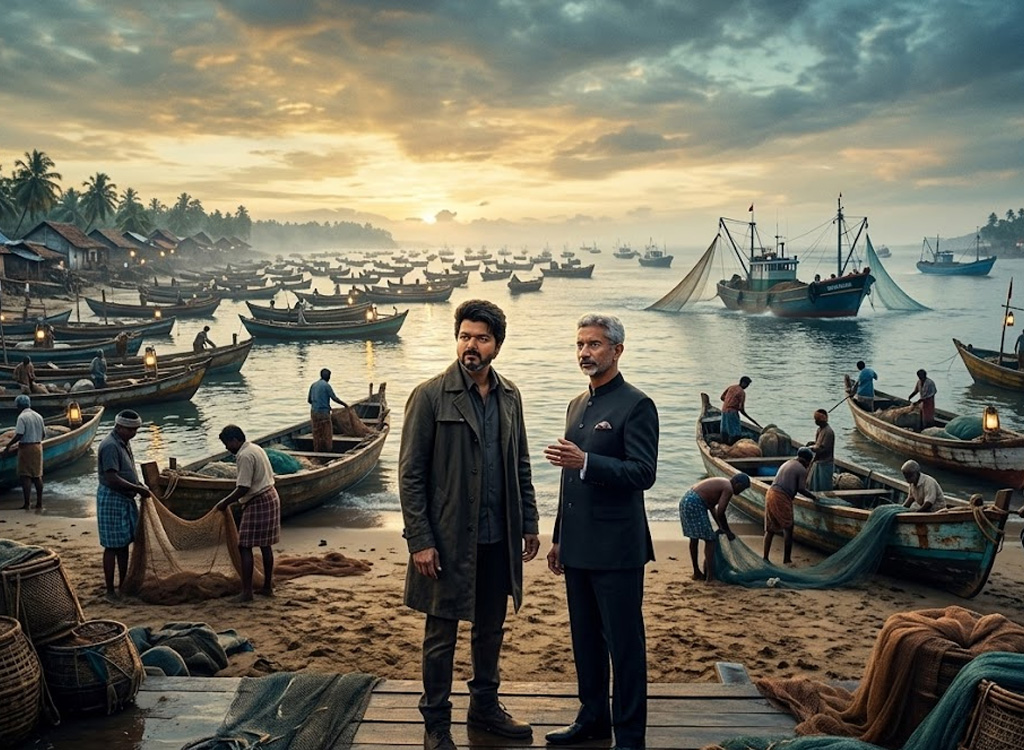
The detention of Indian fishermen by the Sri Lankan Navy has once again brought the troubled waters of the Palk Strait into political and diplomatic focus. This time, the issue has drawn heightened attention after Tamil Nadu Chief Minister C. Joseph Vijay intervened directly, urging the Indian government to secure the release of fishermen currently held in Sri Lankan custody.
In a letter addressed to India’s External Affairs Minister S. Jaishankar, Vijay appealed for urgent diplomatic efforts following the arrest of six fishermen from Tamil Nadu’s Ramanathapuram district. The fishermen were reportedly apprehended by the Sri Lankan Navy for allegedly crossing the International Maritime Boundary Line (IMBL) and fishing in Sri Lankan territorial waters.
The intervention marks one of Vijay’s first major engagements with a long-running and emotionally charged issue that has shaped politics, diplomacy, and coastal livelihoods in both India and Sri Lanka for decades.
But beyond the immediate arrests lies a far more complex and deeply rooted conflict – one driven by geography, history, depleted marine resources, and competing claims over survival at sea.
A narrow stretch of water, a deep divide
The Palk Strait, separating northern Sri Lanka from Tamil Nadu, is barely 30 nautical miles wide at some points. For generations, fishermen from both sides navigated these waters freely, long before modern maritime borders were formally established.
That changed after India and Sri Lanka signed maritime boundary agreements in 1974 and 1976, defining territorial waters and ceding the island of Katchatheevu to Sri Lanka. While the agreements were intended to settle jurisdictional disputes, they also transformed traditional fishing grounds into contested spaces.
Tamil Nadu fishermen, especially from Rameswaram and Mandapam, continued venturing into waters now controlled by Sri Lanka, arguing that the sea had historically been shared. Sri Lankan authorities, however, increasingly viewed such incursions as illegal fishing and poaching.
The tensions escalated sharply after the end of Sri Lanka’s civil war in 2009.
The post-war fishing crisis
During Sri Lanka’s three-decade civil war, large parts of the northern seas were heavily militarised, and many Sri Lankan Tamil fishermen were unable to fish freely. Indian trawlers from Tamil Nadu expanded their operations into these waters during that period, often using mechanised bottom-trawling techniques capable of harvesting large quantities of fish quickly.
When the war ended, northern Sri Lankan fishermen returned to sea, only to find their fishing grounds crowded by Indian trawlers.
For Sri Lankan fishermen in Jaffna, Mannar, and Mullaitivu, the issue was no longer merely about maritime boundaries. It became a question of economic survival.
Local fishermen accused Indian trawlers of “poaching” fish stocks, damaging seabeds through bottom trawling, and destroying traditional fishing nets. Environmentalists also warned that the practice was devastating marine ecosystems in the shallow waters of the Palk Bay.
Sri Lankan fishing unions repeatedly protested what they described as industrial-scale exploitation by Indian boats.
“The problem is not ordinary fishermen crossing accidentally,” a northern Sri Lankan fishermen’s association leader said during earlier bilateral talks. “It is the large trawlers that sweep away everything.”
Arrests, seizures, and political pressure
The Sri Lankan Navy intensified patrols after the war, leading to frequent arrests of Indian fishermen and seizures of fishing vessels. In response, Tamil Nadu political parties routinely demanded intervention from New Delhi, arguing that poor fishermen were being treated harshly.
Every arrest quickly becomes politically sensitive in Tamil Nadu, where coastal communities hold significant electoral influence. Successive chief ministers – from J. Jayalalithaa to M. K. Stalin – repeatedly pressed the Indian government to negotiate releases and prevent confrontations at sea.
Now Vijay has entered that political continuum.
In his latest appeal, the Chief Minister highlighted the growing number of detained fishermen and impounded boats, stressing the humanitarian impact on coastal families dependent on fishing for survival.
For families in Ramanathapuram, Nagapattinam, and Pudukottai, arrests can mean weeks or months without income. Boats worth millions of rupees are often confiscated, pushing fishermen into debt and financial ruin.
Yet on the Sri Lankan side, northern fishing communities argue that they too are struggling to survive amid declining fish stocks and economic hardship.
The trawling problem
At the heart of the conflict lies the issue of bottom trawling – a fishing method in which weighted nets scrape the seabed, collecting large catches but damaging marine habitats in the process.
Sri Lanka banned bottom trawling in its waters, but many Indian trawlers continue using the method due to economic pressures and declining fish stocks closer to the Indian coast.
Sri Lankan fishermen say Indian trawlers frequently enter their waters at night in large numbers, depleting resources meant for local communities using smaller, traditional fishing methods.
Marine experts warn that unless sustainable fishing practices are adopted, the ecological damage could become irreversible.
“The dispute is no longer only diplomatic,” one fisheries researcher noted during a regional maritime forum. “It is now an environmental and livelihood crisis.”
Diplomacy without resolution
India and Sri Lanka have held numerous rounds of talks involving diplomats, coast guards, and fishermen’s representatives. Joint working groups have been formed, promises made, and temporary releases negotiated.
Yet a lasting solution has remained elusive.
India has often sought leniency for arrested fishermen while avoiding direct endorsement of illegal fishing activities. Sri Lanka, meanwhile, faces pressure from northern fishing communities demanding stricter enforcement against repeated incursions.
The issue also intersects with Tamil ethnic politics. Many fishermen on both sides share linguistic and cultural ties, complicating nationalist narratives around the dispute.
Despite tensions, both governments have generally avoided allowing the conflict to escalate into a major diplomatic crisis. Arrested fishermen are often released after negotiations, though seized boats are not always returned.
Vijay’s political test
For Chief Minister Vijay, the fishermen issue represents both a humanitarian challenge and an early political test.
His intervention signals an attempt to position himself as a strong advocate for Tamil Nadu’s coastal communities while navigating a sensitive international issue involving New Delhi and Colombo.
Whether his appeal results in the quick release of the detained fishermen remains to be seen. But the episode has once again underscored the enduring volatility of the Palk Strait – where history, politics, ecology, and survival continue to collide.
For fishermen on both shores, the conflict is not an abstract diplomatic dispute. It is a daily reality shaped by uncertain seas, shrinking catches, and invisible maritime lines that have become some of South Asia’s most contested waters.









Leave a comment