
By The Pulseline News Desk
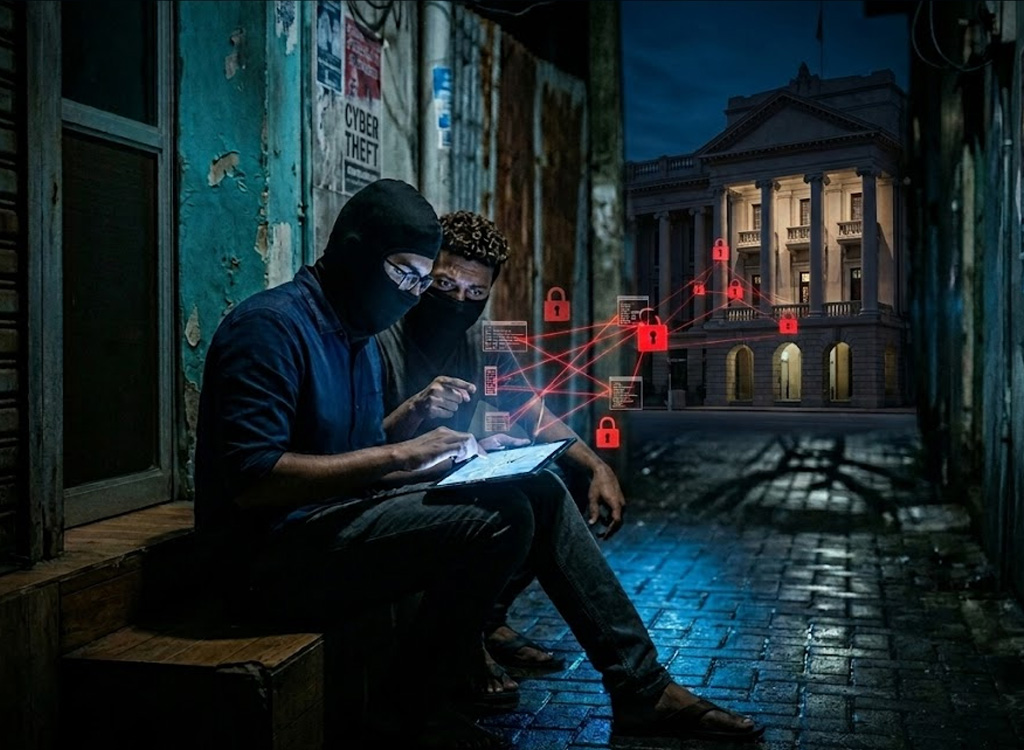
Sri Lanka is witnessing a sharp increase in cyber thefts and online financial fraud, raising serious concerns among authorities, financial institutions, and cybersecurity experts about the country’s preparedness to confront rapidly evolving digital threats.
As internet usage, online banking, and digital payment systems continue expanding across the country, cybercriminals are increasingly targeting individuals, businesses, and government institutions through sophisticated scams, phishing operations, identity theft, and financial fraud schemes.
Law enforcement officials say the nature of cybercrime in Sri Lanka has changed significantly in recent years. What were once isolated online scams have now evolved into highly organised operations often linked to transnational criminal networks operating across multiple countries.
Recent investigations and arrests have highlighted the growing scale of the threat. Authorities have uncovered several cyber fraud operations involving foreign nationals allegedly connected to international scam syndicates using Sri Lanka as a base for digital criminal activity. Security analysts warn that organised cybercrime groups are increasingly shifting operations into developing economies where digital infrastructure is expanding faster than cybersecurity enforcement capabilities.
Financial institutions have also reported increasing attempts to breach banking systems, manipulate online transactions, and exploit weak cybersecurity awareness among users. Experts say cybercriminals are taking advantage of limited digital literacy, inadequate security practices, and gaps in institutional coordination to carry out attacks with greater frequency.
The rise in cyber thefts has intensified calls for stronger national cybersecurity policies and improved law enforcement capacity. Authorities have acknowledged the growing challenge, with plans underway to strengthen cybercrime investigation units, improve digital monitoring systems, and enhance institutional cybersecurity frameworks.
Regional cooperation
However, cybersecurity professionals caution that domestic action alone will not be sufficient.
Experts argue that cybercrime has become fundamentally transnational, with criminal networks operating through complex systems involving cross-border financial transfers, cryptocurrency channels, encrypted communications, and international recruitment networks. As a result, they say Sri Lanka must deepen regional cooperation with neighboring countries to effectively combat the growing threat.
“Cybercrime today operates without borders,” a Colombo-based cybersecurity analyst said. “A scam may originate in one country, use servers in another, route payments through multiple jurisdictions, and target victims across the region. No country can tackle this challenge in isolation.”
Regional cooperation is increasingly being viewed as a critical component of cybersecurity strategy. Analysts say South Asian countries need stronger intelligence-sharing mechanisms, coordinated law enforcement operations, unified cybercrime legislation, and faster information exchange systems to disrupt organised digital criminal networks.
Security experts also emphasise the need for closer collaboration between governments, financial institutions, technology companies, and telecommunications providers. They argue that cyber threats are evolving too rapidly for traditional bureaucratic responses and require real-time coordination between both public and private sectors.
More investments in cybersecurity
At the same time, Sri Lanka faces a shortage of highly trained cybersecurity professionals. Industry observers say the country must invest more heavily in cybersecurity education, technical training, and digital forensic capabilities to build a workforce capable of responding to increasingly sophisticated attacks.
The growing dependence on digital systems following the expansion of e-commerce, online banking, and government digitalisation has made cybersecurity a national economic issue as much as a law enforcement concern. Experts warn that repeated cyber thefts could damage investor confidence, weaken trust in digital services, and expose critical infrastructure to future risks.
International organisations have repeatedly stressed that developing nations must prioritise cybersecurity resilience as part of broader economic modernization efforts. For Sri Lanka, analysts say this means moving beyond reactive enforcement and developing a long-term strategy focused on prevention, regional partnerships, public awareness, and technological investment.
Public concern over online fraud has also grown significantly, with many Sri Lankans reporting phishing attempts, fake investment schemes, social media scams, and unauthorized financial transactions. Cybersecurity specialists stress that public education will remain one of the most important defenses against digital crime.
As cyber threats continue to expand across Asia, the challenge facing Sri Lanka is no longer simply about responding to isolated online crimes. It is about building a resilient regional cybersecurity framework capable of protecting financial systems, businesses, institutions, and citizens in an increasingly interconnected digital environment.













Leave a comment