
By Chanakya
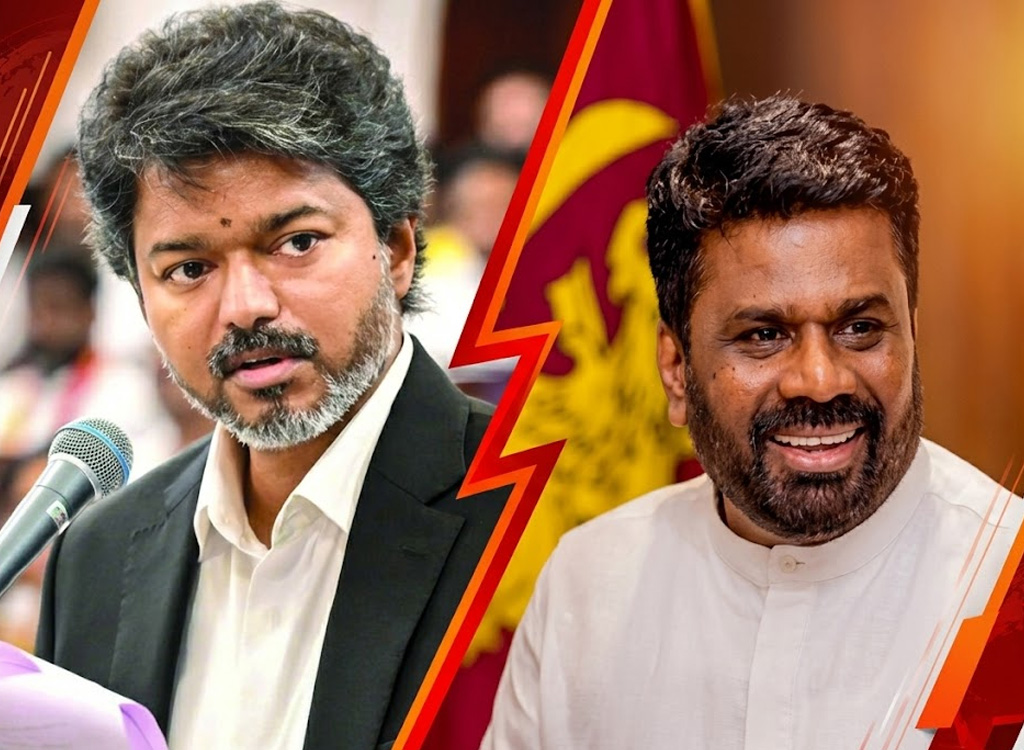
As South Asian politics continues to evolve, two very different political figures – Tamil film star-turned-politician Thalapathy Vijay and Sri Lanka’s President Anura Kumara Dissanayake (AKD) – are increasingly being compared in public discourse for their anti-establishment appeal and reformist messaging.
While operating in different political systems and stages of political maturity, both leaders have built narratives centred on challenging entrenched political elites, appealing to younger voters, and promising systemic change. However, analysts caution that the similarities are largely thematic rather than structural, and their political trajectories remain fundamentally different.
Anti-establishment positioning as a shared theme
One of the most visible points of comparison is their positioning as alternatives to traditional political establishments. Vijay’s entry into politics through Tamilaga Vettri Kazhagam (TVK) has been framed around the idea of rejecting entrenched political dynasties and long-dominant regional parties in Tamil Nadu.
Similarly, AKD’s rise within Sri Lankan politics has been driven by a long-standing critique of political privilege, corruption, and institutional decay, a message rooted in the ideology of his party, the Janatha Vimukthi Peramuna (JVP) and the National People’s Power (NPP) coalition headed by the party. His presidency reflects a transition from opposition politics into executive governance, with reform now being tested in practice rather than rhetoric.
Reformist messaging and youth appeal
Both figures also draw significant support from younger demographics and first-time political participants. Vijay’s political messaging has emphasized transparency, social justice, and governance reform, though his policy framework is still in its early stages of development as his party builds organisational depth.
AKD, by contrast, has a more established political programme shaped by decades of party ideology and parliamentary engagement. His administration has focused on anti-corruption measures, institutional reform, and restructuring state governance, reflecting a more detailed policy architecture than the emerging platform of TVK.
Key differences in ideology and governance
Despite surface-level parallels, analysts highlight substantial ideological and structural differences between the two leaders.
AKD’s political identity is rooted in a leftist tradition shaped by the JVP’s historical emphasis on state intervention, redistribution, and structural economic reform. His policy approach reflects an attempt to balance economic stabilization with institutional restructuring in a governing context.
Vijay’s political identity, however, is still evolving. His movement currently relies more on broad reformist themes than a clearly defined ideological framework. As a newly formed political force, TVK is still in the process of translating leadership appeal into policy detail and governance structures.
Another major difference lies in institutional experience. AKD operates as a head of state with executive authority, managing complex governance challenges and international obligations. Vijay remains in the early phase of political mobilisation, where influence is largely driven by public appeal rather than administrative responsibility.
Two models of political transition
Observers say the comparison between the two figures reflects a broader regional trend: the rise of non-traditional political actors who position themselves as alternatives to established parties.
However, the nature of their roles illustrates two distinct models. AKD represents a transition from opposition politics into governance, where promises of reform are tested against economic and institutional constraints. Vijay represents a transition from celebrity influence into political mobilisation, where public sentiment is being converted into organisational political capital.
As both continue to shape their respective political environments, analysts say the true measure of similarity will depend less on rhetoric and more on how each leader navigates the demands of governance, policy execution, and institutional accountability in the years ahead.
Disclaimer: The views and opinions expressed in this article are those of the writer and do not necessarily reflect the official position of this publication.












Leave a comment