
By The Pulseline News Desk
A stark assessment by the government of the state of Colombo’s public housing complexes has reignited debate over urban poverty, housing policy and the living conditions of thousands of low-income families.
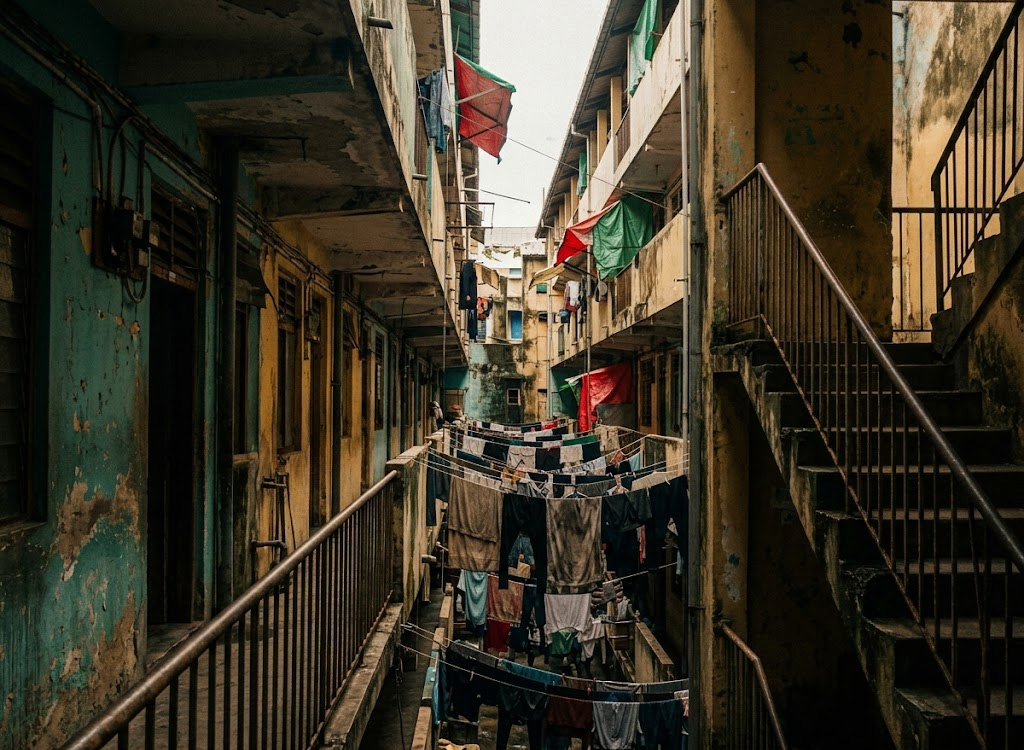
Speaking in Parliament, Deputy Minister of Urban Development Eranga Gunasekara described all 27 apartment housing schemes in Colombo as “hellholes,” acknowledging years of neglect that have left many residents struggling with deteriorating infrastructure, overcrowding and inadequate public services.
The remarks came in response to a question raised by opposition member of parliament (MP) Harsha de Silva and offered a rare public admission of the challenges facing some of the capital’s largest low-income housing communities.
“We are working to make these apartments suitable places for people to live,” the Deputy Minister told Parliament, outlining a government plan to rehabilitate and upgrade the housing schemes.
A legacy of urban relocation
Many of Colombo’s apartment housing complexes were constructed as part of successive urban development and relocation programmes aimed at rehousing families displaced by infrastructure projects, canal reservations, railway expansions and city beautification initiatives.
While the projects were intended to provide residents with safer and more secure accommodation, critics have long argued that inadequate maintenance, poor planning and a lack of social support services have contributed to the deterioration of living conditions in several complexes.
Residents and community activists have frequently complained about malfunctioning elevators, inadequate waste management, water supply issues, poor sanitation and the absence of recreational and community facilities.
The Deputy Minister’s comments appear to acknowledge the scale of these longstanding problems.
Rehabilitation programme
According to the government, efforts are now underway to improve living conditions across the housing schemes.
Gunasekara told Parliament that two apartment projects are expected to be completed during the current year, while a further 11 projects are scheduled for completion in the coming years.
Once completed, the programme is expected to accommodate approximately 7,000 residents.
Officials say the initiative forms part of a broader effort to improve urban housing standards while addressing the growing demand for affordable accommodation in the capital.
Who will receive the housing?
A key issue raised during the parliamentary discussion concerned the allocation of housing units.
The Deputy Minister stated that future residents would be selected based on social needs rather than political considerations, adding that the government is currently developing eligibility criteria for low-income households.
The proposed criteria are expected to determine which families qualify for housing assistance and how units will be distributed.
According to Gunasekara, the guidelines will be presented to Parliament once finalised, allowing MPs to review the framework before implementation.
Beyond buildings
Urban development experts note that housing policy extends beyond the construction of apartment blocks. Successful public housing programmes require long-term maintenance, social services, community engagement and sustainable management systems.
Without those elements, they argue, physical infrastructure alone cannot guarantee improved quality of life for residents.
The government’s rehabilitation plans therefore face a broader challenge: transforming aging housing estates into livable communities while ensuring that existing social and economic problems are not simply relocated from one building to another.
A test for urban renewal
For many residents, the government’s acknowledgement of the problems is a welcome first step. However, expectations remain high that the promised reforms will lead to tangible improvements rather than temporary fixes.
As Parliament awaits details of the proposed housing allocation criteria and the progress of the rehabilitation programme, the future of Colombo’s public housing sector is likely to remain under close scrutiny.













Leave a comment