
By The Pulseline News Desk
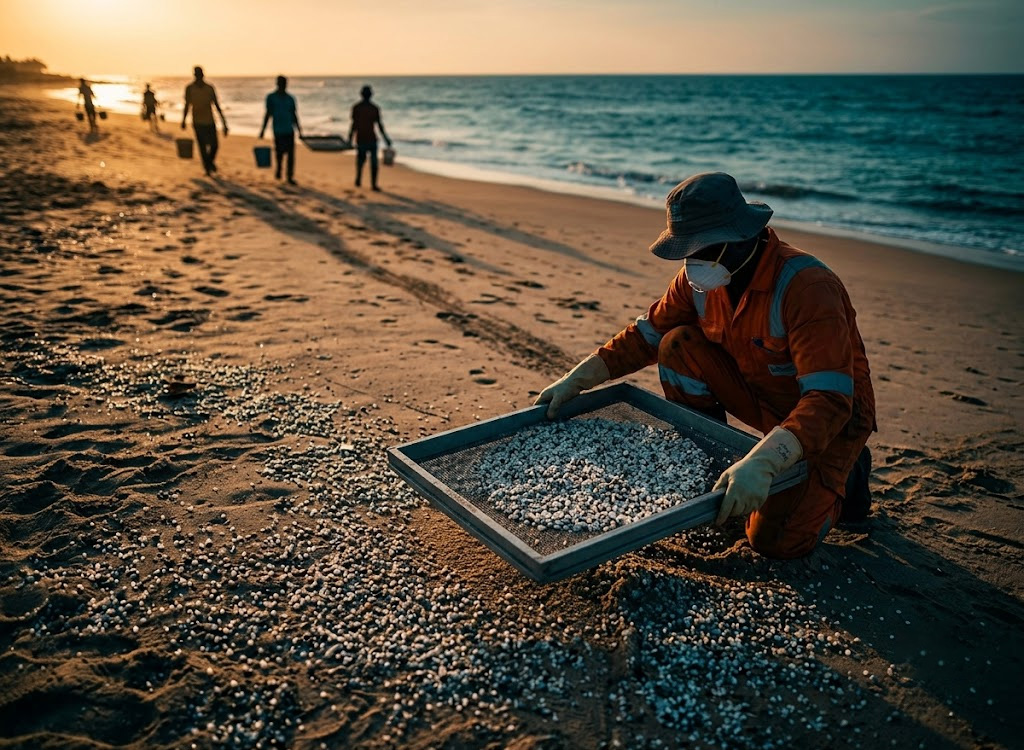
Nearly a year after millions of plastic nurdles began washing ashore following the sinking of the Liberian-flagged container vessel MSC ELSA 3 off the coast of Kerala, Sri Lanka is still grappling with one of the country’s largest marine pollution clean-up operations.
What began as a scattering of tiny plastic pellets on the beaches of Delft Island has evolved into a months-long environmental response stretching across the Northern and North Western coastlines, exposing both the vulnerability of Sri Lanka’s marine ecosystem and the country’s limited preparedness for large-scale maritime pollution incidents.
The first nurdles from the vessel were detected on Delft Island on June 11, 2025. Ocean currents soon carried them to Analathivu, Punkuduthivu, Nainativu, Mannar and Puttalam, contaminating beaches, coastal waters and sensitive marine habitats.
Unlike conventional plastic waste, nurdles – small plastic pellets used as raw material in the manufacture of plastic products – are particularly difficult to remove. Their tiny size allows them to mix with sand, become buried beneath beaches and remain in the environment for years. Marine animals frequently mistake them for food, allowing the pollution to move through the food chain.
The clean-up effort, coordinated by the Marine Environment Protection Authority (MEPA), has since become one of the largest environmental operations undertaken in Sri Lanka.
According to officials, approximately 1,700 workers have been deployed each day to collect nurdles, plastic bottles and other debris that washed ashore or accumulated on the seabed. The recovered waste is transported to the processing centre at Sethapola in Puttalam for sorting and disposal.
Over the past 322 days, authorities have carried out 17,212 beach clean-up programmes across 110 coastal locations, clearing an estimated 1.3 million square metres of shoreline. The scale of the operation illustrates the extraordinary resources required to deal with pollution originating far beyond Sri Lanka’s territorial waters.
The disaster also served as a reminder of the risks posed by the busy international shipping lanes that pass just south of the island.
MSC ELSA 3 was carrying 640 containers when it sank, including 13 containing hazardous materials and another 12 loaded with calcium carbide – a chemical that reacts violently with water. The vessel was also carrying more than 80 metric tonnes of diesel and over 360 metric tonnes of furnace oil, raising fears of a far more severe environmental catastrophe that had significant quantities of fuel escaped into the sea.
Speaking during a coastal clean-up programme at Kalpitiya, Deputy Environment Minister Anton Jayakody has said Sri Lanka must strengthen its capacity to respond to marine pollution emergencies.
With around 400 commercial vessels passing Sri Lanka each day, he warned that the country’s maritime zone remains constantly exposed to the risk of shipping accidents capable of causing extensive environmental damage.
His comments reflect a growing concern among environmental authorities that climate change, increasing maritime traffic and the transportation of hazardous cargo will make such incidents more frequent in the years ahead.
Officials noted that the shipping company has financed the removal of the plastic nurdles under the “polluter pays” principle, helping fund the extensive clean-up operation. While the financial support has eased some of the burden on the State, environmental experts note that restoring damaged ecosystems is far more complex than simply removing visible debris from beaches.
The MSC ELSA 3 incident has inevitably revived memories of the MV X-Press Pearl disaster in 2021, which released billions of nurdles into the sea after catching fire and sinking off Colombo. Although the latest incident has not matched the scale of that catastrophe, it has reinforced concerns that Sri Lanka remains highly exposed to pollution from accidents occurring along one of the world’s busiest shipping routes.
As authorities continue collecting plastic pellets from beaches nearly a year later, the clean-up has become more than an environmental exercise. It is a reminder that for an island nation whose economy, fisheries and biodiversity depend heavily on the ocean, maritime disasters do not end when a ship sinks. Their consequences can continue washing ashore long after the headlines have faded.











Leave a comment