
By The Pulseline News Desk
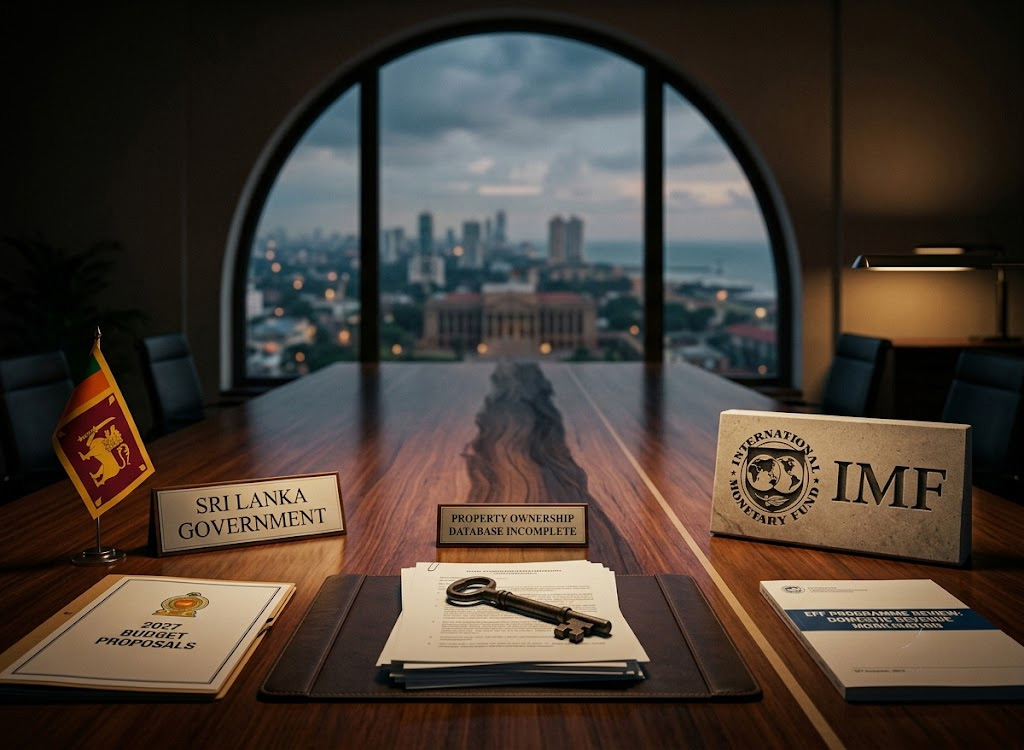
A fresh difference has emerged between the Government and the International Monetary Fund (IMF) over Sri Lanka’s tax policy, with the Fund reportedly pressing for the introduction of a tax on secondary residential properties while the Government insists it can meet its fiscal targets without imposing another levy on taxpayers.
The disagreement comes as officials finalise the 2027 Budget, highlighting the continuing balancing act between meeting IMF-backed revenue reforms and managing the political and economic realities of a country still recovering from its worst financial crisis in decades.
According to sources familiar with the budget discussions, the IMF has proposed that Sri Lanka introduce a tax on second and subsequent residential properties as part of its broader programme to strengthen domestic revenue mobilisation under the Extended Fund Facility (EFF).
The Government, however, has resisted the proposal, arguing that the revenue measures already being prepared for the 2027 Budget are sufficient to achieve agreed fiscal targets. Officials have informed the IMF that there is therefore no immediate need to introduce an additional property-based tax.
Beyond the revenue argument, the Government also points to a practical obstacle that has long complicated attempts to tax property: Sri Lanka still lacks a comprehensive and reliable national database of property ownership.
Without an accurate register identifying who owns what, implementing a tax on second homes would be administratively difficult and vulnerable to disputes, officials say. Building such a database would require considerable time and institutional preparation.
A long-running IMF objective
The current proposal is not a new idea but the latest chapter in a reform agenda that has evolved since Sri Lanka entered the IMF programme in 2023.
Under the original commitments made during the bailout negotiations, Sri Lanka was expected to introduce a nationwide property tax by 2025 as part of efforts to broaden the country’s narrow tax base and reduce dependence on indirect taxation.
However, implementation quickly encountered constitutional and administrative obstacles.
A technical mission by the IMF in February 2024 found that the proposal faced a significant legal hurdle. Under the 13th Amendment, property-related taxation largely falls within the powers of the Provincial Councils, limiting the Central Government’s ability to impose a nationwide property tax without broader legal reforms.
At the same time, the Valuation Department lacked up-to-date and comprehensive information on the country’s estimated five million properties, making the administration of such a tax practically impossible.
From property tax to imputed rental tax
Faced with those constraints, the IMF proposed an alternative.
Instead of taxing property ownership directly, it recommended introducing an Imputed Rental Income Tax, under which homeowners would be taxed on the estimated rental value of the homes they occupy themselves.
Because the levy would be treated as income taxation rather than a property tax, it was seen as a way of avoiding the constitutional complications surrounding provincial taxation powers.
The proposal was expected to take effect in April 2025.
However, following the November 2024 parliamentary election and the formation of the National People’s Power (NPP) Government, the plan was abandoned after the new administration concluded that it was neither practical nor politically feasible.
A new compromise?
The IMF’s latest proposal – to tax only secondary or additional residential properties – appears to represent a narrower and potentially more politically acceptable approach than a broad-based property tax.
Supporters argue that such taxes are increasingly used internationally to discourage speculative investment in housing, improve fairness in wealth taxation and broaden government revenue without affecting the primary residence of ordinary homeowners.
Critics, however, point out that even a limited property tax requires accurate ownership records, reliable property valuations and an efficient administrative system – all areas where Sri Lanka continues to face significant challenges.
Moreover, any new property tax is likely to prove politically sensitive at a time when households and businesses are only beginning to recover from years of economic hardship.
Test of policy independence
The disagreement also illustrates the changing dynamic between Sri Lanka and the IMF.
While the Government remains committed to the IMF programme and has broadly met its revenue and fiscal targets, it has increasingly sought greater flexibility over how those targets are achieved. Rather than accepting every policy recommendation, officials appear more willing to argue that alternative measures can deliver the same fiscal outcomes.
Whether the IMF ultimately insists on the introduction of a secondary property tax remains uncertain. Officials familiar with the discussions say there is a strong possibility the Fund will continue advocating the measure even if it is excluded from the 2027 Budget.
The debate therefore extends beyond a single tax proposal. It reflects a broader question that is likely to shape Sri Lanka’s reform programme over the coming years: how much freedom does the Government have to determine the path to fiscal consolidation, provided it continues to deliver the results the IMF expects?












Leave a comment