
By The Pulseline News Desk
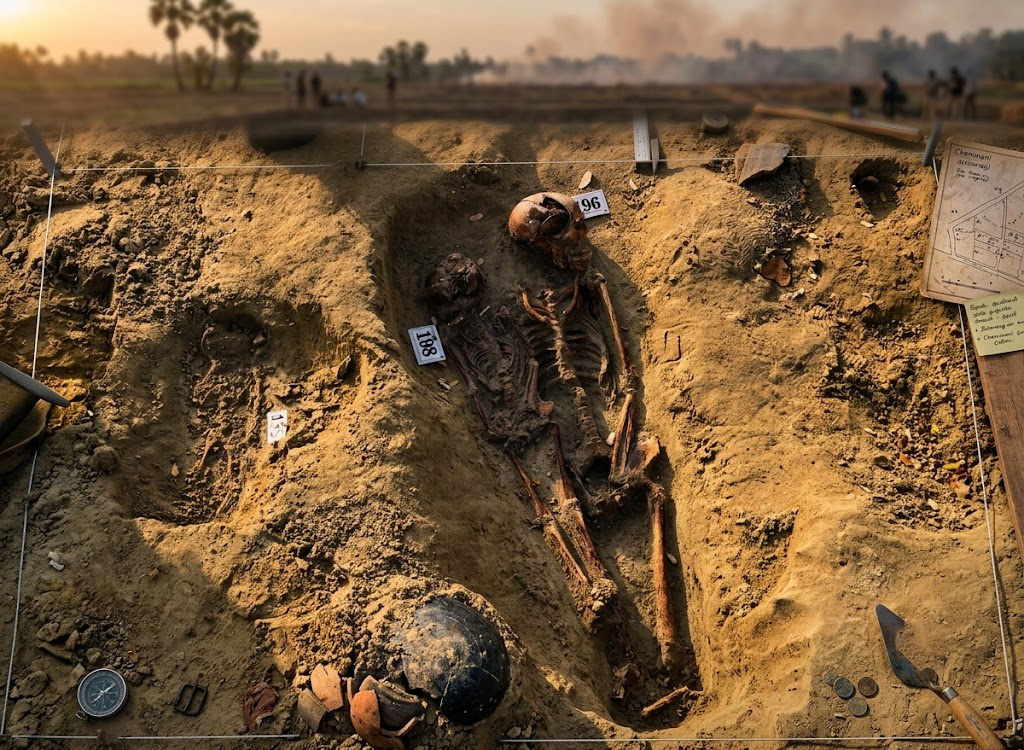
The discovery of nine more skeletal remains, including eight believed to be children, at the Chemmani Siddhupatthi mass grave in Jaffna has intensified concerns over what may ultimately emerge as one of Sri Lanka’s most significant mass grave investigations.
The remains were reportedly unearthed during the 20th day of Phase Three excavations at the site, bringing the total number of skeletal remains identified to 327, with 311 already excavated. According to excavation teams, the latest remains were found at depths ranging from one-and-a-half to two feet below the surface.
What has particularly drawn attention to the ongoing excavation is not only the number of remains recovered, but also the personal belongings found alongside them. Investigators have uncovered baby milk bottles, toys, a doll, children’s shoes and school bags, suggesting that a considerable number of those buried at the site may have been children.
The Chemmani site is now regarded as the second-largest mass grave discovered in Sri Lanka, and each new discovery has renewed calls from victims’ families, human rights groups and civil society organisations for a comprehensive investigation into the circumstances surrounding the burials.
A case that refuses to fade
The story of Chemmani stretches back nearly three decades.
Public attention first focused on the area in 1998 during the trial of Lance Corporal Somaratne Rajapaksa, who was convicted in connection with the rape and murder of Tamil schoolgirl Krishanthy Kumaraswamy, her mother, brother and a neighbour in September 1996.
The killings shocked the nation and became one of the most widely publicised human rights cases of the conflict period.
During court proceedings, Rajapaksa reportedly claimed that hundreds of bodies had been buried in the Chemmani area, allegations that prompted investigations and limited excavations at the time. Although several skeletal remains were recovered, many questions remained unanswered, and the issue gradually faded from the national spotlight.
For families of the disappeared, however, Chemmani remained a symbol of unresolved grief and unanswered questions linked to Sri Lanka’s decades-long ethnic conflict.
Renewed investigations
A new chapter in the investigation began when court-ordered excavations commenced at the Chemmani Siddhupatthi site on 15 May 2025.
The work was temporarily halted before resuming on 27 April 2026 after the Government allocated Rs. 21 million to continue forensic examinations and excavation activities.
The ongoing operation is being conducted under the supervision of Forensic Archaeologist Raj Somadeva and Jaffna Judicial Medical Officer (JMO) Selliah Pranavan, with oversight from Jaffna Magistrate Selvanayagam Leninkumar.
Experts involved in the excavation are carefully documenting each discovery, with forensic analysis expected to play a critical role in determining the age, identity and circumstances surrounding the deaths of those buried at the site.
A search for answers
The latest discoveries have heightened the significance of the investigation, particularly given indications that children may account for a substantial number of the victims.
While the identities of the deceased and the circumstances of their deaths remain the subject of ongoing investigations, the scale of the findings has reinforced the importance of preserving evidence and conducting a thorough forensic inquiry.
For many families who have spent decades searching for missing relatives, the excavation represents more than an archaeological exercise. It is part of a broader search for truth, accountability and closure.
As excavations continue, Chemmani remains a site of both forensic investigation and national reflection, with each new discovery adding to a complex and painful chapter of Sri Lanka’s history.










Leave a comment