
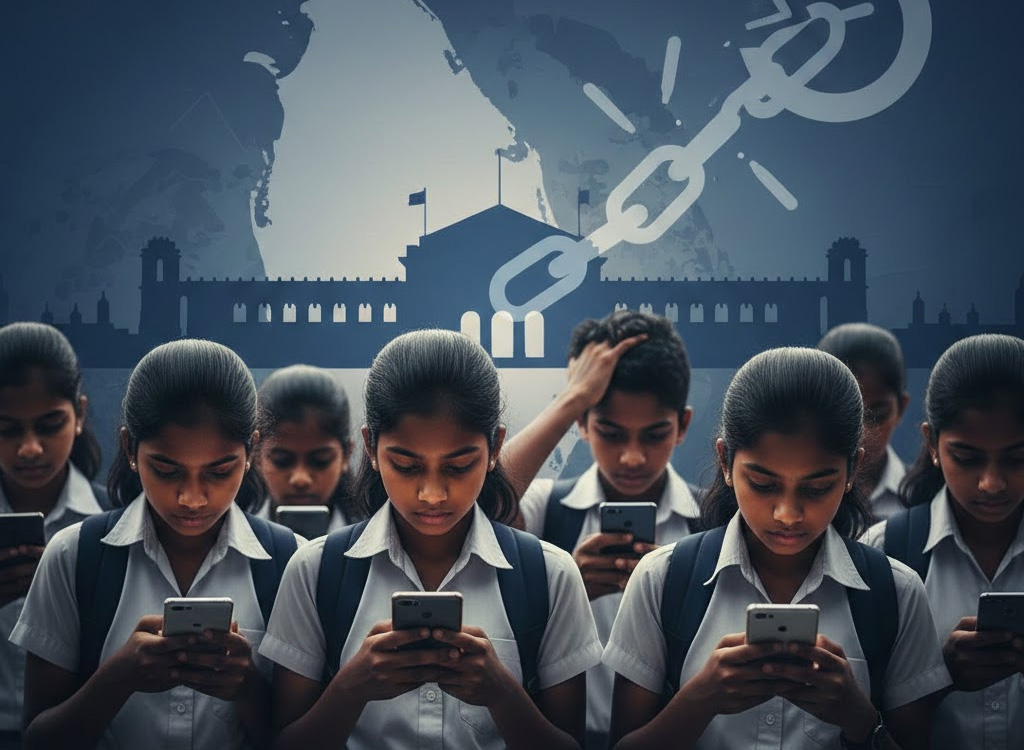
The Digital Economy Ministry has outlined a threefold approach to restrict social media usage for underage students and children, stopping short of a total ban, according to reports.
Deputy Digital Economy Minister, engineer Eranga Weeraratne has told the media that since an outright prohibition of social media is impractical, noting social media’s potential educational benefits, the Ministry is to collaborate with the Computer Emergency Readiness Team (CERT) and the Telecommunications Regulatory Commission (TRC) to provide the government with the necessary technological support to impose restrictions for minors on social media. Detailing the plan, Weeraratne has explained its three core purposes. “First, it is focused on reducing the screen time of the students with the expectation that it will increase the mental and physical well-being of students. Secondly, grounds for addiction will be eradicated by regulations. Thirdly, access to certain websites will be restricted and that will define suitable websites for children. This is to stop exposing children to violent or sexually provocative content,” he has told The Daily Morning.
However, he has said the Digital Economy Ministry will also need to discuss the matter with the Ministries of Women and Child Affairs, and Justice, to identify the appropriate age for restrictions.
The announcement follows Weeraratne’s statement to the media on Wednesday (28) that discussions are underway to explore restrictions on social media for the young, citing a sharp rise in online-related incidents.
Meanwhile, the National Media Foundation of Sri Lanka (NMFSL) organisation has called for an immediate countrywide ban on social media access for children below 16 years.
“In the wake of an incident involving the circulation of explicit video content allegedly exchanged between adult schoolteachers and a head prefect of a leading school in Colombo and subsequently released onto social media platforms, there is an urgent need for decisive national action to protect children from digital exploitation and abuse. This incident has exposed serious failures in safeguarding minors in an era of unregulated social media access, weak digital literacy, and the absence of enforceable age-verification mechanisms. The broader issue is systemic and cannot be ignored. Children below the age of 16 lack emotional maturity, judgment, and legal capacity to navigate social media platforms that are increasingly used for exploitation, manipulation, and permanent reputational harm. Once shared online, such content can never be fully erased, condemning victims — especially minors — to lifelong trauma and stigma,” the statement issued by the NMFSL has noted.
Meanwhile, Sri Lanka Freedom Party (SLFP) General Secretary Duminda Dissanayake has called for a ban on social media use by children, citing concerns over mental health and social behaviour during a media briefing on Thursday (29).
“People no longer talk to each other during commutes or at the family dinner table. Everyone is focused on their phones. This is harmful to children’s mental health,” he said, adding that several developed countries have begun introducing legislation to limit screen time for minors.
“As a party, we propose a social media ban for children. There have been multiple instances where children have misused these platforms. We urge the government to take the right step on this issue,” Dissanayake added.












Leave a comment