
By Lughadarini Yogaraja
On 15 January 2026, as Sri Lanka marked Thai Pongal, members of the Malayah (Hill Country Tamil) community gathered at Liberty Roundabout in Colombo under the banner “Pongal for Rights.” Organized by the Civil Society Alliance for Reforms for the Malaiyaha Community, the demonstration called for land ownership, dignified housing, and equitable disaster recovery.
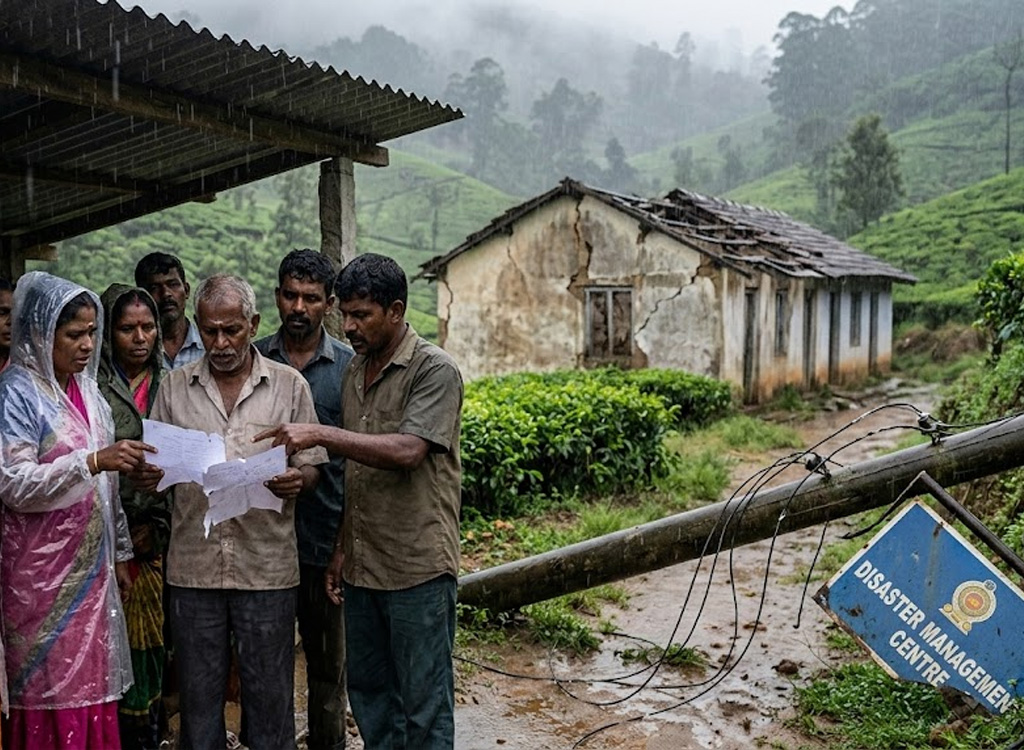
The protest followed the devastation caused by Cyclone Ditwah across the central highlands. According to the Disaster Management Centre (DMC) Situation Report covering 27 November 2025 to 16 January 2026, 17,346 families (58,716 individuals) in Nuwara Eliya District were displaced and forced to stay with relatives or friends. In Badulla District, 5,681 houses were damaged, affecting 7,244 families (27,523 individuals). The cyclone severely impacted plantation-dominated districts including Kandy, Nuwara Eliya, Badulla, Matale, and Kegalle. While emergency relief mechanisms were activated, the recovery experience in estate communities reveals deeper structural challenges.
Officially, post-disaster assistance followed standard procedure: emergency food aid, temporary shelter, and housing compensation, as outlined under the Disaster Management Act No. 13 of 2005 and subsequent government circulars, including Government Circular No. 8/2025 on disaster relief implementation.
However, access to these mechanisms depended not only on need but also on documentation, land tenure status, and administrative interpretation. Most Malaiyaha Tamil plantation workers live in line rooms provided by the estates, without individual title deeds. Under the Plantations Ordinance (Cap. 365) and within the broader framework of the Land Reform Law No. 1 of 1972, these workers are legally recognised as tenants or occupants, not landowners. While national disaster policies do not officially deny assistance to those without formal ownership, in practice, housing relief programmes often assume that recipients hold legal titles.
A flat compensation, uneven impact
Following Cyclone Ditwah, a Cabinet-approved flat compensation grant of Rs. 500,000 was introduced for affected households (Cabinet Media Division, January 2026). While intended to streamline relief distribution, public sector professionals have raised concerns that uniform compensation without detailed technical damage assessments may create inconsistencies and administrative risks.
In plantation areas, this issue is particularly complex. Many line houses were already structurally deteriorating due to age, overcrowding, and limited maintenance. When damage assessments are conducted, distinguishing between long-term structural decay and cyclone-induced destruction becomes difficult. This ambiguity affects compensation decisions and has contributed to delays in permanent resettlement in parts of Badulla and Nuwara Eliya (District Secretariat briefings, January 2026).
Although initial disbursement of relief grants in some divisions has reportedly been completed, long-term relocation and reconstruction for estate-sector families remain in ongoing challenges. Official reports noted few formal complaints about relief delivery. However, a Ceylon Today assessment of Cyclone Ditwah by Prof.
M. P. S. Magamage documented widespread frustration, anger, and distrust toward government disaster response and communication. The article further reported that fragmented and inconsistent official warnings confused the public and contributed to misunderstandings about the severity of the threat, in some cases delaying evacuations. These findings suggest that low complaint figures do not necessarily reflect satisfaction with assistance but may instead point to communication breakdowns and limited engagement with formal grievance mechanisms.
Through the field visits and observations conducted by Arutha staff in Badulla and Nuwara Eliya (January 2026) indicate that this absence of complaints does not reflect satisfaction or effective relief delivery. During these visits, teams systematically documented multiple structural barriers preventing residents from submitting claims: limited Tamil-language communication from Divisional Secretariats and Grama Niladhari offices, unclear eligibility criteria and deadlines, missing documentation required for filing claims, complex administrative procedures across multiple offices, and active interference from estate management. In several estates, management restricted access to relief items through the Plantation Human Development Trust, claiming no damages existed despite families residing in relief camps. Private estate officials also impeded damage claims and blocked relief from reaching affected households. Many families reported fearing retaliation that could affect employment, housing, or future access to aid, which discouraged formal complaints.
The government has maintained the 2026 Budget unchanged despite the Cyclone Ditwah disaster, rejecting calls for interim or revised allocations. A Rs 500 billion supplementary estimate was presented to fund recovery while keeping the core policy agenda intact. The “Rebuilding Sri Lanka” initiative has raised over Rs. 5.6 billion domestically and nearly $9.2 million in foreign donations. The reconstruction pipeline aims to build over 50,000 houses in 2026, addressing estimated damages of $4.1 billion. Yet, miscommunication and unclear communication have caused widespread confusion among affected communities, delaying applications, dispersal of funds, and trust in the recovery process. The Malaiyaha Tamil community allege unequal treatment in post-Ditwah relief and reconstruction: 99% of damaged shelters and 95% of displaced families are from the Hill Country, predominantly Malaiyaha estate workers. A key issue that needs stronger emphasis is the pre-existing structural vulnerability of line houses, many of which have deteriorated over decades due to age, poor construction, and inadequate maintenance. This long-term damage has influenced how assessors perceive the impact of Cyclone Ditwah, making it difficult to distinguish between disaster-related damage and chronic structural deterioration.
Miscommunication and unclear guidance, which has amplified economic and social vulnerability for marginalized communities, particularly the Malaiyaha Tamils. District-level rainfall and landslide alerts were issued in overly broad terms, which left residents uncertain about whether their specific locations were at risk. Similarly, assessments communicated by the National Building Research Organization (NBRO) were framed in general language, creating confusion about whether evacuation was required. These communication gaps contributed to structural inefficiencies in disaster governance and had economic consequences due to delayed or misallocated aid.
Sustainable recovery requires transparent housing and land policies, clear and culturally appropriate communication in Tamil, and community participation in planning. Multi-stakeholder oversight is crucial to ensure equitable access to resources, mitigate economic losses, and protect vulnerable populations from compounding disaster impacts. Ultimately, Cyclone Ditwah highlights that recovery is not only about rebuilding structures but also about addressing systemic gaps in communication, governance, and equity. Without clear, location-specific information, transparent policies, and meaningful community participation, vulnerable populations remain at risk, and resources of risk being misallocated. Ensuring that lessons from Ditwah inform future disaster preparedness and recovery frameworks is essential not only to protect lives and livelihoods but also to build trust, resilience, and inclusive development in Sri Lanka.
Cyclone Ditwah has shown that recovery is not only about rebuilding damaged structures but also addressing systemic gaps in communication, governance, and equity. Vulnerable communities, particularly Malaiyaha estate workers, remain at disproportionate risk due to pre-existing housing weaknesses, unclear disaster protocols, and barriers to accessing relief. To strengthen preparedness and recovery, the government and Disaster Management Centre (DMC) can adopt the below recommendations and observations:
- Provide clear, culturally and linguistically appropriate communication in Tamil, Sinhala, and English, including information on eligibility, deadlines, and appeals.
- Establish accessible grievance and complaint mechanisms with dedicated support staff to help residents file claims safely.
- Ensure transparent and needs-based compensation, taking into account structural vulnerabilities while maintaining rapid disbursement.
- Promote community participation in recovery planning, engaging local families in housing and relocation decisions.
- Implement long-term resilience measures, including upgrades to estate housing and disaster-resilient construction standards. By taking these steps, authorities can accelerate recovery, build trust, and protect marginalized communities, ensuring that lessons from Cyclone Ditwah strengthen Sri Lanka’s disaster management and equitable development in the future.
(The writer is the Research and Communications officer at Arutha an economic research and civic education organization with an interest in public finance and debt)
Disclaimer: The views and opinions expressed in this article are those of the writer and do not necessarily reflect the official position of the organization.
Sources
Disaster Management Centre (DMC), Situation Report: 27 November 2025 – 16 January 2026, Government of Sri Lanka, accessed February 23, 2026, https://www.drrweb.dmc.gov.lk/index.php?Itemid=273&lang=en.
Disaster Management Act No. 13 of 2005 as the legal basis for disaster relief procedures and compensation frameworks in Sri Lanka. https://lpr.adb.org/resource/sri-lanka-disaster-management-act-no-13-2005
Govt to provide Rs. 500,000 to cyclone‑hit households without assessments, Daily Mirror (27 Dec 2025). Available at: https://www.dailymirror.lk/latest‑news/Govt‑to‑provide‑Rs‑500‑000‑to‑cyclone‑hit‑households‑without‑assessments/342‑328819
Magamage, M. P. S. (2025, December 12). Preliminary assessment and strategic recommendations – Part 2. Ceylon Today. https://ceylontoday.lk/2025/12/12/preliminary-assessment-and-strategic-recommendations-part-2/
“AKD Sends Strong Policy Signal: Ditwah Will Not Derail Fiscal Agenda.” Daily FT, 14 Jan. 2026, https://www.ft.lk/top-story/AKD-sends-strong-policy-signal-Ditwah-will-not-derail-fiscal-agenda/26-786932
The Morning. (2026, January 14). Malaiyaha Tamils complain of step‑motherly treatment in Ditwah relief and reconstruction. https://www.themorning.lk/articles/o6XHkjQzkXfBbF7DgbVW
Disaster Management Act No. 13 of 2005 as the legal basis for disaster relief procedures and compensation frameworks in Sri Lanka. https://lpr.adb.org/resource/sri-lanka-disaster-management-act-no-13-2005?













Leave a comment