
By Chanakya
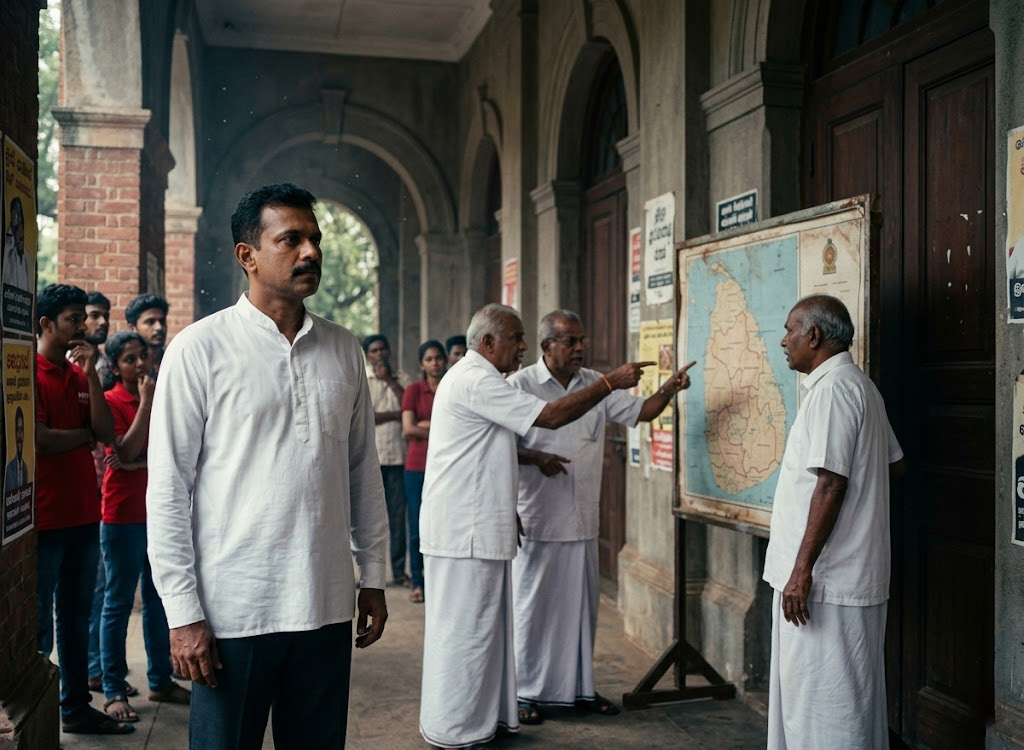
The renewed push for long-delayed provincial council elections is no longer just a procedural or constitutional discussion. It is fast becoming a broader political confrontation that is reshaping alliances, exposing distrust between parties, and testing the credibility of the government’s reform agenda.
At the centre of the latest development is a recent meeting between several opposition political parties, where leaders reportedly discussed not only the urgent need to hold provincial council elections but also a controversial proposal: to repeal the Provincial Council Act pf 2017 and conduct the long-delayed provincial council poll under the old electoral system.
The argument advanced by proponents is straightforward. The current mixed electoral structure – proposed through amendments linked to the 2017 legislation – has been stalled in implementation due to unresolved delimitation and legal complications. With no consensus on boundaries and ward structures, elections have remained indefinitely postponed. In this context, reverting to the earlier proportional system under the 1988 Provincial Councils Elections Act is being presented as a practical “reset button” to break the deadlock and finally restore elected provincial administrations.
Political sensitivities
However, critics view the proposal as both legally and politically sensitive. Any attempt to dismantle or sidestep the 2017 framework could trigger legal challenges and further complicate an already delayed electoral process. More importantly, it raises questions about whether the issue is truly technical, or fundamentally political.
Opposition parties involved in the discussions have also sharpened their criticism of the government’s Parliamentary Select Committee, which has been tasked with examining the legal and administrative barriers to holding the elections. Several parties now openly argue that the committee process is merely another time-buying exercise, echoing a familiar pattern in Sri Lanka’s electoral history where commissions and committees precede prolonged delays rather than resolution.
For the Janatha Vimukthi Peramuna (JVP)-led National People’s Power (NPP) government, the issue is politically delicate. The party came to power on a platform of institutional reform and democratic renewal, and it made notable inroads in the Northern and Eastern provinces during the 2024 presidential and parliamentary elections. That electoral success was driven not only by national-level anti-corruption sentiment, but also by a perception among some voters in the North and East that the NPP represented a break from traditional political divisions.
It is precisely here that the current controversy carries political risk.
Common ground
In the North and East, provincial council elections are not simply administrative exercises. They are closely tied to questions of representation, devolution, and constitutional implementation. Tamil political parties, while often divided on strategy, have now found common ground with southern opposition groups in demanding that elections be held without further delay.
This emerging cross-regional alignment is politically significant. It signals that the provincial council issue is no longer confined to ethnic or regional politics but is becoming a shared opposition platform against the government’s handling of governance reform.
The JVP/NPP’s challenge is compounded by suspicion from opposition parties that the Select Committee process is not aimed at resolving electoral barriers but managing them indefinitely. Even if the government insists the committee is necessary to address legal complexities, the absence of a clear timeline for elections continues to fuel mistrust.
At the heart of the debate is a deeper tension: whether Sri Lanka is prepared to prioritise administrative perfection over democratic urgency. The repeated delays suggest a system trapped between two imperatives – electoral legitimacy and institutional redesign – without a clear mechanism to reconcile them.
If the opposition’s push for reverting to the old electoral system gains traction, it could force the government into an uncomfortable choice: accept a politically expedient but legally contested path to elections or insist on completing reforms at the cost of further delay and growing political backlash.
Either way, the provincial council question is no longer dormant. It has re-emerged as a live political fault line – one that could test not only the JVP/NPP governance strategy, but also its ability to manage competing expectations from voters who supported it for change, and opponents who now see an opportunity to define that change on their own terms.












Leave a comment