
By Vox Civis
For a small island nation that sits far from the deserts of the Middle East, Sri Lanka has an uncanny habit of feeling the shockwaves of conflicts that begin thousands of miles away. Geography offers distance, but economics shaped over centuries often tends to erase it. When war erupts in the Persian Gulf, Sri Lanka does not hear the explosions but it certainly feels the tremors. The escalating conflict between the United States, Israel and Iran is therefore not a distant geopolitical drama for Sri Lanka, but a looming economic test, a diplomatic trial, and a strategic challenge that will determine how well the country has learned the painful lessons of its recent past.
Sri Lanka’s economic arteries remain deeply tied to the Middle East. The country depends heavily on the region for economic sustenance including energy imports and forex income. Hundreds of thousands of Sri Lankans work in Gulf countries, sending home remittances that stabilize the balance of payments while Sri Lanka’s most iconic export, Ceylon tea, has found some of its most reliable buyers in that same region for decades. Therefore, when instability spreads across the Middle East, these connections transform from assets into vulnerabilities almost overnight.
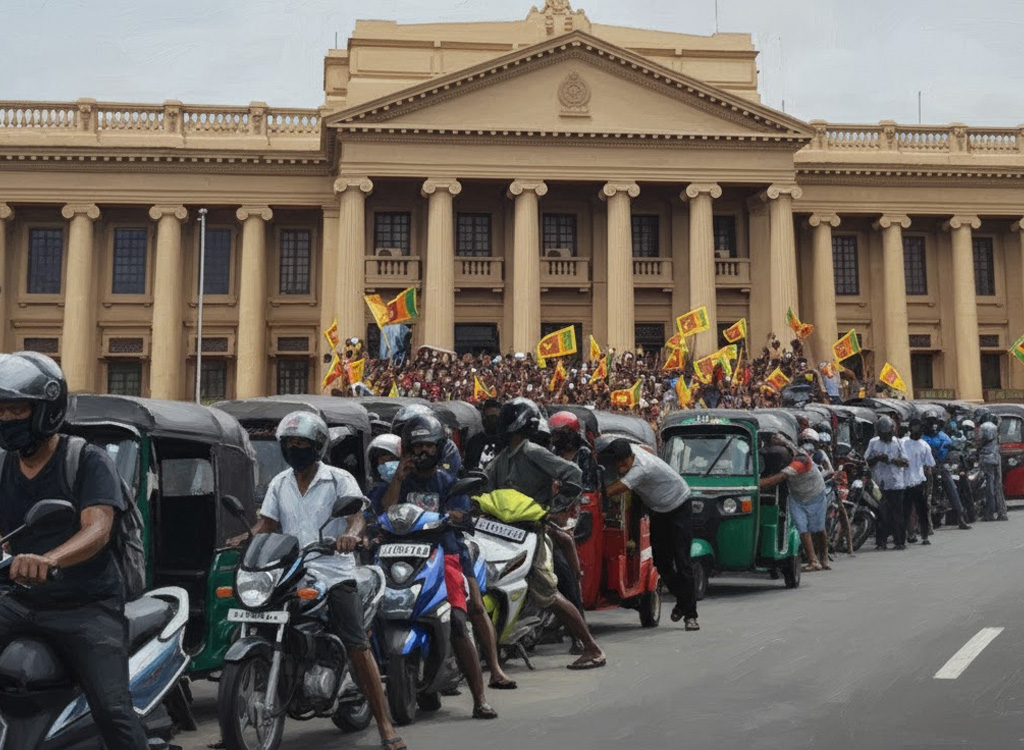
While the memories of 2022 remain painfully fresh when ships carrying fuel to Colombo became rare sightings, when petrol queues stretched for kilometers, LP gas disappeared from markets, and power cuts plunged homes and businesses into darkness when coal supplies for power plants became uncertain, the expanding crisis in the Middle East is threatening to re-enact the entire unpleasant episode. While that crisis was triggered by a catastrophic shortage of foreign exchange, itself the result of collapsing tourism revenues during the pandemic and a sudden drop in remittances as global economic activity slowed, the crisis at hand is being triggered by the shortage of crucial supplies even though the nation is now well equipped to pay for it in cash.
Learning from the last crisis
Even as the nation under its new leadership stares in to the future and what could be if things go from bad to worse, it is as opportune a time as any for this government to reflect on what actually transpired during 2022 and what ultimately led to the downfall of that government. To many, the most consequential failure during that period was not merely economic, it was political and psychological. The SLPP government of Gotabaya Rajapaksa refused to acknowledge the gravity of the crisis until the very last moment. Even as the country teetered on the brink of bankruptcy, officials reassured the public that there was nothing to worry about. Those assurances were repeated almost until the day Sri Lanka formally defaulted on its debt in April 2022. When reality finally broke through the wall of denial, the consequences were explosive.
History has a peculiar way of repeating itself; sometimes as tragedy, sometimes as warning. Four years later, Sri Lanka appears to be drifting toward a familiar pattern. This time the problem is not the absence of foreign exchange reserves. On paper, the country now possesses enough cash to pay for essential imports such as fuel, coal, gas and medicine. But the global energy market has been thrown into turmoil by the conflict in the Middle East. Supplies are tightening as shipping routes come under threat and buyers are scrambling to secure cargoes before someone else does.
In such an environment, delay and hesitation become costly. Energy markets operate on the ruthless principle of first come, first served. Those who act early secure supplies. Those who wait are pushed into the secondary market, forced to pay higher prices and rely on uncertain deliveries. Increasingly, it appears that Sri Lanka may have been late to the party once again. The cargoes that were available earlier have already been snapped up by more decisive buyers, leaving smaller economies scrambling for the leftovers.
The signs of déjà vu are unmistakable. Instead of openly discussing these challenges with the public, the government appears to be shielding the true state of affairs from scrutiny. There is a familiar sense that unpleasant realities are being quietly managed behind closed doors in the hope that they will somehow resolve themselves before the public becomes alarmed. That was the thinking back in 2022 as well and we all know how that turned out.
Dangerous strategy
While the strategy is understandable from a political perspective, it is also dangerous from an economic perspective. Governments everywhere fear panic. Yet experience has shown that secrecy often produces the very panic it seeks to avoid. When citizens eventually realize that crucial information was withheld, the immediate consequence is that trust in the leadership is destroyed, often beyond repair. And once that happens, even honest reassurances are treated with suspicion and contempt.
The current NPP administration also finds itself trapped by its own promises. During the election campaign it projected an image of transformative competence, offering the public a vision of economic stability and efficient governance. Such lofty promises have led to expectations that are difficult to sustain during a global crisis. Having pledged a near-Utopian future, the government now faces the uncomfortable task of explaining why external events are threatening that vision.
For its misfortune, the NPP will need to realise that the war that triggered the present crisis shows little sign of ending quickly. Despite confident pronouncements from Washington, the conflict is increasingly taking on the characteristics of a prolonged confrontation. The longer it continues, the more it will polarize the international system.
This polarization carries serious implications for smaller states. In the Cold War era, many nations relied on the doctrine of non-alignment to avoid being drawn into great-power rivalries. But today that space is shrinking rapidly. In an environment where energy supplies, shipping routes and financial flows are increasingly weaponized, neutrality is becoming harder to maintain. Therefore, for countries like Sri Lanka, the challenge is greater because access to critical resources may increasingly depend on strategic alignment for the simple reason that energy suppliers will prioritize partners. Likewise, shipping routes will favour allies and economic lifelines may come with political strings attached.
This is precisely why diplomacy becomes crucial if not critical during moments of global instability such as the one at hand. A small state cannot influence the course of great-power conflict, but it can navigate the consequences with intelligence and agility. Unfortunately, recent events have raised troubling questions not only about Sri Lanka’s diplomatic preparedness but also about its capacity for the high stakes dog-eats-dog battle that lies ahead.
Lack of competence
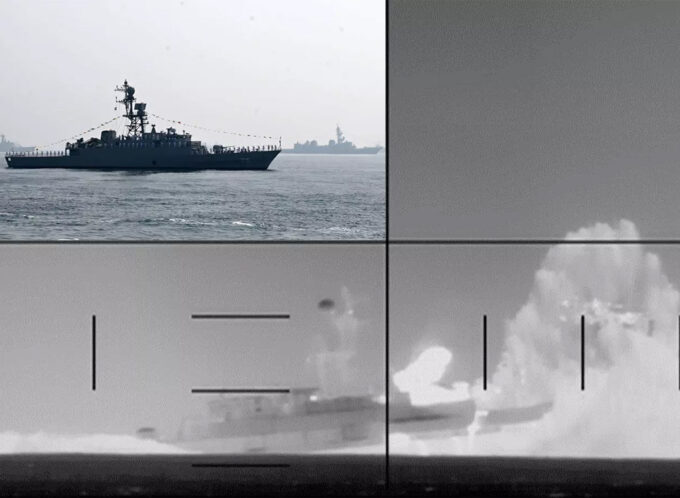
During a recent international discussion in India, Sri Lanka’s Foreign Minister faced questions about the Middle East crisis and the delicate situation created by the sinking of an Iranian warship near Sri Lanka’s maritime zone. Observers were struck less by the substance of the answers than by the visible discomfort with which they were delivered. While command of the language is secondary and what matters is that thoughts are conveyed in whatever manner, the lack of depth and vision in what was expressed by the Minister who repeated a seemingly single prepared line several times, that even prompted audible laughter from sections of the audience, is certainly cause for concern. For, what is on the line is not just the Minister’s credibility but that of the entire nation and the consequences it will have to face as a result of it.
While that episode was unfortunate, it was also revealing to the extent that it was not merely directed at an individual struggling in an unfamiliar setting, but in many ways also reflected the deeper perception that Sri Lanka itself was unprepared for the rapidly evolving geopolitical complexity which it needs to navigate successfully if it is to survive the deepening crisis.
Diplomacy, especially during a global crisis, requires mastery of facts, clarity of thought and the ability to respond confidently under pressure. These are not optional skills. They are the tools through which small nations protect their interests in a turbulent world. It is therefore misguided to dismiss criticism of diplomatic performance as elitism or pandering to the ‘colonial mentality’ because competence is not a colonial virtue just as much as preparation is not cultural betrayal as made out to be by apologists of the regime. They are simply the minimum requirements of serious statecraft made even more serious by what is at stake at this juncture.
Therefore, the real issue is not language proficiency or personal style but whether the country’s leadership understands the rapidly evolving dynamics of global politics. In moments of crisis, it so happens that a single misstatement or diplomatic misstep can have consequences far beyond the room in which it occurs. Under performance carries the same consequences.
The stakes are especially high today because the Middle East conflict has the potential to escalate far beyond its current boundaries. Historically, major global wars have often begun as localized confrontations that gradually pulled larger powers into the fray through alliances and strategic obligations. Besides, defense and other treaties can transform a regional clash into a global conflict almost overnight, and it so happens that every nation is tied to one or the other.
The danger becomes even greater when nuclear-armed states are involved. The United States, Russia, China, Britain, France, India, Pakistan, North Korea and Israel all possess nuclear arsenals. A conflict that entangles several of these powers could escalate rapidly through missile strikes, cyberattacks and naval confrontations before diplomacy has time to intervene. It so happens that the current crisis has the potential to involve all of the current nuclear powers if not already involved.
Early signs of trouble
For ordinary people, however, the earliest signs of global war are rarely military. They appear first as economic shocks as when energy supplies become uncertain, shipping lanes grow dangerous and prices rise sharply. Consequently, food, medicine and industrial goods become scarce and infrastructure networks like electricity, fuel distribution and public transportation begin to strain under pressure. It is this that the current NPP government must endeavour to avoid, drawing from the lessons of 2022 – the precise vulnerabilities that Sri Lanka experienced during the economic crisis. A prolonged disruption of Middle Eastern energy routes could therefore potentially recreate many of the conditions that first led to the economic turmoil and then the consequent political turmoil of 2022.
On top of all this, Iran’s strategic calculations add another layer of complexity. Tehran appears to recognize that defeating the United States or Israel militarily is unrealistic. Instead, its strategy appears aimed at making victory prohibitively expensive for its adversaries. Rather than focusing solely on battlefield outcomes, Iran appears to be targeting the economic foundations of the global energy system.
Attacks on oil infrastructure, disruptions to pipelines and threats to shipping through the Strait of Hormuz therefore cannot be considered as random acts of desperation. They are part of a deliberate effort to push global oil prices dramatically higher. If energy prices rise to extreme levels, the political consequences in consumer nations including the US, could become severe. From Tehran’s perspective, such pressure might force political leaders in Washington and elsewhere to reconsider the costs of continuing the war. In this sense, oil itself will be transformed in to a potent weapon, a tool capable of influencing global politics more effectively than missiles, drones and bombs.
Already the international community has been compelled to react to these disruptions. Major industrial nations have begun releasing strategic petroleum reserves in an attempt to stabilize markets. Yet even these emergency measures offer only temporary relief. The scale of global energy consumption is enormous, and reserves can cushion shortages only for a limited time, usually a few days.
Ironically, the geopolitical consequences of the conflict may benefit some players more than others. Russia, for example, stands to gain significantly from rising oil prices and disruptions to Gulf exports. Higher prices will increase Moscow’s energy revenues manyfold while weakening Western attempts to constrain its economy. An economically powerful Russia, a trusted ally of Iran, could therefore be a thorn in Western flesh adding further complexity and irony to Donald Trump’s convoluted war strategy.
New alignments
Meanwhile, shifting sanctions, policies and emergency energy arrangements have created unexpected alignments in global markets. In a complex twist of geopolitics, decisions made in Washington to stabilize energy prices may inadvertently strengthen the financial position of those whom it does not see eye to eye with; an outcome that would have seemed unlikely only months ago.
For Sri Lanka, these developments underline the harsh reality that the nation’s economic stability is deeply influenced by strategic decisions made in distant capitals. It is precisely this vulnerability that demands a more assertive diplomatic posture. Sri Lanka cannot afford to remain a passive observer while global supply chains are reshaped. It must engage actively with energy suppliers, regional partners and multilateral institutions to secure its interests. Conversations with both India and Russia regarding fuel supplies are steps in that direction, but they must be part of a broader, coherent strategy.
At the same time, the country must remain cautious about enticing, yet entangling alliances. In a polarized world, offers of assistance often come with hidden expectations and agendas. Sri Lanka’s long-term interests require maintaining as much strategic flexibility as possible. This balancing act is not easy and demands diplomatic sophistication, economic foresight and political honesty. Above all, it requires a willingness to speak candidly to the public about the challenges ahead. Whether the NPP is up to the task, only time will tell.
The truth is that Sri Lanka has little control over the course of global conflict. What it can control is how it prepares for the consequences. Transparency, professionalism in diplomacy and urgency in economic planning are therefore no longer mere options to play around with but an absolute necessity in the current context. The world may be drifting toward a more dangerous era, one in which regional wars can escalate rapidly and economic shocks travel across continents in a matter of days but for Sri Lanka, the question is not whether it can prevent these events but whether it can navigate them wisely.
The country has endured a devastating economic crisis in just the recent past and if the lessons of that experience are ignored, the consequences of the next global shock could be even more profound. History rarely offers second chances. Sri Lanka appears to have been given one. Whether it uses that opportunity wisely will determine not only the fate of the current government but the stability of the nation itself.






Leave a comment