
By Vox Civis
It was the late J. R. Jayewardene who once observed with characteristic cynicism, that socialism tends to last only until the socialist acquires his or her first asset. At the time, the remark was dismissed by many as the smug rationalisation of a man who had unapologetically embraced markets and private capital. Yet, decades later, that aphorism has returned with uncomfortable clarity, offering perhaps the most accurate lens through which to understand Sri Lanka’s current political economy presided by a regime that calls itself Marxist in all but name.
Up until the presidential election of September 2024 and the general election that followed in early 2025, no political force embodied performative austerity more fervently than the Janatha Vimukthi Peramuna (JVP) rebranded as the National People’s Power (NPP). From the party leadership down to first-time candidates, the campaign narrative was one of almost monastic simplicity. They spoke of lives stripped of possessions, of wardrobes supplied by supporters, of meals shared communally, of vehicles borrowed rather than owned. Their very lack of assets was presented as moral proof that they were not like the rest; proof that they could be trusted, and proof that corruption was alien to their political DNA.
This cultivated image was not incidental; it was central. In a society traumatised by decades of kleptocracy, where politics had become synonymous with plunder, the absence of visible wealth became a political weapon. The contemporary ruling class was portrayed as a cartel of rogues and rent-seekers, while the ‘new revolutionaries’ stood untainted, unencumbered, and unbought. They were, in their own narrative, the antithesis of privilege.
Then came the asset declarations.
Ironically, it was a legal obligation strengthened under the interim Ranil Wickremesinghe administration – whom the NPP had relentlessly demonized – that triggered the unravelling of this carefully constructed myth. When those declarations finally became public, they did more than surprise. They shocked. The so-called frugal comrades who had claimed to survive on political benevolence were suddenly revealed, on paper at least, to be multi-millionaires. Not merely comfortable, but wealthy by any Sri Lankan standard. Some were richer than many long-established elites of Colombo 7.
A standout declaration
One declaration, in particular, stood out. A senior figure who had repeatedly insisted that his daily needs from food to fuel were routinely met by party supporters, declared a net worth exceeding Rs. 270 million. The portfolio read less like that of a grassroots revolutionary and more like that of a seasoned investor: boasting fixed deposits, treasury bills, equity holdings, and even cryptocurrency. These were, of course, only the declared assets, and Sri Lankans know well how conservative such declarations can be.
The issue here is not wealth per se. There is nothing inherently immoral about financial success. The issue is deception. It is the deliberate construction of a moral narrative based on supposed poverty, followed by its quiet abandonment once power had been secured. With the mask removed, the pretense of ideological purity became untenable. What followed was not a recalibration but a full-scale embrace of economic practices that would make even unapologetic capitalists blush.
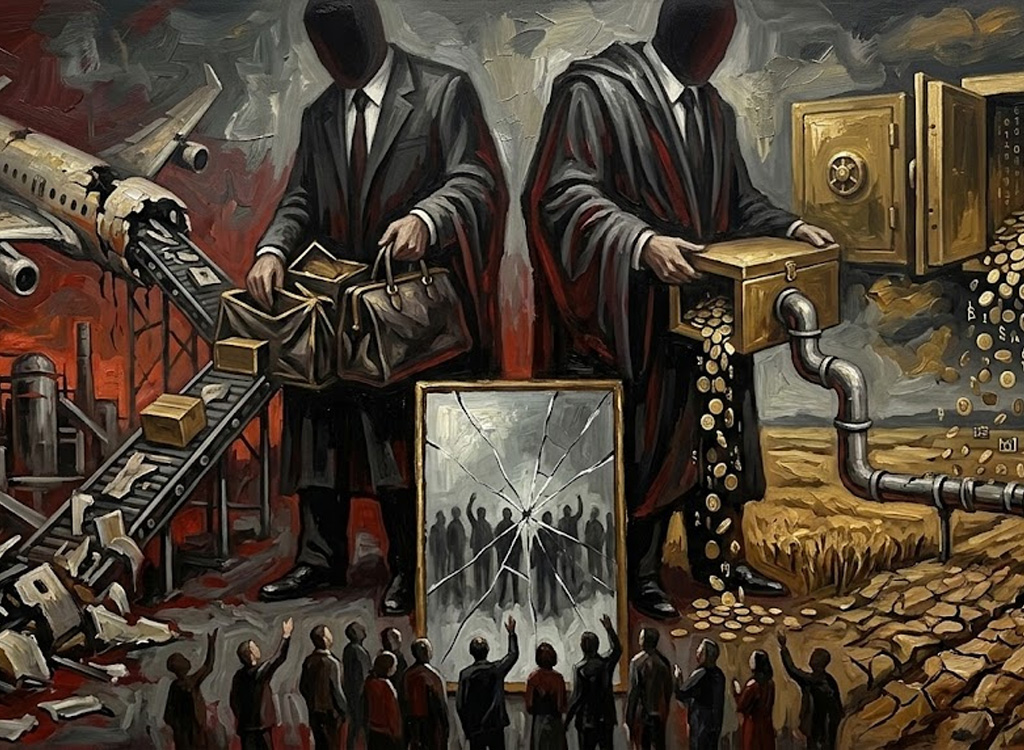
Far from dismantling the structures of elite capture they had denounced, the new rulers have refined them. Indeed, Sri Lanka today is witnessing not merely capitalism under a leftist government, but the evolution of something far more corrosive: crony capitalism cloaked in Marxist rhetoric. Nowhere is this contradiction more grotesque than in the skies, the paddy fields, the power stations and the corporate corridors of this nation.
The ongoing saga of SriLankan Airlines is just one such example. Once a strategic national asset, SriLankan Airlines is today a hollowed-out shell, bleeding public funds while its most profitable components are quietly being siphoned off. The board of directors currently presiding over this decline consists of individuals handpicked by the NPP leadership, many of whom, while in opposition, were the loudest critics of mismanagement and political interference at the airline. In government, those sermons have given way to silence, complicity, or active participation.
The dismemberment of the airline is neither accidental nor the product of incompetence. It is deliberate and follows clear logic: retain public ownership of losses while allowing private actors to extract profits. Central to this strategy is a well-known businessman whose earlier, failed attempt to acquire the airline outright has been replaced by a far more lucrative arrangement under the current regime; control without ownership.
Engineered sabotage
Through loyalists embedded within decision-making structures, access has been secured to the airline’s most profitable routes, notably Colombo-Melbourne and Colombo-London. Acting as general sales agents for foreign carriers on these routes allows private entities to skim revenue while leaving the national carrier burdened with costs, debts, and political responsibility. The taxpayer absorbs the losses. The cronies collect the profits. While liberalisation is the name of the game, what is actually taking place is engineered sabotage of the national carrier.
The same template is visible elsewhere. The property on which what used to be the country’s oldest five-star hotel is situated lays bare the mechanics of state capture in its crudest form. This piece of prime state land, arguably among the most valuable real estate in South Asia, has effectively been handed over to private interests at rents so absurdly low that they defy economic logic. When the Government Valuation Department had supposedly assessed the fair annual rent at hundreds of millions of rupees, the resistance that followed had not come from market realities but from political pressure.
What makes this episode especially alarming is the role played by senior public officials, including individuals simultaneously holding high office in state-owned enterprises such as SriLankan Airlines. These officials had allegedly been negotiating not on behalf of the state, but against it – advocating for the private beneficiary. This is not a conflict of interest in the conventional sense as it usually implies divided loyalties, what Sri Lanka is witnessing is the elimination of loyalty to the public altogether.
This state of affairs can only be described as state capture in its purest form: the systematic placement of agents within public institutions whose sole function is to extract value for private gain. It is nothing but outright plunder, sanitized through committees, board minutes and legal stationery.
Agriculture and food security tell a parallel story. Publicly, farmers are blamed for high prices and inefficiency. In practice, policy is carefully calibrated to entrench monopolies in rice milling and importation. Excessive import duties, arbitrary price controls, and selective enforcement create artificial scarcities that benefit a handful of mill owners. Farmers remain price-takers, consumers pay more, and monopolists flourish.
Don’t blame the farmer
Blaming the farmer for Sri Lanka’s rice monopoly crisis is not only dishonest, it is a deliberate act of political misdirection. The caricature of the farmer as a willing accomplice in monopoly-building breaks down the moment one examines how the system actually works. Farmers sell paddy to millers not out of ideological loyalty or greed, but because millers provide immediacy, liquidity, and convenience; in other words, cash on the spot, at the farm gate, even for wet paddy. The state, with all its rhetoric about regulation and justice, has repeatedly demonstrated that it cannot match this efficiency. To then moralise about farmer behaviour is to punish the weakest link in a chain that has evolved through consistent policy failure.
The real architects of monopoly are not in the paddy fields but in cabinet rooms and ministry offices. Import taxes imposed at precisely the wrong moments, under the banner of ‘protecting local farmers,’ have systematically engineered scarcity and price distortions that benefit mill owners alone. When imported rice is artificially priced out of the market through punitive taxation, local rice prices inevitably follow, creating windfall profits. Since 2010, successive governments have quietly reduced imports, struck opaque deals, and strengthened a handful of powerful millers. The current administration which promised to destroy this system has escalated it by turning modest taxes into crushing barriers.
Public outrage is often misdirected at visible symbols of wealth like luxury vehicles, private jets, or even the ongoing race among the rice dons as to who owns the most luxurious Rolls-Royce. But the true scandal is causation. When the Executive personally intervenes in price-setting and effectively adds an extra buffer per kilo into the pockets of millers, spectacular accumulation should surprise no one. Those luxury purchases are not evidence of entrepreneurial brilliance; they are receipts of policy choices. The irony is that the government first rigs the market, and then proceeds to lecture farmers on ethics.
The grotesque symbolism of this system is impossible to ignore. While farmers struggle to break even, the country’s leading rice millers are competing with each other in a vulgar display of wealth that has now escalated to private jets and helicopters. This ostentatious display of wealth is defended as entrepreneurial success, even though it rests on state-engineered distortions rather than productivity or innovation.
Power sector concerns
This scandalous conduct is not limited to the rice fields but even extend to the nation’s critical infrastructure including power generation. The coal scandal now engulfing Sri Lanka is not an abstract debate about procurement procedures or technical specifications; it is a crisis that reaches directly into households and quietly undermines the country’s energy backbone. The most immediate manifestation will be felt in the upcoming electricity bills.
A proposed 13.56 per cent tariff increase for the second quarter of 2026 is already being justified by the authorities as a financial necessity. Yet trade unions and opposition figures argue that this hike is nothing more than an attempt by the Ceylon Electricity Board (CEB) to transfer the Rs. 7.9 billion loss, allegedly caused by substandard coal procurement, onto consumers. If approved by the Public Utilities Commission of Sri Lanka (PUCSL), even the lowest domestic users will see a noticeable rise, while heavy users face a steep jump.
Owing to the impending energy issue the CEB has already applied for the tariff revision effective from April 1st. But behind the tariff arithmetic lies a far more serious threat to the country’s largest power station. Engineers and academics, including experts from the University of Moratuwa, have warned that the low-grade coal supplied under the disputed contract poses “catastrophic” risks to the Lakvijaya power plant at Norochcholai.
Coal with excessive ash content and mechanical impurities accelerates slagging and fouling in boilers, forcing the plant to burn more fuel to generate the same output. This is not merely an issue of higher operating costs but a matter of irreversible damage to turbines and boilers worth over a billion rupees. Reports that the plant’s effective output has already fallen well below its designed capacity suggest that this damage may no longer be theoretical.
The timing could hardly be worse. As the dry season approaches and hydropower generation declines, Sri Lanka’s energy security will depend heavily on coal-fired baseload power. Any forced shutdown or reduced output at Norochcholai would almost certainly lead to unscheduled power cuts or an increased reliance on diesel-fired plants.
Diesel generation, at nearly double the cost of coal per unit, is a financial haemorrhage the power sector can ill afford. The Cabinet’s decision to authorise emergency coal purchases on the spot market may avert an immediate crisis, but it also signals how badly a flawed long-term contract has cornered the state into more expensive and opaque stopgap solutions more in keeping with crony capitalism than a Marxist regime.
Serious questions
Ultimately, this scandal is as much about governance as it is about energy. Serious questions are being asked about how a company like Trident Chemphar, allegedly lacking large-scale coal supply experience and reportedly blacklisted in other sectors, secured such a critical contract. For the NPP government, this episode is a defining test of its oft-repeated promise of transparency and accountability.
If responsibility dissolves into bureaucratic silence and political defensiveness, the damage will extend beyond tariffs and turbines. Investor confidence in Sri Lanka’s energy reforms will erode, and the public will be left with the now familiar lesson that when governance fails, it is the citizen who pays – first in rupees, and then in darkness.
Marxism, at least in theory, sought to dismantle concentrated economic power. Socialism claims to place public ownership and collective welfare above private accumulation. What Sri Lanka has instead is a parody: revolutionary language used as camouflage for oligarchic reality. Power has not been decentralised; it has been re-concentrated. Elites have not been dismantled; they have been rebadged as ‘friends of change.’
History offers ample warnings. Russia’s oligarchs emerged in the 1990s from the ruins of the state, aided by political complicity and institutional collapse. By contrast, countries such as Singapore and India, whatever their other flaws, have drawn firm boundaries between political power and private enrichment precisely because they understand the consequences when those lines blur. Sri Lanka appears determined to learn nothing from either example.
The tragedy of it all is not only economic, but also moral. A government elected on the promise of ending elite capture has perfected it. A movement that claimed to stand for justice has normalised plunder. A regime that vowed to dismantle monopolies and destroy mafias – from rice to cricket – has instead found itself accommodating them, preserving their privileges, and legitimising their excesses.
What is unfolding is not just socialism betrayed, but socialism being weaponised and used as camouflage for the ruthless crony capitalism project in Sri Lanka. Route by route, acre by acre, kilo by kilo, the state is losing control while the people who voted for change are left watching the familiar spectacle of wealth creation among a handful.
Jayewardene, it seems, was not merely being cynical, he was being prophetic.
Disclaimer: The views and opinions expressed in this article are those of the writer and do not necessarily reflect the official position of this publication.








Leave a comment