
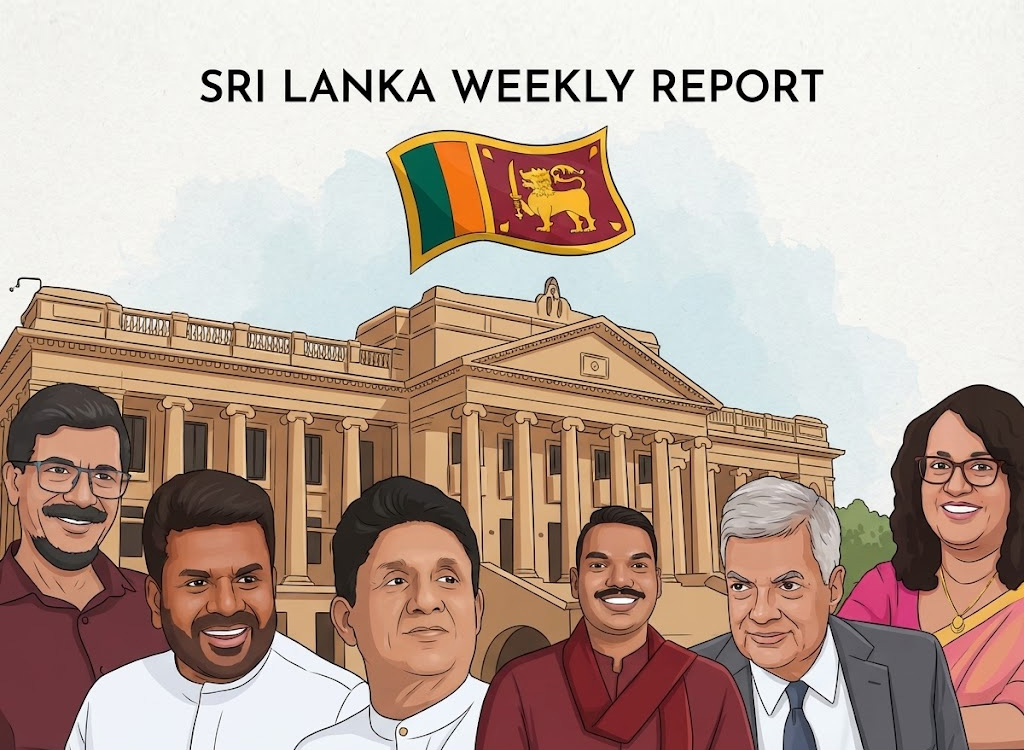
What happened, what mattered and what comes next
The week in a minute
Sri Lanka’s final week of September and first days of October brought together almost every major thread running through the country: an economy recovering in aggregate but still under pressure at household level; a government preparing a Budget while negotiating the endgame of its IMF programme; an expanding corruption and accountability agenda; and a foreign policy balancing act.
The week also produced a striking mixture of reform and controversy. Customs moved fully into electronic declarations, infrastructure projects advanced, new transport services began and investment in ports and energy infrastructure continued. At the same time, inflation remained at 8 percent, fuel prices increased, gold-backed borrowing surged and questions persisted about governance, institutional independence and the scope of new legislation.
WHAT HAPPENED
Economy: recovery is real, but so are the pressures
The headline economic story was September inflation. CCPI inflation remained at 8 percent, unchanged from August and above the Central Bank’s previous upper tolerance level, while food inflation increased from 8.5 to 8.7 percent. The Central Bank kept the Overnight Policy Rate at 8.75 percent. The Bank noted that inflation is expected to remain elevated before moving towards the 5 percent target. A new Monetary Policy Framework Agreement signed on October 1 formally reaffirmed a 5 percent inflation target with a ±2 percentage-point accountability band.
The Government responded to the international oil shock with a Rs.41 billion fuel subsidy for three months, even as Ceypetco raised prices from September 30. Auto diesel increased by Rs.10 to Rs.392 a liter, Super Diesel by Rs.50 and Octane 92 petrol by Rs.15, while Octane 95 and kerosene remained unchanged.
The clearest indicator of household pressure came from the banking sector. Sri Lankans had borrowed approximately Rs.1.11 trillion against gold by the end of June, with pawning advances rising by Rs.211.9 billion, or 23.6 percent, in the first six months alone. Pawning now accounts for almost a tenth of bank lending. Against this, private-sector credit from licensed commercial banks expanded by approximately Rs.2.1 trillion during 2025, a 25.2 percent increase.
The fiscal side produced stronger numbers. Inland Revenue collections reached Rs.2.040 trillion during the first nine months, up Rs.398 billion, or about 24 percent, from the same period last year. September alone produced Rs.288 billion. The department had already collected approximately 85 percent of its annual Rs.2.401 trillion target before the final quarter.
Yet the 2027 Budget demonstrates the continuing scale of the fiscal challenge. The Appropriation Bill provides approximately Rs.4.99 trillion for ministries and departments, while a further approximately Rs.4.92 trillion is statutory expenditure already charged to the Consolidated Fund, bringing total expenditure provisions close to Rs.9.92 trillion.
President Anura Kumara Dissanayake said there would be no property tax in the 2027 Budget, despite property taxation having been contemplated under the IMF programme.
Opposition Leader Sajith Premadasa called for a successor IMF agreement after the current programme expires in March 2027, with greater emphasis on poverty reduction, exports, employment and household relief. However, Minister Bimal Rathnayake said the Government intends to complete the current EFF programme on March 19, 2027, while continuing normal engagement with the IMF and World Bank rather than entering another IMF programme tied to debt restructuring.
The IMF’s own latest assessment provides the context. It said Sri Lanka’s economy remained resilient but emphasised the need for a medium-term revenue strategy, cost-recovery energy pricing, stronger capital-spending execution, exchange-rate flexibility and continued governance reform.
External sector: remittances strong, trade deficit widening
The external accounts presented a mixed picture. Worker remittances reached US$6.1 billion in the first eight months, up 19.8 percent year-on-year. Tourism earnings, however, fell 10 percent to US$2.1 billion and tourist arrivals declined 2 percent.
Merchandise exports were approximately US$9.38 billion, up only 3.3 percent, while imports reached US$16.56 billion, increasing 24.1 percent. The result was a US$7.2 billion trade deficit, compared with US$4.3 billion a year earlier. August merchandise exports fell 1 percent to US$1.269 billion, with apparel, tea and coconut among the weaker sectors, although services exports increased almost 14 percent to US$331.87 million.
Fuel imports accounted for approximately US$4 billion in the first eight months and were 61.6 percent higher than a year earlier. Vehicle imports reached US$1.684 billion.
The United States’ latest investment-climate assessment therefore remains relevant. Although Sri Lanka is recovering from the economic crisis, it continues to face regulatory unpredictability, bureaucracy, inconsistent policies, slow approvals, difficulties obtaining land, complicated taxation, selective transparency and weak contract enforcement. FDI reached approximately US$1.06 billion in 2025, only around 1 percent of GDP, below the 3–4 percent levels achieved by many emerging economies.
Governance, corruption and the law
Governance dominated the political conversation. Attorney-at-law Maithri Gunaratne warned that Sri Lanka should be concerned if the Executive, Parliament and Judiciary appear to converge around one center of political power, raising the fundamental question of whether the Government is entitled to exercise power in a manner that weakens the principle that sovereignty belongs to the people.
The IMF also raised a concrete governance concern, warning that provisions in proposed amendments to the anti-corruption framework could weaken safeguards created by the 2023 legislation. The proposed Anti-Corruption (Amendment) Bill will therefore face significant scrutiny when Parliament debates it on October 8.
The country’s largest recent banking fraud also moved closer to final accounting. Deloitte’s completed forensic investigation into the National Development Bank fraud put the loss at Rs.13.6397 billion, Rs.60 million above the interim figure. NDB said the investigation identified control failures, technology lapses and governance weaknesses and that regulatory, legal and recovery processes would continue.
The Central Bank, meanwhile, took enforcement action against six institutions accused of accepting unauthorised deposits under the guise of plantation and forestry projects, freezing their bank accounts.
A Presidential Commission investigating coal transactions reportedly identified 18 senior officials, including former Energy Minister Kumara Jayakody, in relation to alleged improper actions in coal deals. Those named have been given an opportunity to respond to the allegations.
The Government also moved to amend the century-old Trust Ordinance to increase ownership transparency in trusts, while work continued on legislation governing NGOs. The Government says stronger NGO regulation is needed to address money laundering, terrorist financing and proliferation-financing risks. However, questions remain as whether such regulation would unnecessarily restrict legitimate civil-society activity.
Several prominent cases also moved through the courts. Former President Gotabaya Rajapaksa failed to secure Court of Appeal protection against possible arrest in the Easter Sunday investigation. Gotabaya Rajapaksa also appeared at the Colombo Magistrate’s Court to give evidence on video to the Jaffna Magistrate’s Court over the case on the disappearance of Lalith and Kugan, two political activists. The Fort Magistrate’s Court postponed until November 11 the case involving former President Ranil Wickremesinghe over allegations that Rs.16.6 million in public funds were used for a foreign trip.
SLPP MP Namal Rajapaksa was named the fourth accused in the Krrish case and was granted bail in the Airbus-related money-laundering case, although he remained in custody over another case. The Colombo High Court is due to rule on preliminary objections in the Shashindra Rajapaksa corruption case on October 8.
The Court of Appeal issued an open warrant for the arrest of Ven. Galagoda Aththe Gnanasara Thera and imposed a travel ban following his contempt-of-court conviction. It also dismissed, without hearing, MP Dilith Jayaweera’s writ petition seeking to suspend proceedings related to a contempt complaint.
The Court also ruled that former Minister A.H.M. Fowzie had violated fundamental rights by using a luxury vehicle donated by the Netherlands to the Disaster Management Centre for personal purposes and ordered him to pay Rs.6.6 million to the Consolidated Fund.
Meanwhile, 10 doctors who served on the medical board overseeing former State Intelligence Service Director Suresh Salley’s treatment, together with the National Hospital Director, were ordered to appear before the Colombo Magistrate’s Court on October 6 following a CID application.
Parliament, education and public administration
The 2027 Budget will be presented for its first reading on October 7, with the Budget speech scheduled for November 12 and the final vote on December 14.
Education produced an unusually tangible example of policy reversal. Because the proposed Grade 6 reforms were not implemented this year, more than 2.1 million textbooks from the old syllabus had to be reprinted at a cost exceeding Rs.278 million.
The ADB approved a US$100 million results-based loan to improve technical and vocational education and expand women’s employment in non-traditional occupations.
The Government also announced that the National Medicines Regulatory Authority expects to impose maximum retail prices on roughly 90 percent of imported medicines over the coming year.
Infrastructure, transport and energy
The Western Province saw the beginning of new Metro bus operations across seven routes, with 121 buses ultimately expected to operate across the network. Police simultaneously announced strict enforcement of bus-priority lanes from 6–9 a.m. and 4–7 p.m.
Customs entered a major digitalisation phase on October 1, ending manual Customs declarations. Importers must now submit CusDecs and supporting documents electronically using digital signatures through ASYCUDA.
The Government approved Rs.2.89 billion for the third phase of the Baseline Road Extension, covering only 0.86 kilometers but including six-lanes, an underpass, signalized intersections, pedestrian facilities and drainage improvements.
A 21-kilometre pipeline is being built to connect the Muthurajawela petroleum facility directly to Bandaranaike International Airport, together with expanded aviation-fuel storage.
Sri Lanka is seeking shipping-line partnerships to expand the capacity of the state-owned East Container Terminal, with at least five international shipping lines reportedly expressing interest.
Vidullanka announced winning bids for 18.7 MW/93 MWh of battery energy storage systems linked to existing solar plants.
Sport and culture
A new Sri Lanka Cricket Bill was gazetted, proposing a restructuring of the governance of the country’s most powerful sporting institution through a board containing elected and independent directors.
Rumesh Tharanga won Asian Games gold in the men’s javelin with an 88.55-metre throw, while Sri Lanka won bronze in men’s cricket and the men’s 4×100-metre relay.
Cabinet approved the establishment of a committee to advise on the repatriation of cultural artefacts taken out of Sri Lanka during the colonial era.
International engagement
The JVP opened a new channel of engagement with India through a five-member delegation led by General Secretary Tilvin Silva under the BJP’s “Know BJP” programme. The visit culminated in a meeting with Indian External Affairs Minister S. Jaishankar.
Sri Lanka also held high-level talks with Australia covering trade, agriculture, defence, education and maritime affairs.
Foreign Minister Vijitha Herath addressed the UN General Assembly, calling for stronger climate action, humanitarian access to Gaza and reform of international debt rules.
The arrival of US Army Pacific Deputy Commanding General Lt. Gen. Joel “JB” Vowell, the highest-ranking US Army officer to visit Sri Lanka, highlighted the continuing expansion of military-to-military engagement.
Security and social issues
The Navy seized approximately 81 kilograms of heroin and crystal methamphetamine off Jaffna in one of the country’s largest recent northern-coast narcotics seizures.
Police reported 891 illegal firearms seized during the first eight and a half months of 2026, alongside 40 shooting incidents.
The Government also continued investigations into the alleged fraudulent transfer of US$2.5 million in Treasury funds, although the CID told court that key technical findings and information requested from five foreign countries remain outstanding.
Around 600,000 people are estimated to lack safe or semi-permanent housing.
Sri Lanka will receive US$110 million from the World Bank to repair approximately 600 kilometers of roads devastated by Cyclone Ditwah.
A private television cameraman was arrested after allegedly assaulting a security officer of former President Ranil Wickremesinghe outside court and was released on police bail.
WHAT MATTERED – THE DEEPER STORY
The week’s developments point towards a country moving from emergency stabilisation into a much more difficult phase: deciding who pays for the recovery, how much the State should spend, how quickly reforms should proceed and how institutions should exercise power.
The Rs.1.11 trillion in gold-backed borrowing may ultimately prove more revealing than many conventional recovery statistics. Gold is often the last significant household asset available to families facing financial pressure. When that asset becomes collateral on such a scale, it suggests that the benefits of macroeconomic stabilisation have not yet translated uniformly into disposable income and household resilience.
The central political and economic question is therefore becoming unavoidable: how much can the State promise, how much can it afford, and how fairly will the cost be distributed? That question will dominate the 2027 Budget and, increasingly, the debate over what happens after the IMF programme expires.
The strongest economic numbers are impressive. Tax collection is rising, remittances are growing and private-sector credit has returned. The IMF says the economy expanded 4.2 percent in the second quarter and has recorded 11 consecutive quarters of growth, while reserves reached US$6.9 billion at end-August.
But the household story is considerably less comfortable. Inflation is 8 percent. Food inflation is higher. Fuel prices have risen. Gold pawning has surged. Tourism revenues are declining and the merchandise trade deficit has widened by US$2.9 billion in a year.
That is why the Government’s response to the energy shock matters. The Rs.41 billion fuel subsidy provides immediate relief, but it also demonstrates the continuing tension between politically manageable prices and the IMF’s emphasis on cost-recovery energy pricing.
The same tension exists in taxation. Revenue collection is improving, but the Government is resisting at least one potentially important new revenue measure – property taxation – while preparing an expenditure framework approaching Rs.10 trillion.
The governance question is equally important. The Government’s political identity was built around changing the culture of power. The challenge now is whether the institutions created or strengthened during its tenure will be allowed to operate independently when their actions affect powerful political figures.
The IMF’s concern about amendments to anti-corruption legislation therefore deserves attention beyond the immediate parliamentary debate. The issue is not simply whether a particular amendment passes. It is whether Sri Lanka’s post-crisis institutional reforms are strengthened, diluted or redirected.
WEEK IN NUMBERS
8% — September headline inflation.
8.7% — September food inflation.
Rs.1.11 trillion — gold-backed borrowing outstanding by June.
Rs.2.040 trillion — Inland Revenue collections, January–September.
Rs.41 billion — three-month fuel subsidy.
Rs.9.92 trillion — expenditure provisions under the 2027 Budget framework including statutory Consolidated Fund expenditure.
US$6.1 billion — worker remittances, January–August.
US$7.2 billion — merchandise trade deficit, January–August.
US$16.56 billion — merchandise imports, January–August.
US$1.684 billion — vehicle imports, January–August.
US$4 billion — fuel imports, January–August.
Rs.13.64 billion — final NDB fraud figure.
2.1 million — old-syllabus textbooks reprinted after the Grade 6 reform delay.
600,000 — estimated people without safe or semi-permanent housing.
US$110 million — World Bank road-reconstruction financing.
US$100 million — ADB financing for TVET and women’s employment.
81 kg — approximate heroin and crystal-methamphetamine seizure off Jaffna.
891 — illegal firearms seized during the first eight-and-a-half months of 2026.
18 — senior officials reportedly identified by the coal Commission in connection with alleged improper actions.
18.7 MW/93 MWh — battery-storage capacity awarded through winning bids.
88.55 meters — Rumesh Tharanga’s Asian Games gold-medal javelin throw.
THE WEEK AHEAD
The immediate focus shifts to Parliament. The 2027 Appropriation Bill will receive its first reading on October 7, beginning the formal Budget process. The following day, Parliament is scheduled to debate the Anti-Corruption (Amendment) Bill, after the Supreme Court determined that several provisions require a higher threshold for passage.
Court proceedings will also remain prominent. The Shashindra Rajapaksa corruption case is due for a ruling on preliminary objections on October 8, while the doctors connected to former intelligence chief Suresh Salley’s treatment are due before the Colombo Magistrate’s Court on October 6. The Ranil Wickremesinghe public-funds case is scheduled for November 11.
The IMF’s Seventh Review will be closely watched as negotiations continue over the fiscal framework. The Fund has already made clear that medium-term revenue mobilisation, energy pricing, capital expenditure and governance reforms remain central to the programme.






Leave a comment