
13–19 September 2026
THE WEEK IN ONE MINUTE
Sri Lanka’s economic recovery entered a more complicated phase this week. Second-quarter GDP growth slowed to 4.2%, while the external current account remained in deficit and merchandise trade gap widened sharply. At the same time, remittances continued to provide an important cushion, foreign investors remained net buyers of rupee government securities, and Customs revenue reached Rs.2 trillion by September 15.
The IMF’s seventh review of the Extended Fund Facility (EFF) and the 2026 Article IV consultation dominated the economic agenda, arriving as the Government confronts renewed pressure from global oil prices and shipping disruption. The Government insists that IMF-driven stabilisation should now become the foundation for a “transformative era.”
Politically, the anti-corruption campaign continued to reach into the previous establishment. Namal Rajapaksa’s detention was extended in the Airbus-related money-laundering case, while former Air Force commanders and former First Lady Shiranthi Rajapaksa also came under investigation or summons. Separately, former National Transport Commission chairman Renuka Perera was arrested over alleged corruption.
The judiciary produced one of the week’s most consequential rulings, finding that former IGP Deshabandu Tennakoon and two others violated the fundamental rights of senior police officials Ravi Seneviratne and Shani Abeysekara in an investigation connected to the Easter Sunday attacks.
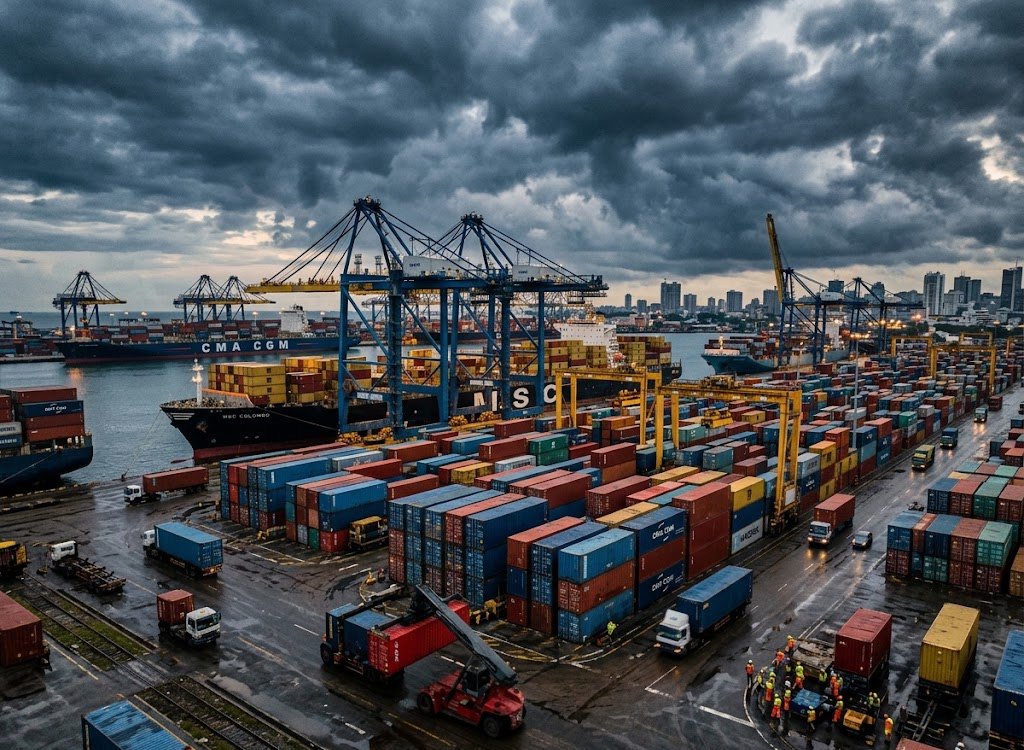
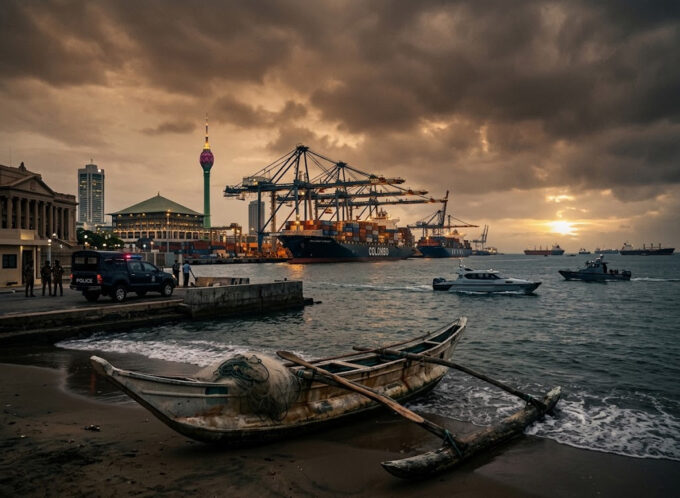
Meanwhile, Sri Lanka’s strategic and economic geography continued to generate opportunities: Colombo’s container throughput is surging, India extended support for the Nagapattinam–Kankesanthurai ferry, and a new floating solar plant and battery-storage system were commissioned.
But the week also exposed persistent vulnerabilities – from shortages of cancer and surgical supplies to overcrowded prisons, pressure on foreign-exchange accounts, and the loss of Thailand’s visa-free access for ordinary Sri Lankan passport holders.
1. POLITICS, GOVERNANCE & ACCOUNTABILITY
Namal Rajapaksa remains in custody
The Airbus investigation intensified this week when SLPP MP Namal Rajapaksa was produced before the Colombo Fort Magistrate’s Court in a separate money-laundering case connected to alleged financial irregularities in SriLankan Airlines’ aircraft procurement.
He was ordered to remain in remand custody, with the case subsequently extended beyond the originally anticipated September 23 hearing. The development follows his earlier arrest by CIABOC over an alleged Rs.100 million bribe linked to the Airbus affair, for which he has been remanded again till 29 September.
The case is politically significant because the Government’s anti-corruption campaign is now reaching directly into the Rajapaksa political establishment.
MiG investigation widens
Former Air Force Commander Air Chief Marshal Donald Perera was summoned by the FCID in connection with the nearly two-decade-old MiG aircraft investigation. The investigation follows questioning of other former senior Air Force officials and former President Gotabaya Rajapaksa, who was Defence Secretary when the transaction took place.
Former First Lady Shiranthi Rajapaksa left Sri Lanka on September 16 and has been summoned to appear before the FCID on September 24.
Another corruption arrest
Former National Transport Commission chairman Renuka Perera was arrested by CIABOC over alleged corruption involving the issuance of 56 passenger-service permits for the Southern Expressway. He was remanded until September 29.
Taken together, the developments suggest that the anti-corruption campaign is moving beyond headline political figures into a wider network of former officials and public-sector decision-makers.
Opposition unites against amendment
Opposition political party leaders and civil society representatives have signed a joint statement opposing the proposed 22nd Amendment to the Constitution, warning that it could undermine judicial independence, democratic institutions and citizens’ rights.
The signatories said the proposed amendment poses a potential threat to Sri Lanka’s representative democratic system, which they noted has been maintained for nearly eight decades. They said they had come together as a united collective committed to protecting democratic principles and opposing the proposed amendment.
Among the parties that signed the memorandum are SJB, UNP, SLFP, SLPP, TPA, Joint Opposition and several others.
2. ECONOMY & IMF
Growth slows to 4.2%
Sri Lanka’s economy expanded 4.2% in the second quarter of 2026, down from 5% in the corresponding quarter last year and 5.1% in the first quarter. The figure confirms that the post-crisis recovery is continuing, but at a more moderate pace.
The slowdown comes as the Government seeks to move from stabilisation towards investment-led transformation. President Anura Kumara Dissanayake told the visiting IMF team that the stability achieved through the IMF programme should provide a “strong foundation” for a transformative phase.
The seventh EFF review is being conducted alongside the 2026 Article IV consultation, making this an important assessment of both programme compliance and the broader economic trajectory.
External accounts flash warning
The current account recorded a US$142 million deficit in July, the fourth consecutive monthly deficit. The January–July cumulative deficit reached approximately US$387 million.
More strikingly, the merchandise trade deficit widened from US$3.9 billion to US$6.5 billion year-on-year. Fuel import expenditure during January–July also rose sharply.
This is one of the clearest reminders that rebuilding reserves and maintaining external stability will remain difficult while imports accelerate and global energy costs rise.
Remittances remain a major buffer
Official worker remittances rose 10% to US$748.6 million in August, bringing the first-eight-month total to approximately US$6.131 billion, up 19.8%.
Remittances remain one of the principal sources cushioning the country’s external position.
Investors continue buying government securities
Foreign investors have been net buyers of Sri Lankan rupee government securities for 13 consecutive weeks, accumulating approximately Rs.92 billion, or about US$280 million.
The inflow is a positive indicator of investor confidence, although maintaining that confidence will depend on continued macroeconomic stability and fiscal discipline.
Debt financing and public investment
Sri Lanka sold Rs.120 billion of 2030, 2034 and 2037 bonds.
Meanwhile, the Government says 2027 capital expenditure will be around Rs.2 trillion, with procurement and approval procedures being accelerated to fast-track public investment projects.
Customs reaches Rs.2 trillion
Sri Lanka Customs collected Rs.2 trillion by September 15, putting the revenue authority on course to potentially exceed its target for the second consecutive year.
The Inland Revenue Department reported processing approximately Rs.82.4 billion in VAT refunds, with 99.98% of eligible refunds reportedly processed within an average of 29 days under the new risk-based system.
These developments point to improving state revenue administration while also addressing long-standing business complaints over delayed tax refunds.
3. ENERGY, INDUSTRY & INFRASTRUCTURE
Fuel pricing faces another test
Private fuel retailers warned of losses of up to Rs.160 per liter of diesel under the existing regulated price, prompting the Government to consider all options in its fuel-price review.
Some private operators have already reduced diesel supplies to parts of their networks. The issue is particularly sensitive because IMF commitments require movement towards cost-recovery fuel pricing.
Renewable energy expands
WindForce commissioned a 5MW floating solar plant developed by its subsidiary Diyajanani, together with a grid-scale standalone battery energy-storage system developed with Vidullanka.
Meanwhile, the Ministerial Consultative Committee on Energy Affairs approved calling investment proposals to explore and develop Sri Lanka’s petroleum resources.
The Government says electricity shortages are unlikely in coming months despite the El Nino implications. Reservoirs reportedly held enough water for approximately 750 GWh of generation, around 58.7% of available hydro-storage capacity.
Manufacturing slows, services accelerate
August’s Manufacturing PMI fell to 53.0, from 55.0 in July, indicating continued expansion but at a slower pace.
Services moved in the opposite direction, with the PMI rising to 65.6 from 61.4, indicating considerably stronger expansion.
4. PORTS, TRADE & INVESTMENT
Colombo enters the global top 20
Container throughput reached 774,513 TEUs in July, up 7.3% year-on-year. First-seven-month throughput exceeded 5.2 million TEUs, up 11.2%, with transshipment alone exceeding 4.18 million TEUs.
Colombo has consequently moved from 26th to 20th in Alphaliner’s global rankings, entering the world’s top 20 container ports. First-half volumes were up approximately 12%, putting Colombo on course for close to 9 million TEUs this year.
From transshipment to logistics hub?
SLPA Chairman Dr Parakrama Dissanayake says a long-awaited logistics hub incorporating free-zone and bonded warehousing facilities could be launched within two to three months.
The objective is to move Colombo beyond its traditional four-decade role as primarily a transshipment port towards a broader logistics and investment center. If implemented successfully, this could become one of the more important components of Sri Lanka’s attempt to monetise its strategic location.
5. LAW, JUSTICE & SECURITY
Supreme Court finds political abuse of police powers
One of the week’s most important institutional developments came from the Supreme Court, which ruled that former IGP Deshabandu Tennakoon, former DIG Palitha Siriwardena and Chief Inspector Induka Silva violated the fundamental rights of Ravi Seneviratne and Shani Abeysekara in connection with an investigation into the Easter Sunday attacks.
The Court found the complaint and subsequent investigation had been politically motivated and held that police powers had been used to advance political objectives.
The ruling is significant beyond the individuals involved: it establishes a judicial warning against the use of law-enforcement powers for partisan political purposes.
Other judicial developments
The Supreme Court ruled that High Court judges, District Judges and Magistrates are liable for income tax and APIT deductions from their remuneration.
The Court of Appeal will hear the contempt-of-court case involving former ministers Wimal Weerawansa and Udaya Gammanpila before a three-judge bench.
The Colombo Chief Magistrate has ordered the IGP to investigate whether remarks made by Weerawansa at an SLPP rally on September 12 amounted to contempt of court.
The Appeal Court is due to rule on September 30 on MP Dilith Jayaweera’s writ application challenging the Fort Magistrate’s finding that he committed contempt of court.
An Interpol Blue Notice has also been requested to locate former Minister Basil Rajapaksa, who is overseas, in connection with alleged money-laundering and election-related offences.
6. HUMAN RIGHTS, HEALTH & SOCIAL AFFAIRS
Drug-related remand population drives bail reform
The Government’s proposed changes to bail law are aimed partly at addressing the extraordinary number of unconvicted prisoners awaiting trial, particularly in drug cases.
The roughly three-quarters of the prison population being on remand, points to a deeper problem of judicial delay and pre-trial detention.
Medicine shortages persist
Approximately 160,000 pre-filled syringes of Filgrastim remain unavailable to cancer patients amid a regulatory labelling problem.
Patients at the National Hospital and other major state hospitals are also reportedly being asked to purchase basic surgical supplies externally because of shortages, including crepe bandages.
Major health investments
President Dissanayake laid the foundation stone for a Rs.600 million Accident and Emergency Unit in Mannar, funded by an Indian grant and scheduled for completion in early 2028.
Foundation stones were also laid for cardiac treatment complexes at the Teaching Hospital Anuradhapura and District General Hospital Trincomalee. The two projects represent an investment of approximately Rs.6 billion, with JICA loan assistance.
Migrant workers’ families receive higher compensation
Death compensation for eligible registered migrant workers who die overseas has increased from Rs.600,000 to a maximum Rs.2 million, with the additional Rs.1.4 million coming from the Migrant Workers’ Welfare Fund.
7. FOREIGN AFFAIRS
Thailand ends visa-free access
From September 15, ordinary Sri Lankan passport holders lost the visa-free access to Thailand introduced in 2024. Thailand says its revised regime reflects security, economic interests and reciprocity. Foreign Minister Vijitha Herath was in Bangkok discussing a possible new bilateral visa-exemption agreement.
India extends ferry assistance
India has extended Rs.300 million in financial assistance for another year to support the passenger ferry service between Nagapattinam and Kankesanthurai.
BRICS application remains pending
Sri Lanka’s application to join BRICS remains pending following the group’s latest summit in New Delhi. The Government’s broader foreign-policy challenge remains balancing economic and strategic relationships while seeking greater access to emerging international groupings.
Anojan death sentence case
Sri Lankan migrant worker Sivarasa Anojan is at the centre of a diplomatic and legal effort in Saudi Arabia following reports that his prison sentence was increased to death over alleged defamatory remarks concerning Islam. Anojan was initially sentenced to five years’ imprisonment and a fine of three million Saudi Riyals. His appeal reportedly resulted in the harsher punishment. However, Sri Lanka’s Foreign Ministry has said it has yet to receive the written judgment formally confirming the death sentence.
Sri Lankan authorities are pursuing legal and diplomatic avenues, while calls have intensified for experienced legal representation and all available appeals to be pursued.
8. MEDIA & INSTITUTIONAL REFORM
Media institute Bill faces scrutiny
Parliament is scheduled to debate on September 23 the second reading of the Chartered Institute of Media Professionals of Sri Lanka Bill, which would establish a statutory institution responsible for professional standards among journalists and media workers, initially under an interim council appointed by the media minister.
For a government elected on a promise of political transformation, the proposed institutional model raises the question as to how professional regulation can be designed without creating a mechanism that could ultimately compromise media independence?
The issue is particularly sensitive given the Supreme Court’s recent determination that several provisions of the Bill are constitutionally problematic.
9. FINANCIAL SECURITY & INTERNATIONAL COMPLIANCE
Sri Lanka faces a new money-laundering test
Sri Lanka’s third Mutual Evaluation by the Asia-Pacific Group, the regional body associated with the Financial Action Task Force, is becoming increasingly important.
The assessment will examine not merely whether Sri Lanka has laws against money laundering and terrorist financing, but whether those laws are effectively implemented.
Sri Lanka previously experienced the consequences of FATF grey-listing. The current assessment therefore represents an important test of whether post-crisis institutional reforms have strengthened the country’s financial safeguards.
10. AGRICULTURE & FOOD SECURITY
Paddy purchases receive another Rs.2.5 billion
Cabinet approved an additional Rs.2.5 billion for the Paddy Marketing Board to purchase paddy during the Yala season after the initial Rs.6 billion allocation was deemed insufficient.
11. SPORT
Rumesh Tharanga wins world javelin title
Sri Lanka’s Rumesh Tharanga won the men’s javelin at the 2026 World Athletics Ultimate Championships in Budapest with a throw of 91.09 meters.
Several of his javelins were reportedly damaged while being transported to Colombo. Turkish Airlines has agreed to compensate him.
Batting sensation Sonal Dinusha was named ICC Player of the Month for August after he scored 420 runs in four innings at an average of 140 during the recent Test series against India.
DEEPER STORY of the week
Recovery is becoming a test of resilience
This week’s numbers tell a complicated story.
Growth is still positive. Remittances are rising strongly. Foreign investors have returned to government securities. Customs revenue is performing well. Services are expanding rapidly. Colombo’s port is moving into the global top 20.
But the other side of the balance sheet is becoming harder to ignore.
The current account is in deficit. The merchandise trade gap has widened dramatically. Fuel costs remain vulnerable to geopolitical shocks. Manufacturing growth is slowing. Electricity pricing remains politically sensitive. The IMF is once again examining the economy at a time of heightened external uncertainty.
The difference between economic recovery and economic resilience is therefore becoming important. Sri Lanka has demonstrated that it can stabilise after a crisis. The next test is whether it can build an economy capable of absorbing the next shock.
WHAT TO WATCH NEXT WEEK
1. IMF seventh review: The mission’s assessment of fiscal, monetary and structural reforms.
2. Fuel prices: Whether the Government changes the pricing formula or provides relief to private retailers.
3. Namal Rajapaksa: Further court proceedings in the Airbus-linked bribery and money-laundering investigations.
4. 22A and judicial reform: The continuing constitutional and parliamentary process.
5. Media Professionals Bill: Parliament’s September 23 debate and its constitutional implications.
6. External accounts: Whether oil prices and import growth intensify pressure on the rupee and reserves.
7. Provincial Councils: Whether Parliament moves towards a credible timetable for restoring elected provincial government.
8. Health shortages: Whether the Government resolves the Filgrastim and hospital-supply shortages.
9. Financial compliance: Sri Lanka’s preparations for its APG Mutual Evaluation.
10. Thailand: Whether Colombo can negotiate a new visa-exemption arrangement.
THE WEEK IN NUMBERS
4.2% — Q2 GDP growth
US$6.13 billion — January–August remittances
US$6.5 billion — January–July trade deficit
US$387 million — January–July current-account deficit
Rs.2 trillion — Customs revenue by September 15
Rs.120 billion — bonds sold
Rs.92 billion — foreign purchases of rupee government securities over 13 weeks
9 million TEUs — projected Colombo port throughput for 2026
750 GWh — hydroelectric energy represented by reservoir stocks
Rs.2.5 billion — additional paddy-purchasing allocation
Rs.2 billion — approximate 2027 capital expenditure allocation
Rs.2 million — maximum compensation for eligible migrant-worker deaths
40,000 — approximate prison population
30,000 — approximate number on remand
91.09 m — Rumesh Tharanga’s winning javelin throw







Leave a comment